China's ugliest fruit sells for 200 yuan each in Japan
Because it looks so ugly, some even call it "Ugly Eight Freak"!
Look at the one below, it really is ugly enough to make you cry:
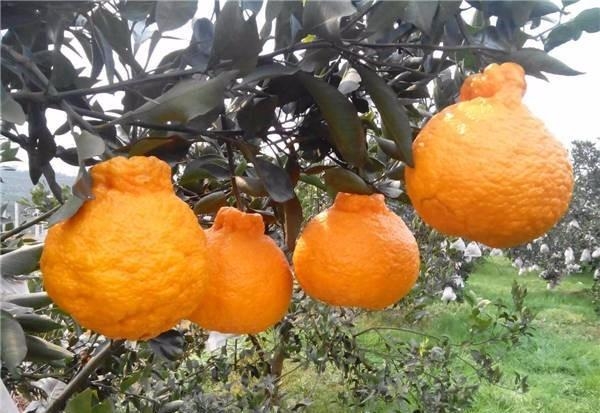
But when you look from a distance, the ugliness fades a bit and instead gains a touch of "ginseng fruit" flair:
Being ugly isn't its fault, the Japanese are to blame for that!
In 1972, the Horticultural Experiment Station of Japan's Ministry of Agriculture and Forestry bred the ugly mandarin by crossing Kiyomi with Nakano No. 3 ponkan, and it has been ugly for more than 40 years.
But in Japan, it is one of the most expensive citrus fruits, and Ehime Prefecture in Japan even produced five-pointed star-shaped ugly mandarins, sold to students at 3,500 yen each (worth 200 yuan), so the students could take them to pray for passing their exams.
Being ugly isn't my fault, but failing to make you fall in love with me is my fault.
At forty, the ugly mandarin is in its prime, and what it wants people to remember now is its scientific name -- "Shiranui," named because eating it doesn't cause internal heat, which does have a scientific basis, since the ugly mandarin is a cooling fruit.
The ugly mandarin's peel is yellow-orange, and the surface is slightly rough, which is the reason it's ugly, but at the same time it peels easily, and the juice's sugar content is above 13%, reaching as high as 17%, extremely sweet;
This is the origin of "although I look ugly, I taste sweet."
The ugly mandarin begins coloring in early October and is fully colored by early December; it ripens from February to March the following year, taking a full year from flowering to fruiting, with the fruit overwintering on the tree, so the flavor is excellent, and it is called the [World's No. 1 Mandarin].
Just look at the treatment the ugly mandarin enjoys in winter and you'll understand, each one wrapped in a white windbreaker, all living under sunny canopies, pretty upscale, right!
Although I'm ugly, I've got class.
In 2000, the ugly mandarin was introduced to China, first planted in Sichuan, and currently the larger planting areas are around Pujiang and Danleng.
Around Pujiang and Danleng, the average annual temperature is 16.3-16.5°C, the forest coverage rate is 50.8%-55%, surface water meets the national Class III water standard, and air quality is better than the national Class II standard; the ugly mandarins grown in this natural environment taste even crisper, more refreshing and sweeter.
Because this area lies at around 30 degrees north latitude, the ugly mandarin is also praised as the [Taste Miracle from 30 Degrees North Latitude].
30 degrees north latitude is a mysterious and peculiar line of latitude, and it not only runs through the four great ancient civilizations;
30 degrees north latitude runs across the entire hinterland of mainland China, all the way from Mount Everest to the Three Gorges of the Yangtze River;
At 30 degrees north latitude, there are "Liu peaches," "the only cherries grown in the high-cold zone," the country's largest lemon production base, navel oranges from the Wuling Mountain area, Huangshan tea, West Lake Longjing......
Of course, 30 degrees north latitude also abounds in beautiful women, and here we recommend one.
This is a 28-year-old, intellectual beauty who returned to her hometown to start a business; the beauty grows ugly mandarins, all at Danleng Kemei Family Farm.