Tea plants without pesticides rely on science and technology for support
Original title: Is it really possible to grow tea plants without pesticides?
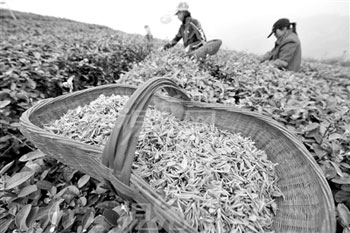
Mingqian tea and Yuqian tea are the terms used in the Jiangnan tea region of China's Yangtze River basin to refer to spring teas picked at different stages according to the solar terms.
Mingqian tea is tea picked and processed before Qingming Festival, and Yuqian tea is tea picked and processed after Qingming and before Guyu. Mingqian tea is tender and of good quality; Yuqian tea is still fairly good in quality; tea picked after Guyu and before Lixia is generally coarser and older, with poorer quality.
"In the tea-picking songs, springtime grows old." Around Qingming, the season for spring tea to come on the market has arrived again.
As an important beverage for Chinese people, tea's safety attracts much attention. Although there are still differing voices in academic circles about the dangers of pesticide residues in tea, related reports of "tea pesticide residues exceeding standards" have also left many people puzzled. Are there tea plants that are not sprayed with pesticides?
On March 27, at the 10,000-mu organic tea garden of Qianxin Town Ecological Agriculture in Jiangxi, the "Qianxin Town Demonstration Base for Screening and Experimenting with Subtropical Ecological Agriculture Resource Plants" of the Institute of Botany, Chinese Academy of Sciences, was unveiled, as both sides jointly sought a technological solution.
-- Frontline observation --
Why plant litsea cubeba in the tea garden?
Qianxin Town is located in Longnan County, Ganzhou, Jiangxi, known as the "cradle of Hakka," and belongs to the remnant ranges of the Jiulian Mountains, a national nature reserve, surrounded by hundreds of thousands of mu of original ecological forest. After a spring rain, clouds and mist wreathe the mountains, like a fairyland.
"The tea is growing very well this year, and output is expected to reach 60,000 kg." said Liao Chenglong, head of the Qiancha base in Qianxin Town. "Qian" is the ancient name for Ganzhou, and "Qian tea" already has a history of a thousand years. "In the past, everyone only knew that navel oranges were the flagship agricultural product of the old revolutionary base area in southern Jiangxi. Now, through our efforts, Qianxin Town organic tea is becoming a new calling card of modern agriculture in southern Jiangxi." Liao Chenglong said that last year, Qianxin Town's organic tea output was 50,000 kg, and sales revenue already exceeded 100 million yuan.
Walking through the 10,000-mu organic tea garden, physical sticky insect traps are everywhere across the hills, and solar insect-killing lamps stand among the tea plants. Liao Chenglong broke off a small piece of stem and leaf from a plant and handed it to the reporter: "Smell it. Isn't there a strong ginger-like fragrance? This is litsea cubeba, which we interplant among the tea plants. It is also the tea garden's secret weapon for plant-based pest repellence. Our tea plants are not sprayed with pesticides and not fertilized with chemical fertilizers. The entire tea garden has several hundred thousand litsea cubeba plants."
The insect-repellent effect of litsea cubeba on tea plants came from an accidental discovery by an agronomist. "This plant originally grew in patches on two hillsides. When the tea garden was first being built, in order to maintain the shade-loving environment for tea seedlings, they were accidentally retained. Later, our agronomist found that in the area where litsea cubeba grew, there were very few pest problems on the tea seedlings, and two-year-old tea plants grew as well as four-year-old ones." Liao Chenglong said.
Regarding this cooperation with the Institute of Botany, Chinese Academy of Sciences, Liao Chenglong told the reporter: "What we see is only a phenomenon, that litsea cubeba repels tea plant pests and diseases. How exactly does it work? How great is this effect? How many litsea cubeba plants should be planted in the tea garden to be more effective? We hope scientific researchers can answer these questions for us and provide us with technical and research-and-development support for making green organic tea."
-- Expert viewpoint --
Citral can effectively repel pests
At the beginning of this year, the Institute of Botany, Chinese Academy of Sciences, set up a research demonstration base in Qianxin Town, mainly to study the screening and testing of subtropical ecological agriculture resource plants, and to provide support for the construction of Qianxin Town as well as China's subtropical regional ecological environment construction and agricultural industrial structure adjustment.
Bai Hongtong, a senior experimentalist at the Institute of Botany, Chinese Academy of Sciences, told the reporter that one important study in establishing the demonstration base in Qianxin Town this time is to clarify the pest-repellent effect of interplanting litsea cubeba with tea plants on the latter, and its impact on the local soil aggregate structure, among other things.
In fact, litsea cubeba is a plant that Hakka ancestors used long ago to repel insects. The oil boiled from its fruit has a very good mosquito-repellent effect, while the branches and leaves themselves are also very good green manure. "About 80% of litsea cubeba is citral, which has a relatively good repellent effect on pests. It ranks first in China's spice exports. However, the specific effect of litsea cubeba in repelling tea plant pests has not yet been the subject of dedicated scientific research." Bai Hongtong said.
As for how the scientific research work at the base would be carried out, Bai Hongtong told the reporter that in the Qian tea garden they would mainly use experimental plots, placing devices according to the experimental design, and through the construction of plant communities, study changes in pests, and test changes in soil aggregate structure, pH value, nitrogen, phosphorus, potassium and other elements.
Interplanting model improves tea quality
In the Qian tea garden, it is easy to see another plant interplanted among the tea plants: Chinese yew. Liao Chenglong explained that the Jiulian Mountain National Forest Park, only a few dozen kilometers from the tea garden, is the largest natural community of southern Chinese yew. Taking advantage of favorable timing and location, the Qian tea garden pioneered the interplanting model of tea plants and Chinese yew, enabling the two to live and thrive together in order to improve tea quality.
Chinese yew, known as a "natural oxygen generator," contains the rare anti-cancer substance "taxol." "This kind of interplanting definitely has an impact on soil aggregate structure, but how large the impact is and what kind of impact it will produce all await further scientific experiments." Bai Hongtong said.
This is also another important task of the demonstration base. Bai Hongtong said: "In addition to research on the Qian tea garden, we also need to establish a local introduction resource spectrum, initially concentrating one to two hundred species of subtropical plants with aromatic, ornamental, or economic value. For example, rosemary is an aromatic plant with a very long industrial chain. The antioxidant extracted from it is globally recognized as having the best natural antioxidant effect. After introduction, we hope to carry out experiments in multiple places, to see whether an industrialization path can be realized, build a new type of ecological agriculture, and bring more economic benefits to local farmers."
Bai Hongtong's team, in the national science and technology support program for Xinjiang, once cooperated with the 69th Regiment, introducing advanced technology for the latter, establishing a factory-based seedling and rapid propagation system, and formulating cultivation technical specifications conducive to increasing the yield of aromatic plants and optimizing target quality, so that it gradually formed a lavender spice industry chain integrating breeding, production, processing, and sales.
-- Industry reflection --
To be high-end and organic, it must rely on science and technology
During the interview in Qianxin Town, one could clearly feel the local residents' expectation for science and technology. Just as Liao Chenglong said: "Doing modern agriculture well still depends on science and technology! In our continuous development, we increasingly feel that to make high-end organic tea, we must rely on science and technology. Just as Professor Bai said, use ecological methods to build a biological community."
The Qian tea garden's expectation for science and technology is precisely a microcosm of modern agriculture's demand for science and technology. From the current and future development perspective, the pressure on ecological environmental protection is growing, and public demand for green and organic agricultural products is becoming stronger and stronger. To develop modern agriculture, it is necessary to rely on scientific and technological support and innovation-driven development, and strive to blaze a path of agricultural modernization with high output, safe products, resource conservation, and environmental friendliness.
The ultimate purpose of the "marriage" between the Institute of Botany, Chinese Academy of Sciences, and Qianxin Town is to provide technical support for China's subtropical regional ecological environment construction and agricultural industrial structure adjustment. At present, China is in a critical period of promoting the synchronized development of industrialization, informatization, urbanization, and agricultural modernization and building a moderately prosperous society in all respects. To advance agricultural modernization, it is necessary to innovate the collaborative innovation mechanism of government, industry, academia, research, and application, improve the market-oriented mechanism for enterprise technological innovation, and make enterprises the main body in decision-making, investment, organization, and application of results in technological innovation. It is necessary to improve the incentive mechanism for achievement transformation, promote the transfer and transformation of scientific and technological achievements, and solve the problems of the "two separate skins" of scientific research and production as well as the "last kilometer" of science and technology services. (Text by Lin Lijun, reporter of this newspaper)