Rice transforms into handicrafts, selling for 30 yuan a bottle
Original title: How can a handful of rice sell for 30 yuan?
-- A record of Xinyi City, Jiangsu Province developing creative agriculture to help farmers get rich
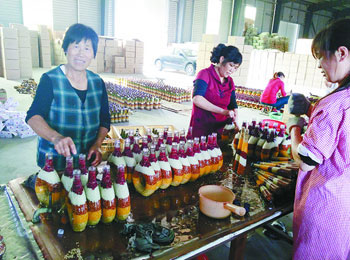
Workers are bottling the products (Image source: Urban Morning Post)
On March 25, farmer Huang Jian from Xinyi, Jiangsu, loaded more than 100 boxes of his colorful bottled agricultural products onto a truck bound for Thailand. Huang Jian said the colorful bottles contain ordinary agricultural products such as rice, mung beans and soybeans. Selling them this way makes the price different.
He said frankly: "With a good creative idea, even the most rustic grain can still sell for big money."
Farmers growing crops and selling grain is nothing unusual. But Huang Jian has found a new way to sell grain, turning ordinary agricultural products into popular handicrafts.
In the processing factory workshop, farmer Du Xuehua, nearly 50 years old, grabbed a handful each of rice, sorghum, corn and mung beans, and layered them proportionally into a glass bottle; then added white oil for preservation, and sealed and packaged it. This is the creative agricultural product known as the colorful bottle, now popular among young people in the city. The author observed that not only ordinary grains like rice, but also vegetables commonly seen in rural areas such as chili peppers, cherry tomatoes, carrots and pumpkins were cut into pieces by workers and layered into different bottles. The natural and colorful hues are pleasing to the eye.
"A handful of rice is not worth much, and a glass bottle is not worth much either. But when you combine them together, the price increases more than 10 times, selling for 30 yuan. Because it is not only a unique home decoration, but also has a beautiful meaning, symbolizing a full harvest and good wishes for a colorful life." Huang Jian said that in order to meet customers' different needs, they also customized various bottle designs such as five-pointed stars, high heels and iron towers. These have now become decorations for restaurants, hotels and homes in big cities. "It is all orders, and we simply cannot make them fast enough. Thanks to this creative agricultural product, the processing factory's annual sales revenue exceeds 60 million yuan, with exports accounting for 80 percent, sold to more than 20 countries and regions."
"Creativity + agriculture" is now widely promoted in many places. But how to truly help farmers find the "golden key" to starting businesses and getting rich requires careful thought. The author observed that in Xinyi, like Huang Jian, many farmers use local materials, closely follow local rural characteristics, keep a close eye on the needs of city people, and do detailed and practical innovation work. Although such creative agricultural products are simple, because they are down-to-earth and innovative, they naturally win over the market.
Chao Chenggong is a farmer from Fuzhuang Village, Gangtou Town. When the reporter visited his home, the 3 cars parked in the small courtyard stood out. Chao Chenggong chuckled: "These are all my own cars. What others look down on as useless firewood, I treat as a 'money tree.'"
What is treated as useless firewood is the paulownia tree that grows in large numbers in front of and behind rural houses. Paulownia wood is light and soft, not suitable for making furniture, cannot fetch a price, and is often used as firewood. Chao Chenggong discovered that many city people have cervical and lumbar spine problems, and taking medicine does not help much, so he used paulownia wood to make pillows and waist pads for auxiliary treatment. This attempt truly succeeded. A small piece of paulownia wood that could only be used as firewood, after careful and meticulous polishing by machine, can sell for more than 30 yuan online.
Business was booming, and Chao Chenggong started thinking again: he branded poetry and pictures onto the wooden pillows, and also planned to add Chinese herbal medicine to create paulownia wood medicinal pillows, making the products more competitive by launching different themes. "Look, the two computers in my office keep beeping nonstop, all orders from Taobao. There are on average over a hundred online orders every day, and annual online sales exceed one million yuan."
Xinyi's landscaping plants are an even more vivid example of getting rich through creativity. Many places in Jiangsu have a tradition of growing landscaping plants. But in recent years, competition in the landscaping market has been fierce. Not to mention making money, sometimes even selling them at all is a problem. However, in recent years Xinyi's nursery stock has been booming.
On March 20, the author came to the Bonsai Culture E-commerce Park in Xin'an Subdistrict. The 800-mu market was thriving, with large and small logistics vehicles coming and going. Farmer Wang Yong, in his 30s, told us that these were all being sent to big cities. "What sells like hotcakes are the creative small potted plants from us farmers in Xinyi."
"Now don't underestimate these little things. The profit margin is much higher than the big ones." Wang Yong found a black pine seedling, the most common local variety. Black pine seedlings on the market cost only 5 jiao each. A black pine seedling 20 to 30 cm tall, after being wrapped with wire, pruned and bent, becomes a simple bonsai shape in just a few minutes. "Don't underestimate just a few adjustments. This black pine seedling's value rises from 5 jiao to 20 yuan. City people, especially white-collar workers, love them very much. This kind of small potted plant is extremely popular online!"
"That's nothing!" said farmer Zhang Xinzhen, standing to one side, pointing to the cattail and lysimachia in the yard. "Look at these grasses. They are the most common, and 5 yuan can buy a big bunch. I combine and arrange them in pots, and in Shanghai office buildings, they can sell for over a hundred yuan per pot." For ordinary office and home potted plants, farmers use local materials, and the technique is not as complicated as that for large bonsai. Most farmers can easily master it after a little learning. In the Culture E-commerce Park alone, there are now hundreds of kinds of creative small potted plants.
For farmers like Zhang Xinzhen, economic terms such as "creative agriculture" and "supply side" seem too difficult. However, Xinyi farmers are market-oriented and adapt to local conditions to provide products customers like. In essence, this quietly aligns with agricultural development, and they have truly tasted the sweetness. The author learned that creative potted plants alone, as a single product, have driven a 300 million yuan industry scale in Xinyi and provided employment for nearly 10,000 ordinary farmers at their doorsteps. (Man Dongguang)