Giant Salamanders Swim onto the Dining Table: Farming Drives Villagers to Increase Income and Prosper
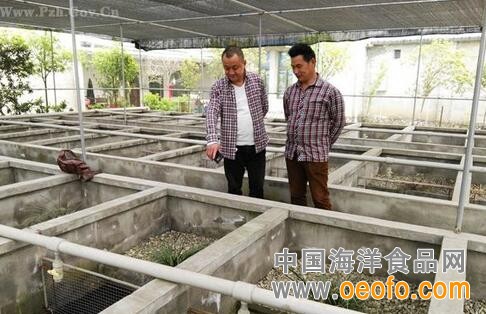
The giant salamander, known by its scientific name Andrias davidianus, is the largest and also the most precious amphibian existing in the world today, and it is a national second-class protected amphibious wild animal. However, Xie Ciyong of Gaoping Town, Guanghan City, is working hard to bring giant salamanders onto the dining table and make them a delicacy in people's mouths. It is understood that, under his leadership, more than 100 local farming households have also begun raising giant salamanders, making it yet another magic weapon for increasing income and prospering.
Working for Others Is Worse Than Starting a Business: Quitting to Farm on His Own
"Whatever I see others raising, I want to try it myself." Xie Ciyong, 46 this year, calls himself a person who has always loved farming. It is understood that in the 1990s, he worked at a Sino-American joint venture, where he began to get involved in the farming and sale of rare wild animals such as pheasants (excluding those prohibited by national laws and regulations). This laid a certain foundation for his later ventures into farming himself.
Working for others is worse than starting a business yourself. With this idea in mind, Xie Ciyong left the company in 2004 and returned to his hometown of Guanghan to start farming on his own. He first set up a farm in Xinglong Town, and then raised pheasants in Hanwang Town, Mianzhu City. But in 2008 it was destroyed in an instant by the earthquake.
"Raising pheasants requires building an overhead net to prevent them from flying away, but the earthquake damaged the net, and most of the pheasants flew off." Xie Ciyong said that at the time he was at Kunming Airport preparing to go to Xishuangbanna to inspect a project, and he hurried home as soon as he heard the news. As for the losses caused, Xie Ciyong did not care too much, thinking that it was good enough that his parents at home were safe.
With the farm in Hanwang destroyed, Xie Ciyong had no choice but to give it up, but he did not give up on the business of farming. He continued to run the farm in Xinglong Town and then began looking for a new farming project. At the end of 2008, he went to the place in Hanzhong, Shaanxi, where a friend was farming giant salamanders.
"I had cooperated with them before in farming giant salamanders, but only a little." Xie Ciyong said he felt that farming giant salamanders was very ecological, because the rearing environment must be clean, the water used is all flowing spring water, and their food is also fish and small shrimp. In addition, the market price of giant salamanders is also very considerable.
It took two years for Xie Ciyong to specifically learn the techniques for farming giant salamanders, and then he began cooperating with others in Shuangliu to raise thousands of giant salamanders. By 2014, Xie Ciyong had established his own farming base in Gaoping Town, Guanghan. "It reached more than 10,000."
Farmed giant salamanders
Raising Giant Salamanders on the Plains: Carefulness Is Very Important
In 2014, after testing that the water quality and climate of his hometown met the standards, Xie Ciyong invested more than 6 million yuan in Gaoping Town, Guanghan City, to build a wild giant salamander domestication and breeding base. Walking into this pitch-black room, one could only hear the sound of dripping water and also feel waves of coolness. When illuminated with a light, it turned out that the room was filled with pools built of bricks, and giant salamanders were being raised in the pools.
"There are now more than 10,000 giant salamanders, and the heaviest reaches more than 10 jin." Under Xie Ciyong's introduction, a reporter from Sichuan News Network saw that some of the giant salamanders in the pools were nearly one meter long, while others were very small. When these giant salamanders saw the light, they began to back away.
Xie Ciyong introduced that the giant salamander is a national second-class protected animal, and only second-generation offspring and those after that can be sold, and only with a farming permit from the aquatic products bureau. At present, the giant salamanders he farms are all ordered from friends, and in the future he also wants to breed brood fish himself for hatching.
Giant salamanders are generally found in places with relatively high altitude, and they also have requirements for water temperature. How did Xie Ciyong solve this?
"I dug an 80-meter-deep well and used flowing well water to raise the giant salamanders." Xie Ciyong said he also plans to build a fish pond and use the water that has been used to raise giant salamanders to raise ordinary fish, which can also save water resources.
"When raising giant salamanders, you must be careful and observe frequently." Xie Ciyong said that giant salamanders, from large to small, all eat bloodworms, small shrimp, and then fish. Some giant salamanders are very good at grabbing food, so those weak and small giant salamanders need to be taken care of. At the same time, the rearing environment must be cleaned once every half month, and it must be scrubbed once with a brush.
Establishing a Cooperative to Drive More Than 100 Farming Households to Increase Income
It is understood that the giant salamanders farmed by Xie Ciyong are not only sold at the agritainment business and base he runs himself, but are mainly sold in Shuangliu, Chengdu, and last year more than 10,000 were successfully sold. A giant salamander weighs about six or seven jin, and each jin sells for 120 yuan to 150 yuan.
In order to help local villagers increase income, Xie Ciyong established a giant salamander cooperative. The cooperative adopts forms such as capital or land shares, and has grown from the initial few people to the current more than 100 people. The base drives surrounding people in Deyang to participate in wild giant salamander farming through fully funded contract farming or teaching techniques for self-farming.
"I have raised 2,000 giant salamanders." Zhang Yingsong, a villager from Shuimozi Village, Gaoping Town, not only invested in farming giant salamanders at the base, but is also a paid administrator at the farming base. "I did it only after seeing that the benefits were good, and so far I have invested 80,000 yuan."
Zhang Yingsong's daily work is taking care of the giant salamanders, and seeing them grow day by day is his greatest expectation. "A fish 20 cm long, it can eat it." Zhang Yingsong pointed to giant salamanders nearly one meter long one after another, a bit of excitement showing in his words. "After eating, it does not need to eat again for a week."
Giant salamander: scientific name Andrias davidianus, it is the largest and also the most precious amphibian existing in the world today. Its call sounds like a baby's cry, so people also call it "baby fish." The giant salamander is a national second-class protected amphibious wild animal, and is a key development species for agricultural industrialization and specialty agriculture as well as a wild animal gene protection species. The giant salamander is an animal with extremely high edible value; its meat is tender and delicious, contains high-quality protein, rich amino acids and trace elements, and has extremely high nutritional value. It is reputed as "ginseng in the water" and is regarded as a rare tonic in the markets of Hong Kong, China, Taiwan, China and Southeast Asia.