Ecological three-dimensional farming and breeding helps Banyuan Village in Zhenghe County find a new path to prosperity
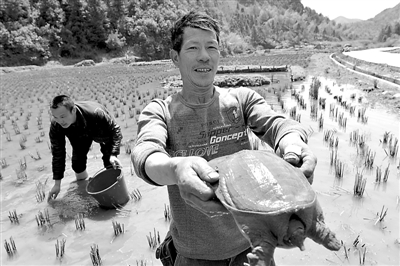
Villagers show the soft-shelled turtles caught from the fields
A bumper harvest of rice-field fish brings smiles to the villagers' faces
On March 27, the sky was clear and wide, and several villagers in Banyuan Village, Zhenqian Town, Zhenghe County were preparing the fields for farming. After three years of management, the villagers used the high-mountain paddy fields to develop three-dimensional farming, and the scene of abandoned fields everywhere was no longer to be seen.
We cannot let our hometown become a desolate rural village
Banyuan Village is a poor village in a high-mountain area, with 13 villager settlement points rather scattered, and the natural villages and administrative villages far apart, making transportation extremely inconvenient. Three years ago, because there were few sources of income, most people in the village chose to go out to work, leaving only the elderly, the weak, the sick and the disabled behind, and the fields were seriously abandoned.
"I cannot watch my hometown become a desolate rural village," Ye Changrui, director of the Banyuan Village Committee, told reporters. He had originally been in business elsewhere, with ventures in Wuyishan and Shanghai, but every time he returned to his hometown and saw the desolate scene in the village, he felt heartache. In September 2012, he, who had originally been striving in the city, was elected village director by the villagers with a high number of votes. Because he was concerned about his hometown's development, he gave up the prosperity of the city and resolutely returned home to shoulder the burden. At that time, Banyuan Village's collective finances were basically zero, and no unit was linked to provide assistance.
"Fields as shares, villagers as shareholders, building three-dimensional farming agriculture in the form of a company." After careful consideration, Ye Changrui and village officials set the development path. In early 2013, the village explored a new model of land transfer, taking the lead in operating the village's land in the form of a company, and established the Fujian Xiadu Ecological Park, investing 2 million yuan, with the village collective holding 51% of the shares, and villagers taking their paddy fields, tea hills and idle land as shares, accounting for 49% of the shares. At the same time, the barren land of villagers who had gone out to work was transferred to the village committee at an annual rent of 300 yuan per mu. As soon as the new model was launched, the village committee signed more than 50 agreements with villagers, and the abandoned fields were put back into use.
Three-dimensional farming and breeding turns mountain-ridge fields from waste into treasure
The village's paddy fields used to grow ordinary rice, with an annual yield of about 500 kg per mu and a price of about 2.6 yuan per kg, and such income was far from enough to change Banyuan Village's situation. Seeing that urban residents had a great demand for green ecological agricultural products, Ye Changrui came up with the idea of ecological farming and breeding.
In March 2013, Ye Changrui introduced the "rice-field fish farming" technique and released 50,000 grass carp and carp fry into the fields. He had originally thought that the pests and weeds in the fields would be exactly the fish's food, while the fish could turn the soil, and their excrement would create good conditions for rice growth, so it would surely be a wonderful thing to achieve two goals at once. However, "ideals are full, reality is bony." Due to a lack of professional technology, the fry were released at inconsistent densities in different field plots, affecting their growth, and the rice growth also failed to achieve the expected results. In addition, some fry were eaten by "greedy" egrets, and some were washed away by floods. One event after another dealt a blow to the enthusiasm of some villagers.
Ye Changrui did not give up. He made a special trip to consult experts and learn professional knowledge. On the basis of releasing fish fry, he also released more than 8,000 soft-shelled turtle hatchlings as well as black loach, field snails, eels and so on into the paddy fields. Through continuous exploration, Ye Changrui and the villagers accumulated rich planting and breeding experience.
The same paddy fields, different output
"We planted red rice in the paddy fields. Although the yield is lower than ordinary rice, the price is higher, and the original ecological products are also sold far away to various cities." Ye Changrui made a rough calculation: although original ecological red rice has an annual yield of only 250 kg per mu, each kg can sell for 12 yuan. In addition, black loach, soft-shelled turtles, rice-field fish, field snails, eels and so on can also be harvested each year, and the annual output value of one mu of field is more than 4,000 yuan.
The benefits of three-dimensional farming and breeding became apparent, attracting a large number of villagers who had gone out to return home. Ye Yanliang returned to Banyuan Village at the end of last year and went to work in the Xiadu Ecological Park. He told reporters that during his time working elsewhere, he got up early and worked late every day, and after a year he earned at most 20,000 to 30,000 yuan. After returning to the village, he earned at least 4,000 yuan a month, which reduced his living burden while also allowing him to care for his gradually aging parents.
"I have stayed in Banyuan Village all my life, and last year was the year I earned the most." Villager Ye Qitian said excitedly that he was already 65 years old and had farmed in Banyuan Village all his life. Previously, the net income per mu of field was at most 800 yuan. Since the village started three-dimensional farming, the fields produced pure natural red rice, and the water raised pollution-free soft-shelled turtles. These high-quality agricultural products greatly increased the income per mu of field, and his own annual income also nearly quadrupled.
Because the ecology had recovered well, the originally unknown small fish in the village stream came back, and wild tadpoles, stone frogs and other animals also reappeared in the woods and fields. "Next year, this place will be a 'Peach Blossom Spring'!" Ye Changrui said. Not long ago, the village planted more than 1,800 peach trees beside the village road. He hoped that three-dimensional farming and breeding would bring considerable economic benefits while also bringing ecological benefits, laying the foundation for building an environmentally friendly ecological agricultural tourism village.
In addition, Ye Changrui also organized villagers to cultivate bamboo mushrooms, which have high environmental requirements, in the bamboo forest. In the next stage, he plans to rely on Banyuan Village's unique climate and green mountains and clear waters to develop under-forest economy, plant precious medicinal materials, and increase villagers' income.