Vegetable base in Huahuo Township, Ziyun, Guizhou brings prosperity to an entire village
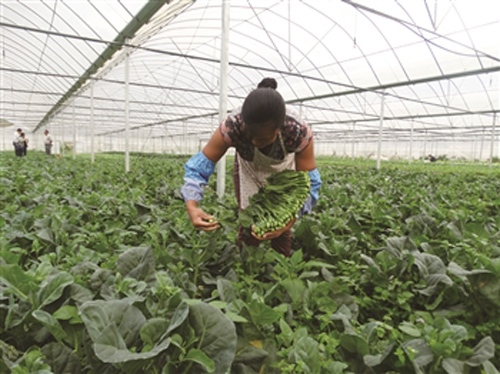
Workers harvest choy sum at the vegetable base.
In early spring in March, it is sowing season. Along the field ridges and beside the furrows, wherever the eye can reach, there is busy cultivation everywhere.
At the vegetable base in Huahuo Township, Ziyun Autonomous County, villager Ren Chunhua from Luocheng Village, who grows vegetables, told reporters that she and her husband work in the vegetable garden and have no problem earning an average of 6,000 yuan a month; in a good month they can earn over 10,000 yuan.
"We transfer our land to the company and receive land transfer fees. We also contract plots from the company to grow vegetables and earn labor fees. It's a good deal!"
This vegetable base belongs to Qianhua Company. Since the company entered in 2013, it has gone through difficult exploration and ultimately, by updating seed selection and innovating planting models, walked out of its difficulties step by step and brought hope of prosperity to surrounding villagers.
Early development: years of losses and difficult progress
In the vegetable base, hope is being sown. Some workers are sowing, some are fertilizing, some are harvesting vegetables, and some are turning the soil... The busy scene fills Yuan Heng, owner of Qianhua Company, with joy.
In 2013, with government support, Qianhua Company invested 8 million yuan to enter the Huahuo low-heat river valley vegetable base, transferred 1,300 mu of land, and developed vegetable planting. At first, relying on the advantages of the low-heat river valley, it rushed to harvest early-maturing vegetables, actively seizing the market with the concepts of "early" and "fresh."
"At the beginning, relying on the geographical advantages of the low-heat river valley, we mainly grew fruit vegetables such as tomatoes, green beans, eggplants, cucumbers, and summer squash, seizing 'early' and 'mature' crops to sell at good prices," Yuan Heng said. Vegetables are products with a market all year round; seizing "early" and "mature" crops only gives a market advantage in spring, and it is hard to accomplish much in other seasons, which brought adverse effects to the company's development.
In terms of planting models, Qianhua Company initially directly absorbed nearby villagers as workers and adopted a monthly wage system of 2,100 yuan per person. The result was: it could not stimulate workers' enthusiasm, let alone improve the fineness and pursuit of excellence in workers' labor, causing the company's vegetable output and quality to encounter a serious bottleneck.
"Taking a fixed salary and eating from the same big pot cannot stimulate workers' enthusiasm. Fruit vegetables have a long growth period, and there were often situations where there were no vegetables to sell, making the company's development quite difficult." In just the two years from 2013 to 2015, Qianhua Company's vegetable base lost 6 million yuan. The losses step by step "eroded" Yuan Heng's confidence, as well as the workers' enthusiasm and patience. Thinking of change in desperate straits was already urgent!
During development: finding the right positioning and "seizing" the market
Yuan Heng gradually realized that relying mainly on seizing "early" and "mature" fruit vegetables could not give him a long-term advantage in the market. For this reason, he visited several large vegetable farms and vegetable sales markets in coastal areas many times. Through repeated searching, he found that low-growing vegetables such as choy sum and vegetable seedlings had huge market potential.
At the end of 2014, Qianhua Company decided to update its vegetable varieties, no longer planting fruit vegetables with longer growth periods such as tomatoes and green beans, but instead planting low-growing vegetables with shorter growth periods such as choy sum, shepherd's purse, and vegetable seedlings. Through the "short, quick, and flexible" product positioning, it gradually opened up sales channels.
"Choy sum has multiple varieties with harvest periods of 45 days, 50 days, and 70 days. Shepherd's purse has varieties with harvest periods of 30 days, 40 days, and 60 days, and vegetable seedlings have an even shorter growth period," Yuan Heng said. Since updating the varieties, the company has ensured that there are vegetables to sell every day, avoiding the "awkwardness" of having a good market price but no vegetables to sell.
Output "soared" upward, and more vegetable varieties were produced. Further expanding the market then became an urgent problem to solve. In early 2015, Qianhua Company sent people to Guangzhou, Shenzhen, Hong Kong, and other areas for inspections and contacts, and established cooperative relationships with Guangzhou Xian Taijian and Hong Kong Shengfeng Company. At this point, the sales market for more than 10 varieties of vegetables produced by the company, including choy sum, shepherd's purse, and vegetable seedlings, was further expanded, and survival space was no longer a problem.
Yuan Heng said that running a vegetable industry, like developing other industries, cannot be smooth sailing; one needs to keep moving forward through exploration. Market dynamics change rapidly, and sticking to old ways will only make the road narrower and narrower.
After development: innovating the model to bring prosperity to an entire village
In operations, Yuan Heng found that to further improve vegetable output and quality, a monthly salary system made it very difficult to stimulate workers' enthusiasm, and innovating the planting operation model was imperative!
"Last spring, after multiple rounds of investigation and analysis, the company decided to adopt the 'reverse lease and subcontracting' planting operation model." Yuan Heng told reporters that so-called reverse lease and subcontracting means transferring land from villagers, completing facility improvements, and then subcontracting the plots back to villagers to grow vegetables. In actual production, the company provides all costs including fertilizer, seeds, pesticides, and machinery, and organizes technical training, while villagers only provide labor for planting. At harvest, the vegetables grown are collected at a price of 6 mao per jin.
The result was: it gave workers greater room for production choices and accurately grasped the key of output and quality. It both stimulated workers' passion for planting and improved the fineness of their work.
"My family contracts more than 10 mu of land from Qianhua Company to grow vegetables. When the harvest is busy, we have to work overtime every night to harvest vegetables." Qin Xiangmei, who was harvesting choy sum in the field, said that there were many vegetables these days; in the morning they turned the soil and sowed, and in the afternoon they cut vegetables. They were too busy, so they could only have family members carry their children on their backs to help cut vegetables together. "But working in my hometown, I can take care of the elderly and children, and I can earn nearly 10,000 yuan a month. No matter how hard it is, it's worth it."
Where there is hope, there is attraction! At present, nearly 100 village households contract plots from the company to grow vegetables, and everyone is planning for a better life for their own families.
"Poor villagers who enter the company to grow vegetables, if they contract a vegetable plot area of 10 mu, have a monthly income of nearly 10,000 yuan. This is no longer just escaping poverty; it is becoming prosperous." Yuan Heng said that Luocheng Village in Huahuo Township still has 180 poor households; the company developed step by step under government support, and to repay the local area, while seeking its own profits, the company has the responsibility to drive local people out of poverty and toward prosperity. This year, the company will absorb 50 poor village households into the base, and strive within 3 years to absorb all poor villagers in Luocheng Village and help everyone escape poverty and become prosperous.