Post-80s young man starts chicken farming business, sells 160,000 yuan worth of chickens online per month
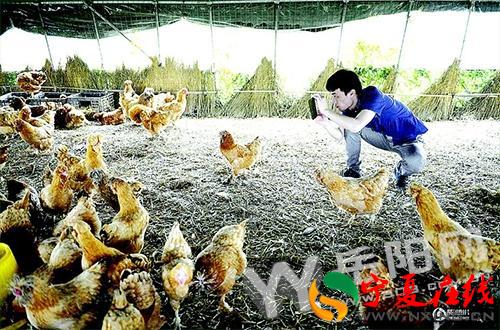
Today, the editor introduces a social media savvy entrepreneur. His online chicken sales alone exceed 160,000 yuan per month. Let's see how he combines chicken farming with online sales.
He Wei, born in 1982, like others of his generation, loves hanging out on QQ, browsing forums, scrolling Weibo, and using WeChat. Tired of the unchanging corporate life, he resigned from a stable job despite his family's objections and returned to Linxiang to start a business——raising free-range native chickens using the area's excellent natural environment.
However, this trend-savvy young man did not use traditional marketing methods. Instead, he promoted his products through popular online platforms such as QQ groups, Weibo, and WeChat. Today, his ecological farming base has 12,000 native chickens in stock, and last year's annual sales reached 4 million yuan. On April 5, the reporter visited this post-80s young man with an unusual entrepreneurial story.
A top-university graduate who quit his job and returned home to start a business
"My online sales alone now exceed 160,000 yuan per month, and this year's sales are expected to approach 10 million yuan," He Wei told the reporter confidently.
He Wei, a native of Linxiang, graduated from Hunan Normal University in 2004 with a degree in Economic Management. Today, he is a "country boss" running a free-range native chicken business.
Every evening, He Wei starts sorting the orders received during the day. The next morning he gets up, prepares to slaughter chickens according to the orders, then packs them in sterile vacuum cold-fresh packaging and waits for the courier company to pick them up. If everything goes smoothly, the chickens reach customers' hands in as little as 10 hours.
But 5 years ago, he was still a corporate employee. "After graduation, I worked at a company in Changsha for nearly ten years," He Wei said with great pride when talking about his first job. Back then, he used his salary to buy an apartment in Changsha.
But He Wei did not like this job with its nine-to-five schedule and frequent overtime. After the 2011 Spring Festival, He Wei resigned from his stable job and returned to his hometown of Linxiang, determined to start his own business. "Why give up a perfectly good job?" He Wei's father could not understand why his son would quit a stable job and return to Linxiang. But no matter how much his family tried to persuade him, He Wei, bent on starting a business, would not listen.
Forty percent of locals love "country goods"
He Wei, born in Hejia Group, Dongfeng Village, Baiyangtian Town, once brought his girlfriend back to his hometown to visit relatives. The elderly villagers treated them to things they normally could not bear to eat themselves.
"The elders slaughtered free-range chickens and ducks, pan-fried free-range eggs, and stewed free-range pork. These are things you simply cannot eat in Changsha. My heart was moved. Why leave when the countryside has such wonderful things?" A thought struck He Wei: he could use the three-dimensional farming method promoted by the state and go home to develop under-forest economy. This would not only develop the low-yield barren hills of his hometown, but also give back to his hometown, drive local employment, and restore the "vitality" and "wealth" of his old village.
He Wei, who studied marketing, immediately began market research. He happened to discover that many locals in Yueyang favored local specialty foods, especially free-range chickens and free-range eggs, but these people did not know where to buy authentic local specialties. "This is a business opportunity," He Wei thought, and he began to entertain the idea of selling native chickens. He discovered that his hometown's Dayun Mountain not only has spectacular natural scenery, but local farmers also have an excellent tradition of farming: no pesticides, no chemical fertilizers, and the ecological environment is very well preserved. The crops, fruits, and vegetables grown there taste better and are more nutritious than those grown at the foot of the mountain. Looking around, there are no industrial enterprises or projects within a 30-kilometer radius, and this environment is ideal for ecological free-range farming of "worry-free native chickens."
Customers pick the chickens, he raises them: online custom chicken farming model proves popular
As a post-80s young man, He Wei, like his peers, loves hanging out on QQ, browsing forums, and scrolling Weibo. As WeChat became popular, he also became an avid WeChat user. Determined to start a business selling native chickens, he wanted to promote them through the methods he knew best. "I'm a Taobao enthusiast. During that period I used Taobao very frequently," He Wei told the reporter. His marketing approach was to "directly post pictures of the native chickens on the farm" and let potential customers judge for themselves, without any particularly deliberate promotion.
Later, He Wei found that WeChat was more effective than Taobao for promotion, so he gradually "switched" to WeChat. "WeChat allows one-on-one marketing, making it convenient for customers to communicate with me and place orders."
But as more and more "imitation native chickens" raised on feed and grain appeared on the market, the industry also faced a test of credibility. To give these online consumers peace of mind, he also set up a base website combined with 24-hour surveillance video and a QR code traceability system, so that consumers can scan with their phones to intuitively understand the actual production scene at the base and the entire farming process.
Through online marketing and word-of-mouth among customers, He Wei's business grew bigger and bigger, and native chickens began to be in short supply. He started mobilizing local residents extensively, mainly using a cooperative base model, bringing in surrounding farmers to participate together, with unified technical guidance and management, unified purchasing and sales, and working together to grow bigger and stronger.
Today, the free-range area of the base He Wei established in his hometown covers over 1,000 mu, the chicken coops cover nearly 1,500 sq m, and there are 12,000 native chickens in stock. He has also set up sales teams in Changsha and other places, bringing products directly to major communities to face consumers, securing a customer base through chain sales outlets, and creating his own unique native chicken brand "Yunshang."
"This year, I want to promote customized specialty farming, letting customers pick the chickens and I raise them," He Wei said. Through nutritionists' formulations, different ingredients are combined to raise native chickens, providing customers with native chickens of different benefits. This way, he can offer consumers a more precise health regimen from the start and take the "country business" to the extreme.