Guangdong Zhongshan rice-duck field farmers earn work points that can be exchanged for money
Original title: Qingming season busy with spring plowing, rice-duck farming in one field boosts income
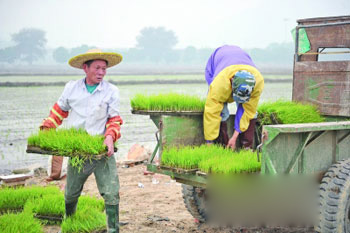
A busy scene in the fields. Photo by Wang Yun
On the vast and fertile rice fields, rice transplanters rolled over one after another, leaving only neat rows of light green seedlings, while the fields were bustling with activity. During the busy spring plowing season at the end of March and beginning of April, reporters successively visited Yakou Village in Nanlang Town and Luquansha Farm in Dayong Town of Zhongshan City. After visiting the front line of spring production, they found that due to the low temperatures and abundant rain at the beginning of the year, this year's spring rice transplanting in Zhongshan was about 10 days later than in previous years, which may affect the summer harvest, making later weather and water-fertilizer management especially important.
Busy farming season
Each person can earn 150-200 work points per day
On the morning of March 31, the outdoor temperature of 20°C was especially refreshing. Standing at the village archway at the entrance of Yakou Village, the reporter could already clearly see the stretches of farmland, with the breeze carrying a heavy scent of soil. Although this year's spring plowing had just begun, the farmland here, after high-standard leveling, still showed how fertile this land is. Tan Weiqin, the current Party secretary of Yakou Village, told reporters that Yakou Village is the largest agricultural farming village in Zhongshan, with 3000 mu of rice planting area. The village is divided into 13 production teams, and production in the village is almost entirely coordinated by the captains of each brigade, with villagers working together, earning work points, and distributing collectively. It is reported that this year more than 500 villagers participated in collective production labor, including 40 agricultural machinery workers. In terms of machinery, there are 4 Dongfanghong 120-horsepower 1204 tractors with rubber tires, 7 Qinggang medium-sized tractors, 10 Yanmar harvesters, and 8 Yanmar rice transplanters.
"Carrying seedlings..." A shout burst out from the field, sounding especially loud and clear. Hearing the sound, more than 20 farmers from Team 6 quickly stood up, patted the mud off their backsides, grabbed their carrying poles, and headed straight for the seedling beds beside the irrigation ditch. The reporter saw an aunt place two trays of seedlings on each side of her carrying pole. After arranging them, she immediately bent down, angled the pole carrying forty or fifty jin onto her shoulder, and hurried forward. "We came over at 8 o'clock. Today we really need to hurry. At this time in previous years, the transplanting was already finished." After carrying the seedlings, 58-year-old Aunt Cheng chatted with the reporter while walking. "Last year it started around March 20. This year the first day of transplanting was not until the 30th, nearly 10 days later."
In fact, these 10 days are not simply a matter of time; they have also truly brought trouble to these farmers who depend on the weather. "It was too cold at the beginning of the year, with lots of rain and little sunlight. The batch of seedlings being transplanted now is not only old, but also about 5 cm shorter than usual. If they grow poorly later, it will definitely have a big impact on yield." Near noon, although somewhat anxious, Team 2 captain Tan still led his team members intensively in moving and transplanting seedlings. According to him, Team 2 was allocated nearly 200 mu of farmland. Last year's harvest was good at 280,000 jin, with an average yield of about 700 jin per mu. This year there may be only 250,000 jin.
The grain from each production team does not go directly to the market. Instead, it is purchased uniformly by the village committee, generally at a price slightly higher than the market price. "We calculate the distribution amount according to the actual amount of rice stored in the warehouse by each production team. During last year's autumn harvest, the market price of rice was 145 yuan per 100 jin, and we purchased it at 165 yuan per 100 jin." Tan Weiqin did a calculation for the reporter: after each season's rice harvest, the village divides the total income of each production team by the team's total work points to calculate the value of each work point, and individuals receive different incomes due to differences in work points. During the four busy farming periods each year - spring transplanting, summer harvest, summer planting, and autumn harvest - because the labor intensity is high, each person can get 150-200 work points per day. For regular work such as fertilizing and applying pesticides, each person gets about 15-20 work points per day.
"Last year was amazing. The average wage of villagers participating in collective labor across the 13 production teams was 1690 yuan per month, but this year there may not be that much." Tan Weiqin told the reporter, "There is no remedy now. We can only hope that the temperature will rise after a while, and that water and fertilizer can be stepped up, but the most important thing is still temperature and sunlight."
Agricultural innovation
Combining planting and breeding, plans to raise field ducks
Luquansha Farm transplanted the first seedling of this year's spring plowing on March 30. What was different was that two days later, they stopped transplanting and instead chose to fill in seedlings. Fifty-four-year-old Huang Lineng is the production manager of Luquansha Farm and is affectionately and reliably called "Brother Neng" by everyone. He told reporters that these days the north wind has been blowing continuously, dry and cold, and the transplanted seedlings were not growing, so they would wait until after Qingming to plant again. "One day of south wind is worth three days of north wind."
On April 1, the weather was slightly sunny, and the reporter came to this small island located in the middle of the Xijiang River. In earlier years, Luquansha Island, covering about 1000 mu, was still wasteland, but now it has become Zhongshan City's "123" grain planting demonstration base and has successively won titles such as Zhongshan Modern Agriculture Demonstration Park and Guangdong Province Pollution-Free Production Area. Following the newly built hardened farm road deep into Luquansha's main production area, the reporter could see from afar dots of green in the fairly large paddy fields, where three or four aunts wearing straw hats were bending over and busy in the fields. Only later did the reporter learn that they all came from Xinhui on the opposite bank of the river and had long worked on the farm. During the busy farming season, there would be extra overtime pay and subsidies, and each person could also get more than 100 yuan per day.
"This year's spring transplanting is about 10 days late. Last year, it was almost finished before Qingming." I have been a farmer for more than 20 years, and this year's situation is a first for me. The sunlight has not been good, and there has also been especially a lot of rain." Just as the reporter was worrying about this year's harvest, Huang Lineng said, "Generally, transplanting lasts until Lixia. After Lixia, no one will transplant anymore. There is still about a month until Lixia now, so by the season it is not too late. If we hurry up later and do a good job in water and fertilizer management, there will not be a big problem. If the weather is good after a while, perhaps the harvest will be even better than last year." In his view, this year's seedlings are a little shorter than in previous years and the transplanting time is later, but overall yield will not be low; only the summer harvest time will be correspondingly delayed.
In fact, last year Luquansha's rice planting also enjoyed a bumper harvest. At summer harvest, the average yield per mu was more than 900 jin, and at autumn harvest it was slightly lower but still reached about 800 jin per mu. While chatting, the reporter saw a bag of premium rice with the words Luquansha printed on the packaging. Lin Minghui, assistant general manager of Luquansha Farm, revealed: "Now all the rice produced here is taken to a processing plant for screening and processing. After being marked with the Luquansha logo, it is sold on the market at about 12 yuan per jin." The high grain selling price is due not only to processing, but also naturally to guaranteed quality. To this end, Huang Lineng brought out his special skill. He plans to release more than 1000 small field ducks into the rice fields. "These small field ducks can eat pests and weeds, and to a certain extent can reduce pests and diseases. Their droppings can also serve as natural fertilizer, so in the future less chemical fertilizer will naturally be used, and the rice produced will also taste better." Huang Lineng was full of confidence in his "work." (Nanfang Daily reporter Guo Dongdong)