What are the green high-yield potato techniques in Dingxi, Gansu
Original title: The "Dingxi Model" of green high-yield potato production
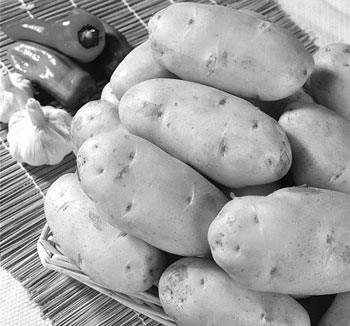
Potato (image for illustrative purposes)
Anding District of Dingxi City, Gansu Province has long been known as the core area of "China's Potato Capital" and honored as the "Hometown of Chinese Potatoes," and is a "National Famous Brand Demonstration Zone for the Potato Industry" named by the General Administration of Quality Supervision, Inspection and Quarantine. In recent years, Anding District has treated the potato industry as a strategic leading industry, adhered to the development philosophy of "ecology, quality, health," stabilized the planting area, expanded improved seed breeding, promoted standardized techniques, upgraded and expanded storage facilities, strengthened leading enterprises, and improved the market system, striving to achieve specialized potato varieties, scaled planting, mechanized production, industrialized operations, and staple-food product development. It took the lead nationwide in achieving full coverage of virus-free seed potatoes, took the lead in implementing potato insurance and incorporating it into the national policy subsidy scope, took the lead in tailor-making the "Jinshubao" credit product for the development of the potato industry, and took the lead in advancing the implementation of the potato staple-food strategy. "Dingxi Potato" has been recognized as a China Well-Known Trademark and a geographical indication certification trademark, and "Dingxi Virus-Free Seed Potato" has been recognized by the General Administration of Quality Supervision, Inspection and Quarantine as a National Geographical Indication Protected Product.
Core techniques
Planting techniques
Crop rotation and stubble change: Choose flat terrain with deep plow layer and loose sandy loam soil, and plots where potatoes or Solanaceae crops have not been planted within three years. Choose preceding crops such as wheat, beans, and corn, avoid continuous cropping, and implement a 3-year or 5-year rotation system of potatoes, wheat, and beans to prevent soil-borne diseases and pests. At the same time, choose irrigated and dry flat land, terraced fields, and dry mountain land with a slope of less than 8° that has a certain scale of area and is conducive to mechanized operations.
Deep plowing and land preparation: Use operation machinery such as tractor-matched dryland moldboard plows, omnidirectional subsoilers, or shovel subsoilers. Require deep plowing of 20cm and subsoiling of more than 35cm, preferably to break the plow pan, with subsoiling once every three years on average. After the previous crop is harvested, carry out subsoiling and plowing in time so as to let the soil stand and dry, accumulate heat and mature, and receive rainwater; after autumn, shallow plow and harrow to preserve moisture; in winter, appropriate compaction may be used to protect soil moisture; before sowing, use a disc harrow for harrowing and land preparation, or use machinery such as a rotary tiller for shallow plowing and harrowing, generally with a depth of 10~15cm, so that the surface is level, the top is loose and the lower layer is firm, the plow layer is soft, and the soil clods are fine.
For plots with severe underground pests, in combination with harrowing and land preparation, generally use 50% phoxim per mu, add 4~5kg of water, and mix into 20~25kg of fine dry soil (sand) to make poisoned soil (sand), or use 4~5kg of 3% chlorpyrifos granules and evenly scatter them on the surface, then turn them into the soil through plowing and harrowing.
Formula fertilization: Adhere to the principle of heavily applying farmyard manure and applying nitrogen, phosphorus, and potassium in combination, adopt soil testing and formula fertilization, highlight the promotion of commercial organic fertilizer, continuously reduce the use of chemical fertilizer inputs, improve fertilizer use efficiency, increase yield, improve crop quality, and reduce environmental pollution. According to the soil nutrient supply in Anding District and the utilization rates of nitrogen, phosphorus, and potassium fertilizers, apply 3000 kg of organic fertilizer per mu in combination with land preparation; according to the N:P2O5:K2O ratio, promote the 1.7:1.3:1.0 formula in the north, the 1.9:1.3:1.0 formula in the southeast, and the 2.0:1.3:1.0 formula in the southwest.
Film mulching and sowing - film mulching: Adopt various potato mechanical ridge-forming and film-mulching planting models such as black full-film double-ridge side planting, black plastic film large-ridge side planting, half-film ridge planting, and drip irrigation under film. Choose black plastic film with a thickness of more than 0.01mm to facilitate recycling and avoid soil pollution.
Sowing: Sowing can begin when the temperature of the 10cm soil layer stably passes 7°C~8°C. Generally, this is from mid-to-late April to early May. When sowing, try to use comprehensive mechanized planting methods, which can complete operations such as ridge formation, fertilization, sowing, soil covering, intertillage, pesticide spraying, and harvesting, improve sowing quality, and reduce labor intensity. The sowing density is 3500~4500 plants/mu, requiring uniformity and consistency, no repeated sowing, no missed sowing, no damage to seed potatoes, consistent depth, uniform and tight plastic film covering, consistent ridge height and ridge width, straight sowing rows, consistent row spacing, and uniform plant spacing.
Soil covering: Generally, soil covering begins about 10 days after sowing, with a thickness of 2~3cm; the soil covering should be even, scattered, and fine.
Field management - chemical weeding: After soil covering and before seedling emergence, use 200 ml of BASF Topgun per mu diluted with 30 kg of water for spray application to carry out soil-closed weeding, or at the 2~4 leaf stage of weeds use 6~7 g of DuPont Baocheng per mu diluted with 30 kg of water for field spray application, which can effectively control annual grassy weeds and some broadleaf weeds.
Intertillage and hilling: Intertillage operations are preferably carried out 2 times. After emergence, when the visually observed emergence rate reaches 50% and plant height is 5~10cm, carry out the first intertillage; when plant height is 20~25cm, carry out the second intertillage. Complete operations such as loosening soil between rows, weeding, topdressing, and hilling, which is beneficial for tuber expansion and prevents stolons from being exposed.
Disease and pest control: Focus on late blight control, use the already established potato late blight monitoring and early warning system to accurately forecast the occurrence time, occurrence degree, and control period of potato late blight, and achieve green prevention and control. Generally starting from mid-to-late July, use agents such as mancozeb, Daconil, Kejia, Fushuaide, Baodasen, Jinlei, and Kelu for alternating spray control, once every 7~10 days.
Vine killing: Before harvest, if there are many vines and weeds, in order to facilitate mechanized harvest, a vine killing machine can be used for mechanical vine killing, generally about 10 days before harvest.
Seed potato treatment
Selection of seed potato varieties: Choose high-yield, drought-resistant, virus-free seed potatoes within three generations, and according to market requirements, choose varieties with specialized use, high quality, and strong stress resistance that adapt to the ecological conditions of Anding District and market needs. In the high-water and high-fertilizer area of the southwest, the main planting varieties are Kexin No. 1, Jizhangshu No. 8, Atlantic, Shepody, Favorita, Longshu No. 10, Longshu No. 7, Longshu No. 6, and the Qingshu series; in the southeast, the main varieties are Longshu No. 10, Longshu No. 7, Longshu No. 6, Zhuangshu No. 3, Jizhangshu No. 8, and the Qingshu series; in the north, the main varieties are Xindaping, Zhuangshu No. 3, Longshu No. 10, and Longshu No. 7.
Seed potato treatment: On the basis of selecting improved varieties, seed potatoes should be selected as tubers that are healthy and disease-free, unbroken, smooth-skinned, brightly colored, weigh 50~100g, are moderately sized and uniform, are well stored, and have the characteristics of the variety.
Sprouting: 10~15 days before sowing, place them indoors at 18~20°C, turn them once every 3~5 days, and after about 10 days when sturdy purple sprouts of about 1cm have grown, they can be cut and sown.
Cutting seed potatoes: Cutting should be carried out 2~3 days before sowing. The size of the cut pieces should preferably be 30~50g, and each cut piece should carry at least 1~2 eyes. Prepare 2~3 cutting knives and soak them for disinfection in a 0.1% potassium permanganate solution or 75% alcohol. Generally, after cutting 30 seed potatoes, replace the knife once. During cutting, if diseased or rotten seed potatoes are encountered, they should be removed immediately, and the knife should be replaced at the same time to promptly cut off the route of pathogen transmission and infection. Whole small seed potatoes are encouraged for sowing.
Seed dressing: Use 100ml of rare earth dryland treasure diluted with 5kg of water to soak the seeds; after soaking for 20 minutes, remove them and place them in a cool place to dry before sowing. Or evenly mix 12.5 kg of 70% thiophanate-methyl + 2.5 kg of Kebo into 100 kg of talcum powder to make a powder, and dress 10000 kg of potato tubers. Or evenly mix 24.0 kg of 70% thiophanate-methyl + 1.0 kg of 72% agricultural streptomycin into 100 kg of talcum powder to make a powder, and dress 10000 kg of potato tubers. Or use a 400-fold solution of 25% metalaxyl wettable powder to soak and disinfect seed potatoes, which can effectively prevent the occurrence of potato blight. Or soak 1 kg of seed potatoes in 50mL of a 2% copper sulfate solution for 10 minutes, which can prevent the occurrence of potato ring rot. Or dress the seeds with plant ash and sow immediately, which can prevent the occurrence of potato blackleg.