Review of Key Points for Major Pest and Disease Prevention and Control in 2016
Original title: Technical Plan for Prevention and Control of Major Crop Pests and Diseases in 2016
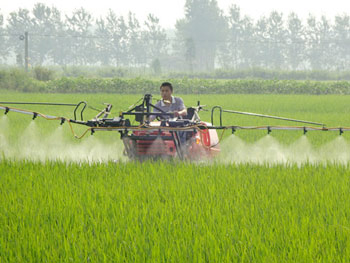
Pest and disease prevention and control (illustrative image from the internet)
In order to implement the spirit of the National Agricultural Work Conference, effectively carry out the prevention and control of major crop pests and diseases in 2016, reduce losses caused by pests and diseases, and promote the action to achieve zero growth in pesticide use, our center organized relevant experts to research and formulate the 2016 technical plans for the prevention and control of major pests and diseases of rice, wheat, corn, and potato. The plans are hereby issued to the plant protection (plant quarantine, agricultural technology) stations (bureaus, centers) of all provinces, autonomous regions, and municipalities directly under the Central Government, the **Agricultural Technology Extension General Station of the Production and Construction Corps, and the Agriculture Bureau of the Heilongjiang General Bureau of State Farms. Please combine with actual conditions, adapt measures to local conditions, and effectively implement all prevention and control technical measures, making positive contributions to ensuring the safety of our country's agricultural production this year.
-- Rice --
According to forecasts by the National Agricultural Technology Center, rice pests and diseases in China in 2016 will show a tendency toward heavy occurrence, more severe than in normal years, with an occurrence area of 1.57 billion mu-times. Among these, the brown planthopper and rice leaf roller have wide areas of heavy occurrence, the rice stem borer (Chilo suppressalis) shows prominent concentrated damage, rice blast and rice false smut have high epidemic risk, southern rice black-streaked dwarf disease shows a rebounding trend, and rice bacterial leaf blight and bacterial foot rot occur heavily in some local areas. In order to do a good job in the prevention and control of major rice pests and diseases in 2016, this plan is hereby formulated.
Prevention and Control Objectives
The treatment rate for major pests and diseases reaches over 90%, the overall control effect reaches over 85%, the loss rate from pests and diseases is controlled within 5%, the application area of green prevention and control technology reaches 24%, the area under specialized unified prevention and control reaches 34%, and the use of chemical pesticides in rice decreases by more than 10%.
Prevention and Control Strategy
Centering on the rice field ecosystem, strengthen zoned management, focus on major pests and diseases and heavily affected areas, cultivate the pest control capacity of the rice field ecosystem, give priority to green prevention and control technologies such as fitness cultivation, resistant (tolerant) varieties, and biological control, strengthen the pest control role of natural enemies, use pesticides safely and reasonably, prohibit the use of pesticides containing pyrethroid components, integrate green prevention and control with specialized unified prevention and control, and ensure rice yield, quality, and rice field ecological safety.
Prevention and Control Measures
(1) Zoned prevention and control priorities
1. South China rice region. Including the double-cropping rice planting areas of Guangdong, Guangxi, Fujian, and Hainan, with priority on preventing and controlling brown planthopper, rice leaf roller, rice blast, sheath blight, rice false smut, and viral diseases, and attention to preventing and controlling Chilo suppressalis, Scirpophaga incertulas (yellow stem borer), and bacterial leaf blight.
2. Middle and lower reaches of the Yangtze River rice region. Including the mixed single- and double-cropping rice areas and single-cropping rice planting areas of Hunan, Jiangxi, Hubei, most of Anhui, most of Jiangsu, Zhejiang, and Shanghai, with priority on preventing rice blast, rice false smut, and viral diseases, preventing and controlling brown planthopper, Chilo suppressalis, rice leaf roller, and sheath blight, and locally controlling rice thrips, Sesamia inferens (pink stem borer), Scirpophaga incertulas, and bacterial leaf blight.
3. Southwest rice region. Including the single-cropping rice planting areas of Yunnan, Guizhou, Sichuan, Chongqing, and southern Shaanxi, with priority on preventing rice blast, rice false smut, and southern rice black-streaked dwarf disease, preventing and controlling brown planthopper, rice leaf roller, Chilo suppressalis, and sheath blight, and attention to controlling armyworm and bacterial leaf blight.
4. Huang-Huai rice region. Including the single-cropping rice planting areas of northern Jiangsu and Anhui, Henan, and Shandong, with priority on preventing rice blast, rice false smut, and black-streaked dwarf disease, preventing and controlling brown planthopper, Chilo suppressalis, and sheath blight, and attention to controlling rice leaf roller, Sesamia inferens, and stripe disease.
5. Northern rice region. Including the single-cropping rice planting areas of Heilongjiang, Jilin, Liaoning, Hebei, Tianjin, Inner Mongolia, and Ningxia, with priority on preventing rice blast, bakanae disease, and rice false smut, and preventing and controlling Chilo suppressalis and sheath blight.
(2) Main technical measures
1. Rice planthopper. In the South China, Southwest, and middle and lower reaches of the Yangtze River rice regions, priority is on controlling brown planthopper (Nilaparvata lugens) and white-backed planthopper (Sogatella furcifera); in the Huang-Huai rice region, priority is on controlling white-backed planthopper and small brown planthopper (Laodelphax striatellus). Give priority to selecting resistant (tolerant) varieties; apply ecological engineering pest control technology, and minimize pesticide use in the early field stage to fully leverage the pest control role of natural enemies. Chemical control should focus on the middle and late stages of rice growth, with control thresholds of 800-1000 insects per 100 hills at the booting-heading stage and 1200-1500 insects per 100 hills at the heading stage; give priority to pesticide varieties relatively safe to natural enemies, spray the base of rice hills at the peak of young nymphs, advocate the use of high-content single-agent formulations, and avoid low-content compound formulations.
2. Rice leaf roller. Fully leverage the self-compensation capacity of rice in the early growth stage, apply ecological engineering technology to enhance the pest control role of natural enemies, focus on controlling the main damaging generation, and protect functional leaves. From the first appearance of immigrant-generation moths, begin using sex pheromone mass trapping technology, and release Trichogramma japonicum at the moth peak to suppress population numbers; from the early peak of egg hatching to the peak of young larvae, give priority to uniformly and finely spraying biological pesticides such as Bacillus thuringiensis, Mamestra brassicae NPV, Beauveria bassiana, and Empedobacter brevis. If chemical pesticides are needed, the control thresholds are 150 rolled leaf tips per 100 rice hills at the tillering stage and 60 rolled leaf tips per 100 rice hills at the heading stage.
3. Stem borers. During the pupation period of overwintering-generation stem borers in spring, plow and irrigate fields to soak them, reducing the pest source base; from the late pupal stage of the overwintering generation, begin using sex pheromone mass trapping technology, release Trichogramma japonicum at the moth peak, and apply Bacillus thuringiensis at the early peak of egg hatching. For chemical control of Chilo suppressalis, apply pesticide at the tillering stage when the rate of hills with dead heart reaches 8%-10% or the rate of plants with dead heart reaches 3%; at the heading stage, focus on controlling rice fields with large residual populations of the previous generation and where the current generation's egg hatching peak coincides with the rice booting-heading stage at the peak of egg hatching. For control of Scirpophaga incertulas, apply pesticide at the early stage of rice booting and heading, focusing on rice fields where the number of egg masses reaches 40 per mu.
4. Rice blast. Plant disease-resistant varieties, implement diversified variety planting, carry out proper seed disinfection, and avoid excessive and late application of nitrogen fertilizer. Focus on implementing timely chemical preventive measures; in commonly affected areas, transplant seedlings with pesticide treatment; at the tillering stage, apply pesticide when disease spots first appear in the field to control leaf blast; apply pesticide 3-5 days before booting to prevent panicle blast; when climate favors disease epidemic, apply pesticide a second time after 7 days. Advocate the use of high-content single-agent formulations and avoid low-content compound formulations.
5. Sheath blight. Strengthen fertilizer and water management, carry out fitness cultivation, and drain fields at the late tillering stage. Chemical control should focus from the late tillering stage to the booting-heading stage, and apply pesticide when the rate of diseased hills in the field reaches 20%.
6. Rice false smut. Plant resistant (tolerant) varieties; apply fertilizer reasonably to improve rice disease resistance. Focus on applying pesticide for prevention at the late booting stage, that is, 10-15 days before booting; if rainy weather occurs, apply pesticide a second time after 7 days.
7. Southern rice black-streaked dwarf disease and ragged stunt disease. Plant resistant (tolerant) varieties; prevent in the seedling stage and early main field stage of single-cropping rice and late rice, with priority on seed dressing or seed soaking, centralized seedling raising, and full-course coverage seedling raising with insect-proof nets or non-woven fabric for non-seed-treated seedling fields to cultivate virus-free strong seedlings; transplant seedlings with pesticide treatment; timely control when viruliferous rice planthoppers migrate into seedling fields and early main fields. In areas where rice planthoppers reproduce year-round, immediately plow after late rice harvest to reduce winter virus host plants such as ratoon rice and volunteer rice.
8. Stripe disease and black-streaked dwarf disease. Plant disease-resistant varieties and appropriately delay sowing and transplanting dates. Use seed dressing or seed soaking, cover with insect-proof nets or non-woven fabric for centralized seedling raising, cultivate virus-free strong seedlings; transplant seedlings with pesticide treatment. Pay attention to controlling small brown planthopper in preceding wheat fields, field-edge weeds, seedling fields, and at the early transplanting stage.
9. Bacterial leaf blight. Plant resistant (tolerant) varieties; focus on comprehensive prevention and control measures including seed disinfection, cultivating disease-free strong seedlings, strengthening water and fertilizer management, preventing flooding, preventing cross-irrigation, and chemical control of disease centers. In commonly affected areas, apply pesticide timely to susceptible varieties after typhoons and heavy rain.
Main recommended technologies for green prevention and control and specialized unified prevention and control