Technical guidance for early rice seedling raising and transplanting in southern China provides support and protection
Original title: 2016 Technical Guidance on Early Rice Seedling Raising and Transplanting in Southern China
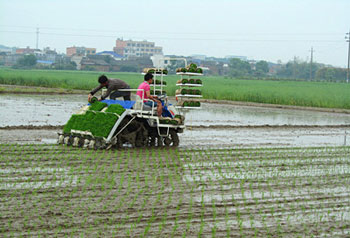
Early rice seedling raising and transplanting in southern China (network illustration)
At present, sowing, seedling raising and transplanting of early rice in southern China have been unfolding successively from south to north. Affected by low-temperature and overcast-rainy weather in the earlier period, the overall progress of early rice sowing and seedling raising this year has been slower than usual, and seedling quality in some areas is on the weak side. In view of the current climate characteristics and seedling quality, with emphasis on key links such as cold resistance and heat preservation, fertilizer and water regulation, and pest and disease control, efforts should be made to cultivate strong seedlings and to transplant well and in sufficient quantity at the right time, laying the foundation for maintaining the area, stabilizing the yield and improving the quality of early rice in southern China. The following technical guidance is hereby proposed.
1. Select superior varieties and treat seeds. According to the ecological conditions and transplanting methods of each locality, select early rice varieties with high yield and good quality, strong stress resistance and good wide adaptability. Before sowing, do a good job of sun-drying the seeds, seed selection, seed soaking, disinfection and germination to prevent the occurrence of bakanae disease. Where conditions permit, factory-based seedling raising and seedling raising with large (medium) sheds and film mulching for heat preservation are encouraged.
2. Sow at the right time according to weather and local conditions. When the daily average temperature steadily passes 12°C, avoid overcast and rainy weather and seize the time to sow early rice varieties with a suitable growth period. Grasp the opportunity of the "cold tail and warm head", and strive to complete sowing of early rice in the middle and lower reaches of the Yangtze River around Qingming.
3. Regulate temperature with water to resist cold and prevent freezing. Recently, temperatures in some areas of southern China have fluctuated considerably, which is unfavorable for spring sowing and the cultivation of strong seedlings of early rice. For seedling fields already sown, cold protection work should be strengthened; where plastic film has not been covered, it should be promptly supplemented, and scientific irrigation and drainage methods such as "irrigate at night and drain during the day" and "drain on sunny days and irrigate on rainy days" should be adopted to regulate the water and heat conditions of the seedling field and prevent seed rot and seedling rot.
4. Scientific regulation to cultivate strong seedlings. During seedling raising, while keeping warm, uncover the film at both ends in a timely manner for ventilation to prevent diseases; if there is continuous sunny and high-temperature weather (≥35°C inside the film), the film should be uncovered for ventilation to prevent high-temperature burning of seedlings; if the weather suddenly turns sunny after continuous overcast and rain, by no means suddenly uncover the film or blindly apply quick-acting fertilizers such as urea; instead, ventilate and harden the seedlings first before uncovering the film, and when uncovering the film at the seedling bed, sprinkle water or irrigate at the same time. At the 1-leaf 1-heart stage, maintain suitable temperature and moisture for strong seedlings, prevent excessive growth, and pay attention to preventing the occurrence of damping-off and seedling blight; at the 2-leaf 1-heart stage, ventilate and harden the seedlings, increase fertilizer to promote tillering, and cultivate strong seedlings; at the 3-leaf 1-heart stage, uncover during the day and cover at night; 5-7 days before transplanting, apply a "send-off fertilizer" by drenching with 1%-2% urea solution, and after application add one more drenching with clear water, or apply a starting fertilizer 3-5 days before transplanting; generally apply 4-5 kg of urea per mu of seedling field. For seedlings with weak growth, increase the application of phosphorus and potassium fertilizers, maintain water balance, and promote recovery of growth. In case of a "late spring cold spell", ensure that heat preservation facilities are intact, regulate temperature with water in a timely manner, maintain field temperature, and prevent seedling rot and dead seedlings.
5. Classified guidance and timely transplanting. When the daily average temperature steadily passes 15°C, seize clear weather to transplant rice seedlings, and strive to complete transplanting in South China around Qingming. For machine-transplanted fields, improve the quality of plowing and field preparation; before transplanting, the field should be allowed to settle, transplant early at the right time, strive for shallow transplanting, and appropriately increase density; the seedling age is generally about 20 days, and it is advisable to use a rice transplanter with a 25 cm row spacing to avoid prolonged seedling recovery caused by excessively old seedlings, with more than 20,000 hills transplanted per mu. For hand-transplanted or throwing-transplanted fields, ensure transplanting density and improve uniformity; the seedling age is generally 25-30 days, with 20,000-25,000 hills transplanted per mu in high-yield fields, 2-3 seedlings per hill for hybrid rice and 5-6 seedlings per hill for conventional rice, so that the basic seedlings per mu reach 50,000-60,000 and 100,000-120,000 respectively. For triple-cropping fields, increase transplanting density, with seedling age generally not exceeding 35 days and more than 25,000 hills transplanted per mu. (Rice Expert Steering Group of the Ministry of Agriculture, National Agricultural Technology Extension Service Center)