Can cucumbers with flowers still attached and spines be eaten? Please feel free to eat them
Are cucumbers with flowers still attached and spines poisonous?
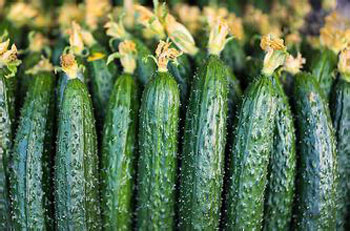
Recently, a reporter encountered such a scene at a vegetable market in Beijing: a customer holding a cucumber with flowers still attached and spines pointed at the vegetable vendor and said that WeChat had reported that this kind of cucumber is "poisonous"! This made passersby stop and look, and the vendor was unconvinced: why say that? The customer said, why do these flowers not wither? It is all caused by hormones, and the composition of the hormones is the same as that of contraceptive pills.
Some cucumbers "with flowers still attached and spines" are a natural phenomenon
"Have cucumbers 'with flowers still attached and spines' really been treated with hormones?" The answer is: some cucumbers really have been.
"Then, are agricultural products that have used plant hormones safe or not?" The answer is: safe.
Wang Qiang, a researcher and director of the Institute of Quality Standards for Agricultural Products of the Zhejiang Academy of Agricultural Sciences, a member of the Ministry of Agriculture expert group on agricultural product quality and safety, and director of the Ministry of Agriculture Laboratory for Risk Assessment of Agricultural Product Quality and Safety (Hangzhou), responded that "contraceptive pill cucumbers" are purely a rumor. Contraceptive pills are animal hormones, have no effect at all on the growth and development of plant-based cucumbers, and cannot possibly be used on cucumbers. Because the plant growth regulators used on cucumbers can promote cucumber growth and development and have hormone-like effects, and contraceptive pills are also hormones. As a result, after being passed around, it finally became the story that cucumbers are treated with contraceptive pills.
Dr. Zhong Kai of the National Center for Food Safety Risk Assessment introduced that "with flowers still attached and spines" cucumbers belong to parthenocarpy, which is an inherent biological characteristic, and there is no safety risk. Cucumber flowers are basically monoecious with unisexual flowers, and occasionally bisexual flowers also appear. The cucumber fruit is a false fruit, formed by the ovary sinking into the receptacle and the ovary and receptacle merging. Cucumbers can set fruit without pollination and fertilization, which is called parthenocarpy, thus producing cucumbers "with flowers still attached and spines." When cucumbers are cultivated in protected facilities in winter and spring, due to the effects of low temperature, short-day conditions, and weak light, cucumber plants grow weakly and slowly. Under low temperature and short-day conditions, cucumbers have more female flowers and a low fruit-setting rate, which affects cucumber yield. Therefore, on the day of flowering or the day before, a solution of forchlorfenuron at a concentration of about 50 mg/L is often applied to the flower stalk to increase the fruit-setting rate and increase yield.
Zhong Kai pointed out that some "with flowers still attached and spines" cucumbers produced in winter and spring are produced by the natural parthenocarpy of cucumbers, and some are produced by parthenocarpy caused by the use of forchlorfenuron, and are not caused by the legendary use of "contraceptive pills."
In addition to the rumor about contraceptive cucumbers, popular posts such as "straight cucumbers have all been sprayed with chemicals, and curved cucumbers are the natural ones" and "buy curved cucumbers, choose short chives" have become widespread again.
"Straight cucumbers and curved cucumbers can both grow and form under natural conditions. Growing conditions determine the proportion of straight and curved cucumbers, and the variety also has an influence." Yu Xianchang, chief scientist of the Scientific and Technological Innovation Team for Vegetable Cultivation and Physiology of the Chinese Academy of Agricultural Sciences, said that generally speaking, straight cucumbers are the normal ones.
Yu Xianchang said: "In the early stage when the plant growth environment is poor, with poor temperature and light conditions, and the plants do not grow robustly, or in the later stage when the plants age prematurely, applying an appropriate concentration of forchlorfenuron to cucumber flowers can improve the fruit growth condition, and can also reduce the proportion of curved cucumbers, improving cucumber yield and commercial value. The normal use of forchlorfenuron is harmless to the human body."
Plant growth regulators are widely used throughout the world
So what exactly is the forchlorfenuron the experts mentioned? It is actually a plant growth regulator.
Wang Qiang introduced that plant growth regulators are a type of agricultural input with the function of regulating and controlling plant growth and development. They are produced by artificial synthesis or through microbial fermentation, and can also be directly extracted from plants. They are commonly known as plant hormones. They are completely different from animal hormones and have no effect or influence on human growth and development.
Wang Qiang further explained that hormones are indispensable in the normal growth and development of organisms. A lack of hormones or insufficient hormones will directly affect the normal growth and development of organisms. Plant hormones act on plants, while animal hormones regulate the growth and development of animals. Their targets and mechanisms of action are completely different. Plant growth regulators are also called exogenous plant hormones. Their effects are the same as or similar to the endogenous plant hormones produced by plants themselves, but they are completely different from animal hormones and have no effect or influence on human growth and development.
Wang Qiang introduced that plant growth regulators, as a technical measure for high-yield, high-quality, and efficient agriculture, have been widely used throughout the world. Including in developed countries such as the United States, the European Union, and Japan, there are currently about 40 or more types of plant growth regulators in use worldwide, such as ethephon, gibberellic acid, naphthaleneacetic acid, indolebutyric acid, paclobutrazol, and chlormequat, mainly applied to crops such as fruits, vegetables, potatoes, and soybeans. For example, the European Union has registered 26 active ingredients and 197 formulation products, allowing these plant growth regulators to be used on crops within the registered scope.
Wang Qiang said: plant growth regulators can achieve purposes such as increasing yield, improving quality, and promoting ripening by promoting or inhibiting the growth of stems, leaves, roots, buds, and flowers or fruit ripening, preserving flowers and fruits or thinning flowers and fruits, advancing or prolonging dormancy, and promoting fruit enlargement. Therefore, some agricultural products need to use plant growth regulators in the production process to achieve their best production results and nutritional quality performance. For example, the use of paclobutrazol on wheat can prevent lodging; the application of gibberellin to pear trees can reduce flower and fruit drop caused by temperature, nutrition, pollinating insects, and other reasons, and improve the fruit-setting rate; treating potatoes with chlorpropham can inhibit sprouting and avoid alkaloid poisoning.
In agricultural production, most crops can rely on the activity of their own endogenous plant hormones to take effect, and through measures such as variety selection, cultivation, fertilization, and disease and pest control to achieve the goals of high yield and high quality. Only when endogenous plant hormones are insufficient to regulate and control the expected plant growth and development in a very small number of cases are plant growth regulators used. Therefore, not all agricultural products need to use plant growth regulators.
There have been no cases of food poisoning caused by agricultural products that used plant growth regulators
Wang Qiang introduced that compared with other pesticides, although plant growth regulators are managed within the pesticide category, they are not pesticides in the traditional sense for disease prevention, pest control, and weed removal. Their products are of low toxicity, are used in very small amounts, and are safe. After use, plant growth regulators will also form some residues in agricultural products to a greater or lesser extent. However, compared with other pesticides, the residues of plant growth regulators in agricultural products are extremely small and degrade quickly. They are used during the flowering period and the early fruit-setting stage, and the interval before harvest is relatively long. Generally, the residue levels in agricultural products at the maturity and harvest stages are very low, and even if individual products have residues, they are negligible. At present, the monitoring of plant growth regulator residues is good. Market monitoring has not found samples with excessive residues, and products on the market meet the requirements of national food safety standards.
Wang Qiang said that judging from the Ministry of Agriculture's monitoring and assessment of plant growth regulator residues in agricultural products, only very few samples of agricultural products at the harvest stage have plant growth regulator residues. Even if individual samples are detected, the residue values are extremely low, almost at an undetectable level, far below the residue limit values in national food safety standards. Market monitoring has not found samples with excessive residues, and all meet the national statutory food safety requirements. Internationally, there have been no food safety incidents related to plant growth regulator residues. (Our reporter Gao Wen)