There are infinite possibilities in an egg; only by hustling can you get on the road to wealth
Original title: One egg fulfilled the dream of wealth
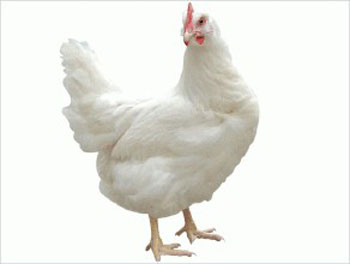
Lohmann laying hens (illustrative image from the internet)
Corps worker Wang Linji: Tasting sweet success raising Lohmann laying hens
His name is Wang Linji, a worker of the Ninth Company of the Twelfth Regiment of the First Division of the **Production and Construction Corps. A few years ago, Wang Linji and his wife contracted cotton fields in the company, but their income was low and only enough to maintain a basic living. Looking at his family's modest living conditions, Wang Linji began to gather market information. Through market research, he found that raising laying hens was an excellent wealth-building project, so he made up his mind to develop large-scale farming - raising laying hens.
In 2009, with the strong support of the Twelfth Regiment's courtyard economy development and interest-free loans, he invested more than 200,000 yuan to build a 520 sq m chicken house, and introduced from Urumqi more than 10,000 birds of a new breed with strong disease resistance and high egg production - Lohmann laying hens. The chicken farm was quickly built, but once operations began, many unexpected difficulties arose. The very first step was far from smooth. Due to a lack of scientific chicken-raising knowledge, he relied only on traditional rearing methods, simply feeding feed and water. He never expected these little creatures to be so hard to care for: eat too much and they would be harmed, eat too little and they would starve to death; too low a room temperature would not do, and too high a room temperature would not do either; often they caught a chill when the windows were opened, and suffered from heat when the windows were closed. Arranging the flock also required care: if the density was too high, the chickens crowded together and ate unevenly; if the density was too low, it was not conducive to keeping warm, and the survival rate dropped. Then there was feather pecking: before feed was introduced they coexisted peacefully, but after feed was introduced they pecked each other's feathers, wings and vents - the mild cases were injured and disabled, the severe cases died. Such situations often occurred: they were perfectly fine the night before, and by the next morning a large number had died for no apparent reason. This made him extremely anxious, like a tank stuck in mud, unable to bring his strength into play.
In order to raise the chickens well, he visited several large chicken farms in Aksu, twice invited professional technicians to his home, and also bought books such as "Analysis of Poultry Diseases" and "Livestock and Poultry Breeding". After many sleepless nights and countless analyses, often performing "necropsy examinations" on dead chickens, he gradually mastered the chickens' living habits and basic pathology knowledge, became able to correctly handle vaccination, disinfection, nasal drops and eye drops, and gradually mastered the techniques of scientific chicken raising. He set up a stove in the shed for heating and cared for the remaining 7,000-plus baby chickens as carefully as if they were his own children. A month passed, the chicks grew up, and the survival rate reached 98%. That year they began laying, realizing a profit of 130,000 yuan. After expanding the chicken house by 520 sq m, he achieved scale in chicken raising.
In 2014, Wang Linji registered his eggs under the brand "Ge Ge Da". That same year his chicken farm was expanded from the original 500 sq m to 1,000 sq m, and the number of laying hens increased from the original 20,000 birds to 50,000 birds, with a daily egg output of 500 kg. That year he realized a net profit of more than 500,000 yuan. Wang Linji's farm was rated by the division as a "Demonstration Site for Workers' Independent Entrepreneurship and Diversified Income Growth". Wang Linji thus became a wealth-building expert known far and wide throughout the regiment. He often says: it was this one tiny egg that fulfilled my dream of wealth.
Village cadre Yu Xiaozhen: "Green-shell eggs" bring wealth to farmers
A large group of customers came to the Xiaozhen Planting and Breeding Cooperative in Yuhuang Village, Nanfeng Town, Duchang County, Jiangxi Province, to order green-shell eggs. But in the end they could only go home disappointed, because the green-shell eggs here had long been sold out. Yu Xiaozhen, chairman of the Nanfeng Xiaozhen Planting and Breeding Cooperative in Duchang County, said: "The hens are not laying many eggs now, and market demand is relatively large, which has led to supply falling short of demand. Many customers, in order to buy green-shell eggs, have paid deposits in advance. To meet market demand, I plan to further expand the scale."
Yu Xiaozhen's entrepreneurship began in 1998, when he partnered with others at home to run a red brick factory and contracted the Nanfeng tea hills to raise native chickens. In 2000, he went to Jingdezhen to run a ceramics factory, producing large vases from 1.6 m to 2.4 m. He did this for more than two years, but due to poor management he lost everything. Later he joined a large factory producing large vases, painting blanks and doing odd jobs. In 2013, he began making antique-style porcelain. Because of accurate positioning, low costs and his advantage in carving and painting blanks, it developed fairly well. After returning to the village in 2014, he was elected deputy village director, and wanted to lead the whole village's villagers to start businesses together and become rich.
With the development of the social economy, food safety issues on the market are attracting more and more attention, and developing green agriculture is the general trend. In 2012, he bought an incubator that can hatch 260 chicks at a time, and last year he built another chicken shed. He now has about 1,000 hens. Every year he sells some chicks to local farmers. So far, twenty or thirty households of local villagers have raised green-shell chickens, selling the eggs they lay, which can also add some income for the local villagers.
Yu Xiaozhen said: "Green-shell eggs are highly nutritious, rich in various proteins and amino acids, and are an excellent tonic. I once did an experiment: I broke an ordinary egg and a green-shell egg at the same time and put them in two bowls. A toothpick could be inserted into the yolk of the green-shell egg and would not fall for a long time, while the yolk of the ordinary egg would immediately topple as soon as the toothpick was inserted. The experiment fully shows that the yolk of green-shell eggs is more viscous and more nutritious."
Regarding the future, he is full of confidence. He said: "I hope that in the future I can promote green-shell laying hen breeding techniques and lead more fellow villagers onto the road to wealth through eco-friendly farming. When I have nothing to do, I can do what I like, accompanying my son by the shores of Poyang Lake to carve and paint - what a pleasant life that would be."
"Returnee woman" Xiong Yaqiu: Creating "Chinese yam eggs" at 5 yuan each
As more and more young people choose to return to their hometowns to start businesses, traditional farming is showing more and more "variations": some raise chickens in oil-tea camellia forests, and some experiment with raising chickens on Chinese herbal medicine... It is not just farming methods; concepts are changing too. In 2013, Xiong Yaqiu returned to her hometown of Ruichang and also entered the farming industry, taking a high-end route in chicken raising. She not only feeds the chickens Chinese yam, but also conducts nutritional testing on the eggs, and travels abroad to study techniques. Today, Xiong Yaqiu's Chinese yam eggs sell for 5 yuan each, and nearly 80,000 Chinese yam eggs are sold to Beijing and Shenzhen every month.
Xiong Yaqiu was once an international student studying in Greece. After returning to China 8 years ago, she worked in Beijing the whole time. Entering the farming industry was, for her, an "accident".
"Ruichang Chinese yam is famous. Every time I returned to Ruichang, I heard my family talk about how good Ruichang Chinese yam is. At that time I thought I should share the good things from my hometown. Once, I saw a lot of Chinese yam peels and other waste piled up in our family's Chinese yam processing factory. My heart stirred: since Chinese yam is so nutritious, isn't it too much of a pity to throw away the peels and other scraps for nothing?" Xiong Yaqiu said. In fact, her family had also been researching how to make by-products of Chinese yam, and after seeing the discarded Chinese yam waste, she felt it was a pity that the nutrients were wasted, and thought it would be better to turn it into feed.
So Xiong Yaqiu returned to her hometown of Ruichang and decided to process the Chinese yam peels and other waste, combining the hometown specialty Ruichang Chinese yam with traditional farming to produce a unique Chinese yam feed, for which she applied for a patent, and opened a farm to produce "Chinese yam eggs". These "noble chickens" grown on the nourishing delicacy Chinese yam lay "Chinese yam eggs" that sell for 5 yuan each, mainly to Beijing and Shenzhen. But whether Chinese yam eggs are really good, and whether they are worth consumers paying this price, in Xiong Yaqiu's view, is not something that can be achieved just by adding the two words "Chinese yam", nor is it something publicity can solve; it must rely on scientific evidence. Xiong Yaqiu sent the eggs to the Beijing Institute of Nutritional Resources for testing. The test report showed that this kind of "Chinese yam egg" has less egg white, a larger yolk and high lecithin, and its beta-carotene content is more than three times that of ordinary eggs. "A scientific test report not only lets consumers clearly know what they are paying for, but also lets them understand the benefits of Chinese yam. Through Chinese yam eggs, more people can get to know Ruichang Chinese yam."