Summary of Information on Multifunctional Large-Cycle New Agriculture
Original title: Six Major Fields Build Multifunctional Large-Cycle Agriculture
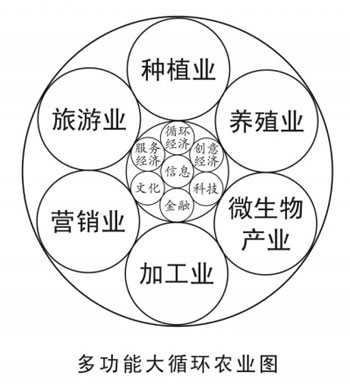
Schematic Diagram of Multifunctional Large-Cycle Agriculture
In 2013, on the basis of long-term practice and repeated reflection, I first explicitly put forward "multifunctional large-cycle agriculture" and drew a "Multifunctional Large-Cycle Agriculture Diagram." In the diagram, 15 circles - large, medium and small - vividly illustrate large-cycle agriculture: the first layer is 1 large circle, representing the overall interconnected large cycle; the second layer is 6 medium circles, representing crop farming, livestock farming, the microbial industry, processing, marketing, and tourism respectively; this medium circle in the third layer serves as a link between what comes before and what follows; the fourth layer is 6 small circles, representing the circular economy, creative economy, service economy, science and technology, culture, and finance respectively; the fifth layer is a small circle at the center, representing information.
The 15 large, medium and small circles in the "Multifunctional Large-Cycle Agriculture Diagram" are tangent to one another, linked ring by ring, interconnected ring by ring, and interlocked ring by ring, forming an overall multifunctional large cycle. From the practice of a large number of advanced models, I have summarized that multifunctional large-cycle agriculture has nine major functions: economic, social, ecological, environmental protection, cultural, tourism, conservation, high efficiency, and health. Multifunctional large-cycle agriculture is different from ordinary circular agriculture, and also different from the sixth industry promoted in Japan and South Korea, but it is not fabricated out of thin air in isolation from the above different forms of agriculture; rather, it is continuously deepened and expanded on the above basis. It is a new business format integrated by a large system, a new model spanning industries and disciplines, and an important strategic emerging industry.
In my view, "multifunctional large-cycle agriculture" has ten major effects: continuously turning waste into treasure and harm into benefit, continuously lowering production costs, continuously reducing environmental pollution, continuously optimizing the ecological environment, continuously expanding employment, continuously increasing farmers' incomes, continuously raising the resource output rate, continuously enhancing the overall efficiency and competitiveness of agriculture, continuously solving problems in development, and continuously making innovations.
How to realize "multifunctional large-cycle agriculture"? It means establishing, in an agricultural park or a county, a strong research and guidance center for multifunctional large-cycle agricultural producer services. Under this guidance center, each of the six major fields carries out its own operation.
For crop farming, we must adhere to the "four goods" and "three nurturings." Good seed means further selecting fine seeds of various agricultural products according to soil, climate, water sources and other ecological and environmental conditions, so as to meet the requirements of "efficient output, safe products, resource conservation, and environmental friendliness." Good methods means agricultural technicians selecting cultivation and management methods suited to the local area and the specific variety. Good farmland means, first, promptly tackling soil pollution and water pollution, and second, adhering to "using land while nurturing land, nurturing land while using land." Good ecology actually means co-cultivation in rice fields, optimizing the farmland ecological environment. "Nine savings and one reduction," namely: saving land, saving water, saving fertilizer, saving pesticides, saving seeds, saving electricity, saving fuel, saving firewood (saving coal), saving grain, and reducing people (reducing farmers engaged in primary production).
For livestock farming, the healthy farming I hope for runs from healthy soil to growing healthy plants, raising healthy animals, processing healthy food, and nurturing healthy human beings. Crop farming, livestock farming and the microbial industry should develop through a virtuous cycle and interconnected development; according to the area of farmland and crop farming, the scale and types of crop farming, livestock farming, green manure, farmyard manure and agricultural microorganisms should be developed in a coordinated way according to how much organic fertilizer and green manure are needed. The feed problem must be solved well. Fine, high-quality livestock and poultry breeds with high feed conversion efficiency can be bred, and scientific farming methods such as staged feeding and the optimal selling period can be adopted to reduce feed consumption. The excrement of livestock and poultry should be recycled and utilized. Advanced and applicable aquaculture technologies should be promoted.
In the microbial industry, agricultural and forestry waste, straw, vinegar residue, distiller's grains, brewer's grains and other wastes can, after microbial fermentation, become high-quality feed and high-quality organic fertilizer; they can also inhibit weed growth, restore and optimize the ecological environment, and improve the quality and efficiency of crop farming and livestock farming. At present, many places in China are using biogas and edible fungi as bridges in circular agriculture. Practice shows that microorganisms are like an invisible chain, threading together and connecting crop farming, livestock farming, the microbial industry, processing, marketing and tourism, producing an effect of mutual interconnection, integration and amplification, with notable benefits in increasing output, conservation, high efficiency, safety, high quality, health, and environmental protection.
For processing, the agricultural product processing industry is an indispensable and important link in multifunctional large-cycle agriculture. Deep processing and utilization of various agricultural, forestry, livestock and fishery products is a key measure for adjusting structure, transforming the development model, expanding demand, and increasing efficiency. Serial development and deep utilization of the by-products after processing agricultural products can sometimes yield benefits exceeding those of the main product. Various wastes and pollutants produced by crop farming, livestock farming and agricultural product processing should be recycled and utilized.
For marketing, we must first start from market demand. Demand is the scarcest resource in today's world, and the industrial structure must be adjusted and optimized according to market demand. In 1998 I proposed that "we should start from the 'six demands' to adjust the rural industrial structure, namely basic demand, special demand, development demand, changing demand, processing demand, and safety demand." In fact, these six demands still have reference value for adjusting and optimizing the rural industrial structure today, and are conducive to the marketing of agricultural products. We should learn from advanced experience at home and abroad and from creations in various places to solve problems. Through partnerships established among producers, sellers and consumers, product sales can be carried out in forms such as direct selling, collective purchasing (consumer cooperatives), home delivery, and small-scale retail stores. Research on and application of the circular economy and Internet thinking should be strengthened, closely combining Internet thinking with the mass line.
For tourism, tourism is not only driving and economic in nature, but also has cultural attributes. Tourism in multifunctional large-cycle agriculture is different from ordinary sightseeing agriculture and leisure agriculture. It can both drive marketing and promote the development of crop farming, livestock farming and processing, and is an effective way to publicize, display and promote the development of multifunctional large-cycle agriculture.
To develop multifunctional large-cycle agriculture, we must actively explore the integration of circular agriculture, creative agriculture and service agriculture, merging the circular economy, creative economy and service economy into one, and adhere to taking the circular economy as the principle, the creative economy as the engine, the service economy as the link, science and technology as the support, and policies and mechanisms as the guarantee; in this way, sound and rapid economic and social development can be achieved. Some breakthrough ideas can also solve problems, reverse dilemmas, overcome difficulties, and ride out risks.
(The author Ji Kunsen is former deputy director of the Standing Committee of the Anhui Provincial People's Congress and president of the Anhui Provincial Circular Economy Research Institute)