Four Ways to Turn Weak Wheat Seedlings into Strong Ones, Backed by the Agricultural Technology Station Chief
Original title: An Agricultural Technology Station Chief's "Guide to Turning Weak Wheat Seedlings into Strong Ones"
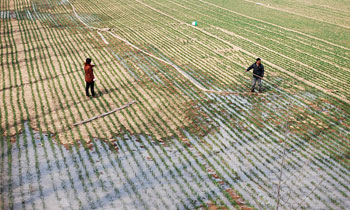
Villagers of Yangji Village, Liji Township, Yuncheng County, irrigating wheat (web image: An Lei, Shandong Yellow River Network)
On April 3, despite it being the Qingming holiday, Wang Qingli, head of the agricultural technology station of Qinggangji Township, Cao County, Shandong Province, was still preoccupied with the condition of the wheat seedlings. Having just finished lunch, he arrived again at the field edge in Liji Village. "This is a patch of sandy, alkaline, poor soil, and the seedlings are still on the weak side. We should take advantage of the jointing-stage irrigation to apply 30 jin of urea per mu, and it would be best to also spray foliar fertilizer once." Wang Qingli instructed the village committee director.
Since the Spring Festival, Wang Qingli had been constantly on the move through the fields of Qinggangji Township, busy with the matter of "promoting weak seedlings to turn strong." "Affected by last autumn's drought and winter freezing damage, this year's wheat seedling condition is not as good as in previous years, mainly shown by a higher proportion of third-class seedlings than usual. Therefore, seizing spring management, the only opportunity for the wheat seedling condition to transform, and promoting weak seedlings to turn strong is the top priority," Wang Qingli said.
After more than two months of rushing about, Wang Qingli summed up his own "guide to turning weak seedlings strong."
The first is that fertilizer and water management involves knowledge. Wang Qingli said the focus should be on early management, with emphasis on classified management according to seedling type. Third-class wheat fields should be dealt with earliest, preferably carrying out fertilizer and water management at the greening stage, with topdressing of nitrogen and phosphorus fertilizer; second-class wheat fields should be topdressed and watered at the standing-up stage; first-class wheat fields are best topdressed and watered at the jointing stage.
"This especially calls for thanking the small-scale farmland water project implemented in our township last year, which invested nearly 30 million yuan and developed high-efficiency water-saving irrigation on 26,000 mu, covering more than half of the township's land area," Wang Qingli said. "In the past, watering in our township required diverting Yellow River water. First, it was uncertain when the water would come; second, the cost of watering was especially high, wasting labor and water. Now it's better: pipes reach the field edge, and farmers can water whenever they want by just turning a valve."
The second is to mobilize farmers to carry out compaction and hoeing, especially in wheat fields with many clods, loose soil, some excessive growth, and dryland wheat fields. Carrying out compaction and hoeing in early spring can play multiple roles, such as preserving soil moisture, raising moisture, increasing temperature and controlling excessive growth. "The problem now is that farmers all go out to work, so increasing the step of compaction and hoeing especially requires broad mobilization. We also used various methods such as holding training sessions, distributing plain-language leaflets, and announcements over loudspeakers, trying every means to make farmers realize the importance of this step and actively go into the wheat fields to work," Wang Qingli said.
Next is spraying herbicides and foliar fertilizer. Spraying herbicides is to prevent spring weed damage, and spraying foliar fertilizer is to prompt wheat seedlings to green up early and grow vigorously early. Regarding this step, Wang Qingli particularly affirmed the role of cooperatives, family farms and socialized service organizations: "Relying on farmers wearing masks and carrying knapsack sprayers to spray is no longer realistic. The new plant protection machinery of large growers, such as self-propelled boom sprayers, has played a big role. One machine can cover dozens or even a hundred mu a day. Those with machines do it themselves; those without machines spend a little money to hire them."
Wang Qingli also particularly praised the land trusteeship services launched by some cooperatives: "Farmers have all gone out to work, so they work for the farmers, providing services at every stage from sowing to harvest. Farmers only need to pay the service fee and can wait to harvest the wheat, and the yield is not low at all."
The last is to prevent late spring cold freezing damage. Wheat often suffers late spring cold freezing damage at the jointing stage, so close attention must be paid to weather changes and timely irrigation should be carried out before the temperature drops. If freezing damage occurs, promptly topdress with quick-acting fertilizer and spray plant growth regulators such as brassinolide and sodium nitrophenolate.
"Seize the spring time and accomplish these four points, and promoting weak seedlings to turn strong is achieved," Wang Qingli said with a smile. "If the seedling condition is still not good enough, you can also seize the wheat flag-leaf stage to irrigate, so as to reduce floret abortion and increase the number of grains per spike, and appropriate topdressing can also be done."
Are Wang Qingli's four methods effective? Li Song, Party secretary of Qinggangji Township, introduced that at present nearly 90 percent of the township's wheat fields have been irrigated in spring, and more than 80 percent have been topdressed. The seedling condition has clearly improved since the beginning of spring, the population is moderate, individual development is robust, and first- and second-class wheat seedlings account for more than 90 percent. "In other words, the effect of promoting weak seedlings to turn strong is very good, the transformation of seedling condition is obvious, and the proportion of first- and second-class seedlings has basically caught up with last year. So tell me, is it effective or not?" (Author: Lü Bingbing)