Trendy boss from Jiange becomes a pig herder, leading fellow villagers out of poverty and to prosperity through pig farming
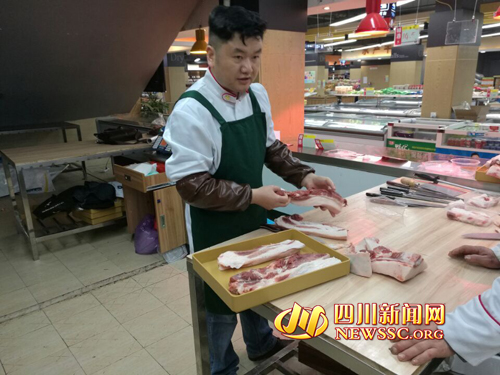
Eco-friendly pork hits the market
Over the past three years, through the "company + professional cooperative + family farm" production model, Wang Bo has helped more than 300 households and over 900 people in Jinping Township, Jiange County, Guangyuan City escape poverty through pig farming. At present, he has driven development in multiple townships across the county.
Free-range mountain pigs are growing well
Wang Bo told this writer: "In the early days of starting the business I encountered many difficulties - my family was opposed, my friends were doubtful, my fellow villagers did not trust me, and I was short of funds. I put in all the more than 8 million I had saved up before, and even mortgaged the house I lived in. At my poorest, I had only a dozen or so yuan in my pocket, and when I caught a cold I could not bear to spend money on medicine... Now I have opened up the consumer market, I have added four more stores, and I also supply pork to hotels, restaurants and canteens, earning a very good reputation, with pork in short supply. But making money was not my original intention. My original intention was to set my fellow villagers on the road out of poverty and to prosperity, and to let consumers eat pork they can trust!"
A chance experience creates a bond with pigs
Wang Bo was born in rural Jiange. After finishing the first year of high school he dropped out to go into business, successively running a small stall, working as a chef, doing decoration work, and later contracting engineering projects, saving up quite a lot of money. His success made his father regard him with new respect, and the villagers in his village also took him as a role model, calling him "young and capable, a promising boy," the pride of the whole village.
But a chance experience turned Wang Bo into a pig herder and a "pig boss." One summer in 2012, he and several friends went on an outing to Jinping Township, Jiange County. They went to an elderly woman's home to ask for water and learned that traditional rural pig farming has a long growth cycle and is not profitable, sometimes even losing money. Because transportation was backward, they could only wait for a boss to come to the door to collect pigs, and the price was often driven very low. The elderly woman's words shook him deeply and kept swirling in his mind, pressing on his heart like a big stone. "I want to help my fellow villagers raise pigs and lift them out of poverty and to prosperity," he secretly made up his mind. When he went home and told his family, unexpectedly the whole family firmly opposed it, especially his father, who said he was "making a pointless fuss," and was so angry he fell ill. His wife did not support him either, and even his younger brother, who was usually closest to him, came out against it. With no other option, Wang Bo had to go discuss it with his best friend. His friends were first very surprised, then expressed opposition, and later even jokingly gave him the nickname "Pig Boss," saying he was foolish - a respectable construction boss choosing not to be one, and instead going off to raise pigs, and besides, different trades are worlds apart, and pigs are not easy to raise.
Determined to become a pig herder
Although he could not get the support of relatives and friends, it could not shake Wang Bo's determination to raise pigs. The trendy boss was resolved to become a pig herder. He began reading books and gathering pig-raising information online. Sichuan Province is a major pig-exporting province, and Jiange County is an agricultural county and also a nationally designated poverty-stricken county. If he raised pigs in the traditional model there would certainly be no future in it, and the pig breed would also have to be changed. He needed to introduce a breed suitable for local raising, liked by consumers, and with good economic returns that could help fellow villagers escape poverty and become prosperous. In the end he chose this kind of black pig, but it is not an ordinary black pig - it is called the Sichuan-Tibet black pig (also known as the "Shu-Zhou Kelang" pig). The Sichuan-Tibet black pig is an excellent breed with delicious meat. After choosing the breed, Wang Bo immediately set out to visit the villagers' homes to promote it, but as soon as the villagers heard they were to raise black pigs, they shook their heads like rattles: "No, no, who would buy black pigs these days?" "The older generation used to raise black pigs - black pigs have thick fat, lots of lard, and don't taste good." Wang Bo hurried to explain: "My black pigs are a breed introduced from Germany, not native black pigs, and different from the black pigs you raised before..." The villagers were still unwilling: "No matter which country your black pigs come from, what if they can't be sold?" Wang Bo hurried to guarantee: "I'll give you the piglets to raise, and when they're grown into fat pigs I'll buy them back." Then Captain Wang spoke up: "Look at you in your suit and leather shoes - you don't look like a pig farmer at all. If you lose money and run off, who will the villagers collect their money from?" The villagers discussed it back and forth, none of them believing the black pigs he brought could make money. It seemed that to gain the villagers' trust, he would also have to get the government's support, Wang Bo reasoned.
Government support in the battle against poverty
Wang Bo ran to the township government and carefully laid out for the leaders his idea of driving fellow villagers to raise pigs and become prosperous. He immediately won the recognition of the township leaders, who felt they had met him too late. Together with Wang Bo they discussed the breeding model, sales channels and so on, and the township leaders even personally led village officials and Wang Bo from door to door to work on the villagers, secure guarantees, and sign contracts.
The production model Wang Bo chose for pig farming is "company + professional cooperative + family farm." Put simply, Wang Bo gives the piglets and sows to the villagers to raise on credit, not taking a single cent. When the sows give birth to piglets and the piglets grow into fat pigs, and Wang Bo's company buys back the piglets and fat pigs at the price set in the contract, the cost of the piglets and sows is then deducted. During the raising process, Wang Bo's company is responsible for technical guidance and supervision, and must ensure original ecological raising, feeding on rice bran, wheat bran and the like. The pig pens are built with poverty-alleviation funds applied for by the township government, and the ordinary people do not need to pay. In addition, with the support of the township government, Wang Bo established the Jiange County Shenghong Livestock Breeding Professional Cooperative in Jinping Township. Farming households join the cooperative as shareholders, acting as both bosses and employees, and the villagers are highly enthusiastic. The cooperative has a special guarantee fund, jointly supervised by the township government, Wang Bo's company and the members. If a member's black pig falls ill or dies, this guarantee fund makes up the member's loss, letting the villagers farm with zero risk and ensuring the villagers' vital interests.
Tasting the sweetness, villagers give a thumbs-up
Captain Wang, who once sang a different tune: "To be honest, the first time I saw that boss I didn't believe at all that he could raise pigs. How could such a trendy boss be willing to come to the countryside to raise pigs - it's dirty and tiring. But now I'm convinced. Before, my wife and I raised three or four pigs a year at home and didn't make much money, just barely getting by, because we were too old to go out to work. I joined the cooperative in 2013, and have raised foreign black pigs for two years (the villagers habitually call the pigs imported from Germany 'foreign black pigs'), earning 150,000 to 160,000 a year." At this point Captain Wang looked very mysterious, yet could hardly hide his joy. "This year I plan to expand the pig pens and raise one hundred foreign black pigs. My son and daughter-in-law are both not going out to work anymore - raising pigs at home is much better than working outside. Now I am a loyal supporter of 'Boss Zhu.'" You could tell that this time, when Captain Wang called him "Pig Boss," it was with a tone of admiration and gratitude.
According to the person in charge of the township: "Wang Bo has found us a path out of poverty and to prosperity. This new production-and-sales model fits our township's development model very well. Before, the whole township produced only just over 1,000 pigs a year; now a single village produces more than 6,000 pigs a year, rising from last place in the whole county to third from the top, and we have repeatedly received the county leaders' recognition and praise."