Tsinghua graduate returns to his hometown to start ecological agriculture, greatly increasing villagers' income
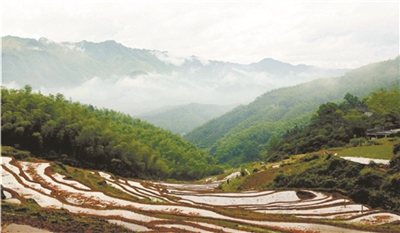
Qili Township is located in the northwest of Quzhou city proper. It is a purely mountainous township with high mountains and deep valleys. Ten years ago, it was still the poorest township in Kecheng District, Quzhou. Agricultural input was high and output was low, and most villagers' income depended on working away from home. In recent years, the area has vigorously developed high-mountain organic vegetables, forming a 10-kilometer green vegetable corridor from Huangtuling Village to Yuntou Village. The township's vegetable planting area has reached 2,000 mu, with an output value of more than 24 million yuan. Farmhouse inns and high-end homestays have also been built. Once summer arrives, the farmhouse inns throughout Qili Township are almost fully booked every day.
A Tsinghua graduate returns to his hometown to do ecological agriculture
Adopting the latest international model
Several consecutive days of spring rain have added a bit more chill to this mountainous Qili Township, yet a farmers' market here is bustling with activity: 20 native eggs, 10 wild eggs and 10 silkie eggs are neatly arranged and packed into foam boxes, then placed into paper boxes, tied with colored ribbons, loaded onto trucks, and sent to family kitchens in major cities such as Hangzhou, Shanghai and Nanjing.
"These eggs are all naturally raised in the mountains, and sell for 198 yuan per box." Xianyu Wenhua, chairman of Quzhou Nongben Agricultural Development Co., Ltd., told reporters that all sales are completed through WeChat. Since launching on November 1 last year, more than 6,000 orders had been sold by the end of November, with revenue exceeding 1.1 million yuan. "We hope to maximize the value for farmers and customers, and work hard for humanity's ecological and healthy dining table."
Xianyu Wenhua, 36 this year, is a Chinese of Korean descent who graduated from Tsinghua University with a bachelor's degree and a master's degree. In 2012, he returned to Quzhou, Zhejiang, where his ancestral home is located, and began exploring the path of ecological agriculture. This year, he formally established Quzhou Nongben Agricultural Development Co., Ltd. He implemented the latest internationally popular CSA+ model, that is, an upgraded version of Community Supported Agriculture (CSA), delivering fresh fruits and vegetables grown deep in the mountains to private kitchens in the city in the most timely manner.
Farmers study regularly
Planting knowledge and packaging and sales skills
Driving from Quzhou to the vegetable corridor in Datou Village of Qili Township at an altitude of more than 600 m, as far as the eye can see, there are stretches of eggplants and rows of baby bok choy, cabbage and so on. In the pattering rain, they are growing vigorously and delightfully.
"On average, these vegetables of ours can sell for 20 yuan per jin. This baby bok choy, for example, sells for as much as 100 yuan per jin." Speaking of the changes after joining "Nongben," villager Wang Mingli could not stop smiling. There are more types of vegetables being planted, the planting techniques have become more advanced, and income has also increased quite a bit. "Before, when I planted on my own, even at the best of times my income was less than 50,000 yuan. Now, with only 3 mu of land, the annual rent alone is 60,000 yuan."
Purchasing farmers' products at a guaranteed price of 3 to 5 times the market price, then converting that into an annual rent of 20,000 yuan per mu of land paid to farmers in one lump sum, and incorporating farmers together with the land into the company as a "package," truly transforming "status farmers" into "professional farmers" - this has always been the direction Xianyu Wenhua strives for.
In order to achieve this goal, the first thing Xianyu Wenhua did after founding the company was to open a business school, so that every farmer under the company could regularly come to learn planting-related knowledge, packaging and sales skills, and so on. At the same time, he also integrated traditional Chinese studies education into it to improve farmers' humanistic cultivation.
"At the end of the year, we will award a car to the most outstanding farmer." Xianyu Wenhua told reporters that "Nongben" will also launch pension and housing fund plans for farmers, enabling farmers to buy homes in the city, commute by shuttle bus, and, like urban employees, receive fair returns for their work and have support in old age. "In the future, we will lead 50,000 farmers into a new era of wealth creation and innovation, truly breaking the urban-rural dual structure."
Farmhouse inns in Qili Township
Beds are often "hard to find"
Another weekend, more than 20 families from all over the country, 50 people in total, came as a group to Qili Township. Listening to springs by the stream stones, viewing waterfalls at Xiangxi, seeing the flying wonder stone... in this heavenly scenery, they picked fresh fruits and vegetables on site, enjoyed an authentic local farm meal, and then personally experienced various folk activities such as grinding soy milk, pounding rice cakes, seesaws and swinging. At night, they stayed in homestays, attended bonfire parties, and felt the rare tranquility and peace not found in the city.
It is hard for them to imagine that just over ten years ago, this was still the poorest township in Kecheng District, Quzhou. In Huangtuling Village, which has the most tourists, because of the large amount of pollution brought by the traditional handmade paper industry, the village stream was a "Yellow River" all year round, and people could not even wash their hands in it.
In 2005, Huangtuling made up its mind to shut down all paper mills, restored clear water sources, and opened the first batch of farmhouse inn businesses. Eleven years later, relying on its excellent natural environment and well-run farmhouse inns, the area has become a national 4A-level scenic spot featuring "microclimate, original ecology, farmhouses and high-mountain vegetables." "Kecheng Qili" has also become a well-known rural tourism attraction near and far.
Villagers told reporters that today, there are already more than 100 farmhouse inn operators throughout Qili Township, scattered like stars along the Shiqi Highway. In the summer vacation season, all more than 2,200 farmhouse inn beds in Qili Township are fully booked every day, and a room is hard to find.
Transformation and upgrading ease environmental pressure
Make beautiful villages more attractive
In order to help improve the service quality of farmhouse inns, farmers operating them have also joined the Kecheng District Farmhouse Inn Association one after another. Association president Cai Jianhua told reporters that in response to some problems existing in farmhouse inns, the association conducts targeted training every year and invites professionally matched teachers to offer courses such as cooking and etiquette.
"Training must be conducted every year, otherwise our service will fall behind." Cai Jianhua said.
In addition, in response to the current bottleneck that Qili's farmhouse inns are generally of a low grade, the Qili Township government also plans to build a mid-to-high-end homestay, "Qili Yunshe," to lead villagers in transformation.
"The current situation is somewhat similar to that in 2005. Just like when we first started farmhouse inns, we want to use this project to give them a demonstration and leading role. Later, when they see there is a market, they may spontaneously follow suit and develop the entire industry into the mid-to-high-end range." said Xu Zhenyu, head of Qili Township.
It is understood that the entire "Qili Yunshe" project is divided into three phases. The first-phase tourist distribution plaza was completed in September last year and has already been put into use. In Qili Township's plan, the local government will first build the infrastructure well, and then make the project truly land through investment promotion.
"We hope that in the end we can build small wooden cabins in the moso bamboo forest, somewhat similar to the style of Hainan's 'Bird's Nest' homestays. Let Qili's farmhouse inns achieve transformation and upgrading." Speaking of future plans, Xu Zhenyu was full of confidence. In his eyes, Qili's beautiful transformation is still continuing.