Chu Yuefeng of Yuexi, Anqing: Even Small Walnuts Can Grow a Spring
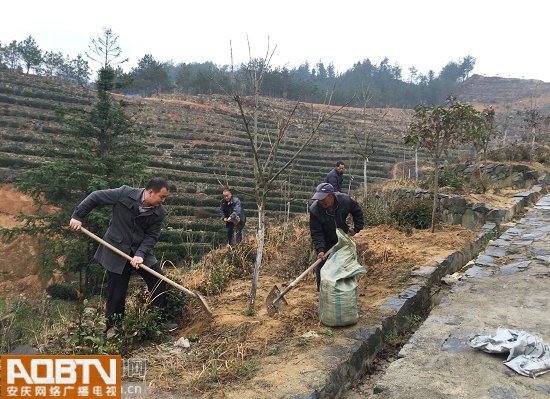
The photo shows Chu Yuefeng (left) busy working together with his fellow villagers.
From the prosperity of a first-tier city to the poverty of a grassroots village; from a mid-level manager at an international company to a striver who returned home to start his own business... Chu Yuefeng, a young man born in the 1980s from Zhongguan Township, Yuexi County, in our city, has poured tremendous hardship and sweat into the "walnut dream" in his heart.
"Fortunately, I have always kept holding on to my dream, and every step of effort has been seen by others." Chu Yuefeng said that he dares to use the confidence of "following one road to the very end" to exchange for a bright future for himself and his fellow villagers.
Going South to Work and Smoothly Making Money
Chu Yuefeng, born in 1981, lives in a small village called Doushui Village. In 1999, he was admitted to Yuexi Normal School, but because of poor family conditions, Chu Yuefeng could only choose to drop out. In 2000, he went alone to Beijing to work at a hotel. However, the outside world was not as smooth as he had imagined, so he chose to return home and resume his studies.
"In 2002, I went south with the villagers to Shenzhen. At the talent market, my resume was noticed by the production department of the IBM Group." On March 28, Chu Yuefeng said that the recruiter was attracted by his "rich" experience. After multiple rounds of tests, the sincere Chu Yuefeng formally entered the production department and became a mid-level office manager.
Although the work pace was fast and the pressure was great, the knowledge and skills he learned benefited Chu Yuefeng for life. In 2004, the company was acquired and became a large enterprise group with diversified development in the information industry. By this time, Chu Yuefeng was already a key business backer in the company, his career was thriving, and he was deeply appreciated by his leaders, which also allowed him to smoothly earn his first pot of gold.
In the eyes of his family, relatives and friends, Chu Yuefeng had a very good job and a generous income, which made people envious. But no matter how prosperous the city was or how high the salary was, his heart remained like drifting duckweed. In 2009, after much thought, Chu Yuefeng resigned from his job and went to Hangzhou to jointly establish an advertising company with relatives. At this point, his entrepreneurial path was officially laid out.
Harboring a Dream and Returning Home to Start a Business
"At that time, the market for advertising companies was very tight." Chu Yuefeng said that he soon established business connections with universities around Hangzhou. Although he was running advertising business, he always had an idea in his mind. "My hometown has such good mountain and water resources. I must find a good project to start a business back home, so that farmers can not only find employment at their doorstep but also become prosperous." Chu Yuefeng said.
In 2013, an opportunity formally connected Chu Yuefeng with hickory walnuts. In a conversation with Huang Jianqin, dean of the School of Forestry and Biotechnology at Zhejiang Agricultural University, he truthfully told him about his idea of returning home to start a business. Huang Jianqin was moved by him and immediately suggested that he grow thin-shell hickory walnuts, and recommended that he visit Yinkeng Village in Lin'an, Zhejiang, the famous "No. 1 Hickory Walnut Village."
With a blank mind, he came to Yinkeng Village in Zhejiang. Seeing that hickory walnut trees were all around the houses in Yinkeng Village, and that patches upon patches of walnut trees stretched out, Chu Yuefeng was suddenly astonished. "To understand the real situation, I randomly found a household at the time and asked about the income from growing walnuts. The villagers there told me that each walnut tree could bear 50 kg of fruit, could sell for 3,000 yuan, and that the average annual income per household in the village was above 300,000 yuan. I was extremely excited at the time and made up my mind to grow hickory walnuts." Chu Yuefeng said.
After 20 days of investigation, Chu Yuefeng returned home with more than 2 million yuan in savings and his ideals. First, he selected a piece of flat land and began preparing the soil. After soil sampling and analysis and market research, it was finally tested that thin-shell hickory walnuts could be grown. "This variety has strong environmental adaptability, and also has a high oil yield, good taste, and broad market prospects." Chu Yuefeng said. "The thin-shell hickory walnuts planted can bear fruit in 3 years and enter the full-production period in 7 years. Once they enter the fruiting period, the early costs can be recovered. After entering the full-production period, the yield per tree is 20 to 50 kg, and the output value per mu will be more than 20,000 yuan." Chu Yuefeng confidently calculated the benefit account.
At the end of 2014, Chu Yuefeng registered and established a local ecological agriculture and forestry enterprise, transferred 300 mu of barren hills in Zhaoling Group of Doushui Village, and planted thin-shell hickory walnuts. The township and village also strongly supported Chu Yuefeng's return home to start a business, integrating agricultural-related funds such as the village-level livelihood project "one matter, one discussion" to help improve the infrastructure in the base, including water, electricity and roads. The full support and expectations from all sectors of society gave Chu Yuefeng great motivation and confidence in the early stage of entrepreneurship.
Expanding Scale and Leading Villagers to Prosperity
In the early stage of entrepreneurship, Chu Yuefeng knew well that going it alone would definitely not work. To make the industry bigger, it was necessary to innovate the development model and drive the surrounding people to plant together. In order to encourage farmers to plant, Chu Yuefeng not only provided seedlings and technology for free, but also gave a subsidy of 5 yuan for each thin-shell hickory walnut tree planted by a farmer. "Growing hickory walnuts can not only increase the people's income and lift poor people out of poverty, but also increase the village collective economy. After entering the full-production period, the village collective economy can increase by 300,000 yuan. At the same time, the root system of hickory walnuts reaches 8 meters long, and the ecological benefits it produces are even more precious than the economic benefits." Chu Yuefeng persuaded the villagers.
In order to let the villagers see his determination to start a business, Chu Yuefeng promised to provide seedlings and technology free of charge for the first three years. Farmers only needed to use their own mountain land and land as shares, did not need to invest a single cent of funds, and could instead earn labor subsidies. The fruiting benefits would be divided according to proportion, which gave the farmers reassurance and also greatly increased the enthusiasm of every household for planting hickory walnuts. At present, Doushui Village has established a 1,300-mu thin-shell hickory walnut base, including a 300-mu company demonstration base, with a total of 28,000 hickory walnut trees planted, involving 258 surrounding farming households, averaging 3 to 5 mu per household, achieving an annual income increase of 2,000 yuan.
"At present, Doushui Village has taken the planting and development of thin-shell hickory walnuts as an important way to promote poverty alleviation and development and lead the people out of poverty toward prosperity, forming a multi-party cooperative and win-win development model of 'company + base + farmers + village committee + technical college.' A total of 91 poor households in the village participate in planting, and relying on this industry, 30% of the poverty alleviation task can be completed this year. Next, the village will also expand cooperation with the company and plan to plant 5,000 mu of thin-shell hickory walnuts." Chu Delin, secretary of the Party branch of Doushui Village, told the reporter.
Chu Yuefeng said that the next step will be to register a hickory walnut trademark, build a walnut processing factory, explore farming culture, and develop a picking and sightseeing garden at the hickory walnut base, so that tourists can enjoy a rural tour integrating agricultural sightseeing and picking. "Entrepreneurship ignited my passion and also made me complete my enterprise planning, filling me with drive and strength from head to toe." Chu Yuefeng said with an honest smile.