Hunan migrant worker returns home to farm, breaks 2,000 mu to become "Grain-Growing Champion"
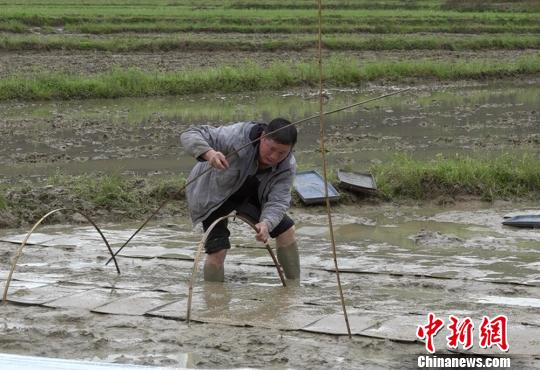
As the state successively rolls out preferential agricultural policies such as grain farmer subsidies and support for migrant workers returning home to start businesses, more and more farmers who worked away from home have returned to their hometowns to take up farming again in recent years. Luo Yuanbo, a villager from Sanhe Village, Huatang Town, Beihu District, Chenzhou, Hunan, is one of them. From returning home in 2009 to start farming as an entrepreneur until now, the scale of the land he has contracted has reached 2,050 mu, making him a "Grain-Growing Champion" known to everyone locally.
On April 9, in a field contracted by Luo Yuanbo, the reporter saw him working with more than 10 farmers in the rain, rushing to sow rice seeds and plow the farmland. Luo Yuanbo said that this field, located in the hills, was exactly the 168 mu of farmland he first contracted back then.
January 8, 2009 was an unusual day for Luo Yuanbo. That evening, all the villagers of Group 6 of Sanhe Village gathered together to discuss the matter of land transfer. The villagers were frowning over a piece of land far from the village that had been abandoned for many years, and offered terms of "seven years rent-free, with preferential renewal upon expiry."
"Because there are no irrigation canals or tractor roads, none of us were willing to farm this land, and I felt it was a great pity." Luo Yuanbo, who had worked away from home for 15 years, discussed it with his wife and decided to grit his teeth and tackle this "hard bone." Group 7 next door, seeing Luo Yuanbo's great determination, also contracted a piece of land in similar condition to him on the same terms.
Facing these 168 mu of wasteland, Luo Yuanbo and his wife took out their savings and bought a walking tractor, working from dawn to dusk to level and plow the land. After more than two months of hard work, just as they had finished plowing and harrowing the rice fields, it was immediately time to sow and transplant rice seedlings. Looking at the large expanse of land still to be farmed, Luo Yuanbo panicked: "What should I do if I don't have the money to hire people to transplant rice seedlings?"
When the local agricultural department learned of the situation, it helped him buy a rice transplanter through financial subsidies at all levels in accordance with policy provisions. With the rice transplanter, Luo Yuanbo's sowing efficiency greatly improved. During the busy double-harvest season, the agricultural department again took the initiative to contact him and supported him in buying a harvester. In less than half a month, all 168 mu of rice had been harvested, and the grain harvested reached 120,000 jin. Adding the income from using the farm machinery in idle time to help other villagers transplant rice seedlings and harvest, he earned nearly 200,000 yuan in the first year.
After tasting the sweetness of mechanization, Luo Yuanbo successively added more machinery such as rice transplanters, harvesters and tractors. To cope with the problem of spraying pesticides after the contracted land area became larger and larger, he also bought a drone, achieving full mechanization throughout the grain-growing process.
This year, Luo Yuanbo's grain-growing "territory" continued to expand, reaching 2,050 mu, and the crops planted also changed from a single crop of rice to vegetables, rapeseed and tobacco, among others. He brought in 4 shareholders to build a tractor road, and with the help of the local government also improved the water conservancy facilities. Now, together with nearly 100 hired villagers, he is working from dawn to dusk plowing and sowing.
"With the support of policies and the government, next year I will continue to expand the scale of my contracting and lead more villagers to prosperity!" Luo Yuanbo is full of confidence about the future.