Loach farming sets Sun Xuelin of Qionglai, Sichuan on the road to prosperity
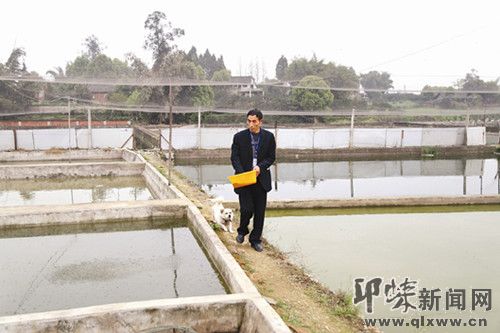
Loach is rich in protein and is known as the "water ginseng." Taiwan loach, with its short cycle and high profit, has become a farming hotspot in the past two or three years, and driven by market demand, since the second half of 2013 breeding farms for Taiwan loach fry have sprung up like bamboo shoots after rain. Sun Xuelin, head of the Mushulin Farm in Muli Town, is one of them.
"I'm still young, I don't want to become a 'useless person.' I want to make my farming base bigger and stronger and drive the surrounding aquaculture farmers to improve their economic returns." Although over 50, Sun Xuelin still keeps a young mindset. He told reporters that his favorite thing to watch is the entrepreneurship programs on CCTV Channel 7 and the finance channel. Seeing people older than himself also striving hard and succeeding in business deeply encouraged him, and in early 2013 he invested hundreds of thousands of yuan to build a breeding and farming base of more than 40 mu at the Huabei Reservoir in Muli Town.
Learning to "recharge" and keep pace with the times
On March 29, the reporter came to Mushulin Farm and saw a large expanse of water divided into several small ponds, with loaches happily tumbling and foraging in the water, and anti-theft nets set up overhead to prevent egrets and other water birds from stealing the loaches. "The inlet and outlet of the pond must be fitted with escape-prevention nets to stop the loaches from escaping or wild fish from entering the pond. A fish pit should be set up in the pond to make catching easier and to give the loaches a place to escape the heat in the hot season..." When it came to the tricks of loach farming, Sun Xuelin talked on and on.
Sun Xuelin said that in addition to conventional pond farming, Taiwan loach can also be farmed indoors, in cages, in rice paddies, and in aquatic-animal-plant symbiosis and other farming models. Among them, the rice-paddy farming crop-livestock cycle model is especially worth promoting: the loaches fully take in feed and weeds in the water, reducing farming costs, and their excrement can serve as fertilizer for the rice. In addition, the loaches' activity can help loosen the soil for the rice and promote rice root growth. Farming loach in rice paddies saves water and land, and while increasing farmers' economic income it also plays a role in environmental protection.
In 2015, Sun Xuelin took part in new-type professional farmer training in Qionglai and Wenjiang successively, and obtained a preliminary qualification certificate. "I never thought I could still go to school at this age. I feel very lucky." Sun Xuelin said with emotion that the training broadened his horizons and expanded his thinking, and he learned knowledge about business management and identifying the authenticity of agricultural products, which benefited him greatly. He was especially impressed by the lecture on Internet Plus agricultural products. After the training ended, he immediately bought a smartphone, downloaded WeChat, and set up a WeChat group with his classmates so everyone could exchange technical and market information. He said agricultural projects must also rely on the power of science and technology, and only through constant innovation can they develop and grow. This year he wants to apply for the intermediate professional farmer training, so that he can become a high-quality new-type professional farmer who understands technology, is good at business, and knows how to manage.
Determined to return home and start a business
The first half of Sun Xuelin's life could be called a "drama." In the 1990s, he was a large-scale specialized pig farmer, then went into business, selling motorcycles, running a processing factory, and so on, gradually accumulating wealth and nearly becoming a millionaire. But later, due to an addiction to gambling, within a few years Sun Xuelin not only lost all the family's savings but also owed more than 300,000 yuan.
With a daughter to raise and debts to repay, Sun Xuelin "turned back from his wayward ways" and decided to go to Tibet to work. During his days in that foreign place, he worked hard to earn money, and in 2009 Sun Xuelin returned to his hometown, paid off his debts, bought an apartment, and his daughter had also graduated and started working.
"I was free, and had time to do what I wanted to do. Later, I took a fancy to loach farming." In the days that followed, Sun Xuelin and his wife went to Longchang County to start his "loach business." Through constant practice and summarization, Sun Xuelin's farming techniques advanced by leaps and bounds, and the farm also achieved good economic returns.
In 2013, he had the idea of returning home to start a business, but his family opposed it: "You're already in your fifties, why go back and endure that hardship? Your health matters most!"
However, Sun Xuelin was very stubborn: he was only in his fifties, and he still had to do something, after all. And developing an agricultural industry back in his hometown would bring both good returns and help the villagers who wanted to increase their income, so why not do it?
So he founded Mushulin Family Farm in Muli Town, engaged in loach farming and farming technology development, and the breeding, cultivation, and sales of loach fry as well as farming technology guidance services.
"Taiwan loach is an artificially selected breed. Compared with local loach, it has strong immunity, a short growth cycle, a large size, does not burrow into the mud, has tender meat, and has high medicinal value." When it came to loach, Sun Xuelin could talk about it as if counting his family treasures. He told the reporter that local loach takes about a year from fry (seedlings) to commercial size (20 grams each), while Taiwan loach needs only three or four months, which means two batches can be farmed each year. After fully investigating market demand, in 2014 he spent a large sum to introduce Taiwan loach and carry out his breeding and farming business.
Not afraid of difficulties, opening up the market
To expand the business, relying on oneself alone definitely would not work. This was Sun Xuelin's insight from starting his business. So getting the surrounding farmers to accept Taiwan loach became an important task for him. In the days that followed, Sun Xuelin and his wife spent more than three months traveling to aquaculture farmers throughout Qionglai and Xijin, Pujiang and other places, learning about the varieties and growth characteristics of local loach farming while promoting his new variety.
Of course, sales require "strategy." Facing the farmers' concerns, Sun Xuelin promised: if farming Taiwan loach resulted in a loss, he would give the second batch of fry for free. "I have confidence in my own variety." Sun Xuelin said that to boost farmers' enthusiasm, he provided customers with free services such as farming technology and scientific management. Having farmed loach for many years, he had gotten to know many loach farmers and buyers, and through these friends he could keep abreast of market trends at any time and regularly provide customers with market price information and introduce buyers.
At the end of last year, Gao Tianli, a farmer in Qianjin Town, farmed more than 3 mu of Taiwan loach, and with Sun Xuelin's guidance and help, enjoyed a bumper harvest, catching the good prices around Spring Festival and making a net profit of more than 60,000 yuan. In March this year, Gao Tianli pre-ordered another 2 million fry.
After trial farming, the customers were all very satisfied. In 2015 Mushulin sold 80 million loach fry and 30 million sized fry, and has now developed the capacity to hatch more than 300 million loach fry per year.
Feeding the loach morning and evening every day, running around for sales, taking one step at a time, his business developing amid the busyness, Sun Xuelin is very happy and feels all his efforts are worthwhile. Speaking of the difficulties in starting a business, Sun Xuelin laughed them off. "Only if you are not frightened by difficulties can you overcome them. As long as you hold this mindset, no difficulty counts as a difficulty."