White-collar worker returns home to raise black goats, annual output value reaches 1.24 million yuan
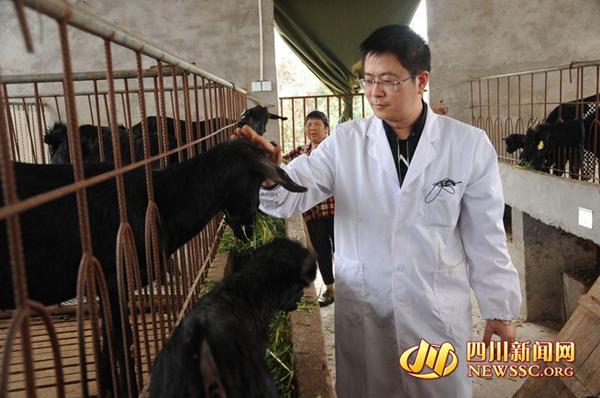
Deng Ling feeds grass to the goats
"They're really bustling over there." When talk turns to the breeding base of "Goat Boss" Deng Ling, the villagers of Sanqinggou Village in Haitan Township, Peng'an County give a thumbs-up.
Here, the once-barren little hills have taken on a new look, with waves of green rippling across plots of ryegrass. In the distance, the goat sheds gleam in the somewhat scorching sun, with occasional bleats of "baa baa" drifting out. Stepping into the farm, workers are busy at their respective posts.
Last year, Deng Ling's breeding base sent 830 commercial meat goats to market, achieving an output value of 1.24 million yuan and helping 17 nearby farming households get rich by raising goats. Recently, a reporter from Sichuan News Network walked into Haitan Township to see what enabled Deng Ling and his wife to capture the mutton market, and how they are driving local farmers to prosperity.
Breeding pure black goats, scientific feeding by stages
On April 13, stepping into the goat shed run by Deng Ling, a uniform row of black goats rose to their feet from the pens all at once, tall and sturdy, stretching their necks, lining up in two rows in front of the feed troughs and gazing at the workers coming to feed them.
"These goats are all purebred Chuanzhong black goats." Stroking these lively "treasures," Deng Ling explained that these goats were introduced from the Lezhi original breeding farm. Compared with local yellow goats and yellow-hemp goats, they are larger in build and have very strong reproductive capacity. After 18 years of selective breeding, this breed can adapt to damp, rainy and windy living conditions, making it very suitable for raising in the northeastern Sichuan area.
As a base for developing breeding and raising, on the basis of promoting Chuanzhong black goats, they place particular emphasis on the purity of the goats' bloodlines and constantly cull old breeding goats; pure bloodlines naturally win favor in the market. At the same time, strictly following the local standards for black goat production, they have formulated and implemented their own scientific and standardized black goat feeding and management procedures, fully carrying out scientific feeding by stages, and conducting effective exploration and practice on topics such as breeding and selection of high-reproduction varieties, early weaning of lambs, and improved crossbreeding. At present, the black goats raised by Deng Ling have been rated as a provincial-level standardized demonstration farm for meat goat breeding and have passed pollution-free certification, which greatly improves the quality of the goats and also enhances market potential.
Capturing the supply-and-demand platform, implementing a "all-in, all-out" feeding model
"We have built a unique closed commissioned breeding model of 'company + base + farming households,' rapidly expanding the population scale of this advantageous Chuanzhong black goat line throughout the county to meet ever-rising market demand." Walking out of the base's breeding shed, Deng Ling introduced the company's business model to the reporter and took the reporter to the home of farming household Li Xingwen.
Arriving at Li Xingwen's farm, he was preparing fodder for the goats. The black goats in the pen all had glossy coats. Last year, after Deng Ling established the goat-raising association, he promoted farmers' participation in entrusted raising. On the day the association was founded, Li Xingwen looked at this new breed with its excellent growth and his eyes lit up at once. He simply entrusted more than 20 black goats to the base that very day. After a year of change, more than 20 extra goats had appeared in his pen, and the sweetness in his heart was written all over his face.
"Other than fattening the goats, I don't have to worry about anything at all." Speaking of the entrusted-raising model, Li Xingwen said that during this year, the company's technical director would visit from time to time to provide technical guidance. Not a single link was left out, from production, feeding, feed formulation, to issues needing attention. Now, he is about to become a "goat expert" himself.
Deng Ling explained that the company has established a closed breeding management and service mechanism, implementing an "all-in, all-out" feeding model, in which farming households advance part of the funds, use the lambs, feed, veterinary drugs and other supplies from Shilian Company, take charge of the feeding work, and finally deliver the grown goats to the company, receiving payment according to their breeding performance.
"This model can resolve one-sided supply-and-demand support, and at the same time drive the simultaneous development of surrounding large-scale farming households." Deng Ling said this model was proven last year. In one year, he drove 17 surrounding farming households to raise goats, among which 11 were large-scale farming households with an annual market volume of more than 100 goats.
Building standardized breeding sheds, precisely helping 17 farming households
Next to Deng Ling's breeding base there is also a completed standardized breeding shed. This spacious and bright goat shed was not built for him to expand his own scale, but was specially built as pens for the village's 17 precisely targeted poverty-alleviation households.
It is understood that Liping Village, crisscrossed by gullies, is a typical poverty-stricken village, and how to use industry to lift these poor households has long been a headache for village officials. Seeing this situation, Deng Ling and his wife took the initiative to coordinate with the village and signed a foster-raising goat contract with it.
"The original intention of returning home to start a business was also to drive the surrounding ordinary people to common prosperity. Now that these poor households need us, we must not shirk the duty." Regarding this responsibility, Deng Ling dares not be the least bit careless. He made it clear in the contract that the company is responsible for the production, management, epidemic prevention and sales of the foster-raised goats. Breeding and reproduction work shall be carried out according to standards and norms, complete and thorough production records, breeding records, sales records and death-and-culling records shall be kept for the goats involved in the contract, and each month tables of production conditions, cost and expense conditions, and income conditions shall be prepared and submitted to the relevant township and village Party and government personnel.
At the same time, the company stipulates that at the end of each year, after the year's foster-raised goats are sold, the net profit after deducting all costs shall be divided equally between the company and the village. After the village receives its allocated profit, it shall then uniformly forward it to all foster-raising households. At the same time, the company guarantees that the profit allocated to the poverty-stricken village each year cannot be less than 8% of Party A's actual total investment amount, thereby ensuring that each village household's annual income reaches about 3,000 yuan. The tangible dividends led Sanqinggou Village and Doutan Village to follow suit, actively expressing their intent to Shilian Agriculture and Animal Husbandry.
At two in the afternoon, it was time for the daily goat grazing, and Deng Ling and his wife reached their happiest moment again; their tense pace of life became relaxed and natural at this moment. The couple sat on the hilltop, watching the frolicking flock, and smiles rose at the corners of their mouths in unison.