Investing Ten Million to Start a "Happy Farm" and Give Back to His Hometown
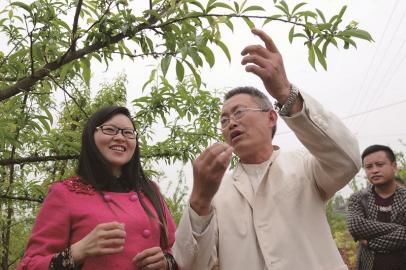
Wu Mingzhong explaining the growth of the fruit trees to those who have adopted them.
On April 19, in the "Happy Farm" of Wu Mingzhong, a migrant worker who returned to his hometown in Biyunsi Village, Tianjia Town, Dongxing District, Neijiang City, emerald-green plums already hung heavy on the branches. "Plum blossoms for half the year, plums to pick for half the year." This is Wu Mingzhong's dream, and also the direction he has been working toward for years, planting American cherry-red plums, cultivating a "Happy Orchard," and building a real-life version of "Happy Farm."
Returning Home in His Fifties to Build a Real-Life Version of "Happy Farm"
A few years ago, "Happy Farm" rose to popularity on the internet, loved by office workers, students and others, and sparked a craze of "planting and stealing vegetables." Now, in the Wujiaba American Cherry-Red Plum Base in Biyunsi Village, Tianjia Town, Dongxing District, Neijiang City, a real-life version of "Happy Farm" has begun to take shape.
It is hard to imagine that the trendy term "Happy Farm" would actually be connected to a migrant worker who returned home in his fifties.
His name is Wu Mingzhong, a native of Wujiaba in Biyunsi Village. He once went far from home with his family to make a living in Shanghai and other places, working there for 30 years. Later he started a factory, and the family was well-off and happy together.
Unexpectedly, in 2012, Wu Mingzhong made a startling move - giving up the factory that was already on track, leaving his family behind, and returning alone to his hometown of Biyunsi Village, transferring land to begin his entrepreneurial journey once again.
"In his fifties and still starting a business, what a hassle!" For a time, whether family members, relatives and friends, or hometown neighbors, all said they could not understand.
Even so, Wu Mingzhong returned to the native soil he had left for many years, and used his actions to explain the true driving force behind his return to start a business: "Before I went out to work, I was also a genuine farmer. At that time our family was the poorest in the village, and many neighbors around helped our family. A person cannot be heartless and ungrateful. This time I came back to give back to my hometown, and to help my fellow villagers get rich by developing an industry."
Investing Over Ten Million Yuan to Develop American Cherry-Red Plums
What industry is suitable for his hometown? What industry can help the villagers get rich? With 30 years of experience in the business world, Wu Mingzhong believed he had to achieve "what others don't have, I have; what others have, I do better."
By chance, Wu Mingzhong visited a friend's home and tasted American cherry-red plums, found them exceptionally sweet, crisp and fragrant, and immediately developed a strong interest. However, American cherry-red plums come from the other side of the ocean after all, and the climate and soil are different from those locally, so many villagers took a doubtful and wait-and-see attitude toward Wu Mingzhong's plan. Wu Mingzhong realized: "To make the villagers believe, I must be even more cautious." To that end, he made a special trip to the United States to study and investigate, and sent the soil from his hometown to relevant institutions in the United States for testing. At the same time, he invited American agricultural experts to come to his hometown to once again assess the climate, soil and other natural factors...
After receiving a positive answer, Wu Mingzhong carried out a series of preparatory work, and transferred 33.3 hectares of land at a rent of 12,000 yuan/year/hectare, developing more than 30,000 American cherry-red plum trees, involving Biyunsi Village in Tianjia Town and Longqiao Village in Liuqiao Town. Over several years, Wu Mingzhong has invested a cumulative total of more than ten million yuan in his "Happy Farm."
Company Purchasing + Tree Adoption to Open Up Sales Channels
This year, some of the plum trees in Wu Mingzhong's plum orchard have officially borne fruit, with an estimated yield of up to 100 kg per tree. By next year and the year after, most of the fruit trees will enter their full-production period, with an estimated yield of 150 to 200 kg per tree.
How to ensure a market for the cherry-red plums? Recently, the specialized cooperative founded by Wu Mingzhong has signed a purchase agreement with a company in Chengdu. When the cherry-red plums ripen, the company will purchase them all at a uniform price of 40 yuan/kg.
At the same time, from the currently popular "picking craze," Wu Mingzhong found a brand-new way to earn economic returns - adopting fruit trees. Under an adoption fee standard of 2,000 yuan to 5,000 yuan per fruit tree per year, the cooperative has established a new type of cooperative relationship with fruit tree adopters. During the adoption period, adopters not only enjoy the right to visit the fruit trees, the right to name them, the right to consultation, the right to returns, and the right to dispose of the fruit, but can also bring their children to the base to learn planting techniques, experience the joy of picking, and cultivate and train their children's hands-on and thinking abilities as well as work habits.
According to statistics, since the fruit tree adoption model was introduced on March 12, in addition to local adopters from Neijiang, adopters from Yibin, Zigong, Chengdu, Chongqing and other places have also come in droves after hearing about it. A teacher named Xie Daiqun told this writer that adopting fruit trees not only allows herself and her family to experience the joy of rural farming, but also allows her to often bring students to the orchard in the future, so that students living in the city can understand the whole process of fruit trees from pruning and fertilizing to branching out and spreading leaves, and then to flowering and fruiting.
Having a good market is still far from enough for Wu Mingzhong. "The existing cherry-red plums have only one season, ripening only at the end of June, which is too limited." Wu Mingzhong began to take active action, consulting many parties and planning. "I plan to introduce plum saplings that bear fruit in different seasons, so that within half a year, there will be plum blossoms every month and plums to pick every month."
Providing Saplings and Technology So Fellow Villagers Can Happily Earn Money
However, starting a business is not always smooth sailing, even for someone with Wu Mingzhong's rich entrepreneurial experience.
Since American cherry-red plums do not officially bear fruit until the fourth year, the first three years can be said to bring very little income. Add to that soil testing, land transfer, purchasing saplings, hiring workers and so on, and at least more than one million yuan had to be invested each year. Last year brought another flood disaster, with fish ponds submerged and fruit trees destroyed, causing very heavy losses, which left Wu Mingzhong short of funds several times. "Because I had no money to pay the workers their wages, at one point I did not even dare go home."
Fortunately, Wu Mingzhong's down-to-earth spirit moved many people around him, and everyone extended a helping hand to him. The local government also took the initiative to help him come up with plans, using land management rights as collateral to help him get loans, and gave support in building roads, constructing fish ponds and other aspects.
"The year before last and last year, some cherry-red plums already bore fruit, achieving a cumulative income of more than 1.5 million yuan." Wu Mingzhong said happily, "Judging by the situation, this year will be a bumper year, and the fresh fruit output of the plum orchard is expected to exceed 250,000 kg, achieving sales revenue of 5 million to 6 million yuan."
Seeing that growing American cherry-red plums had "potential," his family changed their attitude toward him, and the villagers also began to believe that growing American cherry-red plums had prospects, and one after another asked to join the cooperative. Wu Mingzhong, on the one hand, provided saplings to the villagers free of charge, and on the other hand actively cooperated with the Neijiang Academy of Agricultural Sciences, appointing experts to provide free technical support to the villagers. Wu Mingzhong said that in the next step, he will continue to work hard, adopting the model of "company + cooperative + scientific research institution + base + adopters + farmers," so that farmers can gain even greater returns.
At present, more than 50 villagers have come to work in the orchard. Wu Jinsen is one of them, earning a monthly wage of more than 2,000 yuan. "Although it is the same old line of work, it is easier than farming alone, and the key thing is that I earn cash, can take care of my family, and there is almost no risk," Wu Jinsen said.