Don't grow pumpkins, raise free-range chickens instead: understand the loquat tree and you can get rich
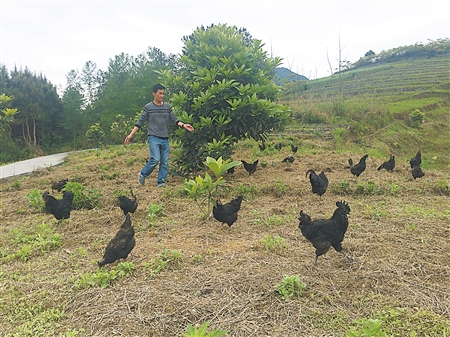
In Heixi Town, Qianjiang District, villager Zhou Qing raises free-range chickens in a loquat grove.
In late spring and early summer, in Gaige Village, Heixi Town, Qianjiang, this loquat orchard lets visitors pick loquats, and the fresh free-range chickens have become a delicacy tourists vie to taste. This is precisely the ecological loquat orchard the town introduced in recent years: the orchard gives the free-range chickens space to move around, and the chickens pecking for insects in the orchard in turn promotes the growth of the loquats, achieving a unified ecological cycle. This "under-forest economy" model also let 42-year-old villager Zhou Qing taste the sweet rewards, earning a full 200,000-odd yuan last year.
Growing both loquats and melons makes the land hard to manage
Yesterday, the reporter arrived at Group 2 of Gaige Village, Heixi Town, Qianjiang District, at the Fengfei White Sand Loquat Plantation run by Zhou Qing, which occupies most of a mountain in the hills. The loquats on the trees have already grown green fruit, and under the trees more than a thousand black silkie chickens run freely through the grove. Scattered among the woodland are three to five chicken coops in orderly arrangement, and here and there are quite a few "green-shell eggs" laid by the silkie chickens.
Yet 2 years ago, apart from loquats, what was intercropped in the orchard was pumpkins. "The spacing between each loquat tree is 1.5 m, and after planting loquats, a lot of the land sits idle; intercropping is a customary way to increase the per-mu yield of the land," Zhou Qing said. In 2011 he planted loquats on 200 mu of land in Gaige Village, and to increase the land's utilization rate, he began intercropping other crops in the gaps between the trees.
In the very first year after planting, problems appeared: "Pumpkins and loquat trees both absorb nutrients from the soil, and there were too many weeds, so neither grew well," Zhou Qing said. Not only that, both pumpkins and loquat trees bred certain pests and diseases, and the two affected each other, so in fact they grew poorly, and the soil was hard to nourish.
How to make the loquat trees grow well, keep land utilization high, and yet let the soil's nutrients recover - this truly stumped Zhou Qing.
Loquats plus free-range chickens raise the land's value by 100%
The turning point came in early 2012, when the Heixi Town government began promoting the "under-forest economy" to the village. The so-called "under-forest economy" refers to an ecological agriculture model that relies on forest land resources and the forest ecological environment, making full use of the under-forest land resources and the advantages of forest shade to engage in under-forest planting, breeding and other three-dimensional composite production and operation, so that agriculture, forestry and animal husbandry can achieve resource sharing, complementary advantages, cyclic mutual generation and coordinated development.
This new idea instantly solved Zhou Qing's problem.
"Yes, we should raise the natural enemy of grass and insects - chickens." Zhou Qing calculated that chickens eating insects can prevent pests and protect the grove, and their droppings can fertilize the forest land. The good natural ecological environment under the forest also benefits the chickens' growth, not only lowering costs and reducing disease, but also greatly enhancing the flavor of the free-range chickens.
Without delay, starting in 2012, Zhou Qing specially introduced 4,000 improved black-skinned chickens from Hubei and other places and began raising them free-range in the loquat grove. "Normally the chickens find insects to eat in the grove and also eat some weeds, and are supplemented with corn, soybean meal and so on, ensuring the quality of the free-range chickens, with no need to worry at all," Zhou Qing said. The natural weeds growing in the loquat orchard, and the raising of free-range chickens, dry ducks and other poultry, make it a "natural oxygen bar" for the poultry, with ventilation and cooling and little illness, which is very good for the poultry's growth. The poultry eat grass and insects, and their droppings fertilize the forest land, forming a benign biological cycle with the trees. Poultry products produced in the forest land sell well and fetch high prices, belonging to green, pollution-free poultry products.
Starting in 2014, after the loquat trees went through a 3-year seedling period, the loquats began to bear fruit, and the chicks had just grown up as well.
"On average, 50 loquat trees are planted per mu of land, and the average loquat yield per mu is 250 jin. Calculated at 20 yuan per jin, that comes to 5,000 yuan. One mu of loquat orchard can on average raise 25 free-range chickens, and at about 100 yuan per chicken, that's 2,500 yuan. Add the 'green-shell eggs' at 3 yuan each, which brings at least 3,000 yuan a year, and the two together come to more than 10,000 yuan in income," Zhou Qing said, equivalent to doubling the value of each mu of land.
Pick-your-own tours boom, earning 200,000 a year
Last May, the white sand loquats Zhou Qing grew ripened. With tender flesh and sweet, delicious taste, the loquats attracted the attention of nearby city residents, and a steady stream of people drove themselves to the loquat orchard to pick loquats.
"20,000 jin of loquats is nowhere near enough for picking; there's simply no need to sell them elsewhere," Zhou Qing said. The good quality of the loquats attracted large numbers of tourists to come pick them, and at 20 yuan per jin there was no worry about sales. Add the presence of the rural free-range chickens, and residents catching and buying chickens themselves made the picking tour all the more fun, with participation growing higher and higher.
In the past year alone, Zhou Qing achieved a profit of 200,000 yuan from loquats and free-range chickens. This year, Zhou Qing transferred nearly 800 mu of land to plant loquats, and led nearby poor households to jointly launch the under-forest economy model of loquats paired with free-range chickens, driving them toward prosperity.
This year, 48-year-old poor household member Liao Yuxian works in Zhou Qing's loquat orchard learning loquat-growing experience on the one hand, and on the other has planted 10 mu of loquats herself and raises more than 300 chickens free-range, and has begun joining Zhou Qing's loquat-growing cooperative. It is expected that after 3 years, the returns from loquats and free-range chickens will bring her 50,000 yuan in income each year.
The under-forest economy makes the land greener and the people richer
Li Song, chairman of the Heixi Town People's Congress, told the reporter that the under-forest economy requires little investment, shows results quickly, is easy to operate and has great potential. "Developing the under-forest economy can make the land greener and farmers richer, with benefits on many sides," Li Song said. At present, the park also drives 51 surrounding farming households to grow loquats and raise free-range chickens, among them 7 poor households, and all planting has been completed this winter. By the end of this year, a planting scale of 1,000 mu is expected to be achieved, with the number of free-range chickens and dry ducks raised reaching more than 8,000 birds. By then, the pick-your-own tours will be able to sell loquats and free-range chickens without leaving the farm, with profits reaching 300,000 yuan.