Using Trichogramma to control rice pests: an old folk method holds great wisdom
Original title: Trichogramma "flies" into the rice fields
-- Natural enemies controlling pests explores a new path for improving the quality of Hunan grain
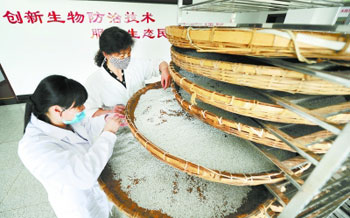
At the Hunan Natural Enemy Breeding Center, staff members are breeding Trichogramma. (File photo) Photo by Hunan Daily reporter Guo Liliang
In recent days, early rice transplanting in Hunan has entered its peak period. As the seedlings are transplanted into the fields, batches of Trichogramma are dispatched from the Hunan Natural Enemy Breeding Center and released into the rice fields to deal with stem borers, planthoppers and other major rice pests.
At the provincial Natural Enemy Breeding Center, staff members are busy tending to box after box of insect eggs, pupae and larvae. Zhou Gang, head of the center, told reporters: "This looks like silkworm rearing, but the purpose is different. What we are breeding is a natural enemy of pests -- Trichogramma, used to 'attack pests with insects,' which can reduce pesticide spraying and produce high-quality green rice."
On one hand, the province's rice stockpile has reached a historic high, and ordinary early indica rice is not circulating smoothly; on the other hand, high-grade green fragrant rice is in short supply and still requires large imports. Provincial rice expert Zhong Wuyun said that the tiny Trichogramma can improve the green quality of Hunan rice, and can be called a "supply-side reform" on the dining table.
Control principle: one thing subdues another
"Using natural enemies to control pests is actually very simple in principle -- it is the 'one thing subdues another' of the biological chain," Zhou Gang said. What we often call the eagle catching the snake, and the snake eating the mouse, are all the same principle.
However, in certain areas or certain periods in nature, the number of natural enemy insects is often in a state of "the enemy is many and we are few," and some even completely lack natural enemy insects, causing pests to run rampant and triggering ecological imbalance.
Five years ago, natural enemy pest control in Hunan was mainly used in forestry. In some scenic areas, when forests suffered pests and diseases, it was not suitable to spray pesticides, so forestry departments turned to using natural enemies to control pests. In 2011, the State Forestry Administration supported Hunan in establishing the Natural Enemy Breeding Center, with the Provincial Academy of Forestry undertaking its construction. At present, the center has domesticated and reared more than 10 natural enemy populations including Trichogramma, Sclerodermus, and ladybugs. Liu Yuejin, head of the Forest Pest Control Station of the Provincial Forestry Department, said that Zhangjiajie, Huangshan and other scenic areas have for several consecutive years brought in Trichogramma and Sclerodermus; these natural enemy insects reproduce on their own and have achieved a relatively good effect of sustained pest control, maintaining ecological balance.
In recent years, natural enemy pest control has been increasingly used in green agricultural production. With the improvement of living standards, people's concerns about agricultural products have shifted from "whether there are any" to "whether they are good," and the harm to health caused by chemical pesticide residues has increasingly aroused worry. Large growers, cooperatives and other new types of business entities have introduced Trichogramma and ladybugs for producing green rice and vegetables.
Trichogramma is the most common natural enemy in southern rice of pests such as the striped stem borer, the yellow stem borer, and the rice leaf roller. Zhou Guosheng, Party secretary of the Provincial Academy of Forestry, vividly explained that adult Trichogramma lay their eggs inside the eggs of pests such as the striped stem borer, and by absorbing the nutrients of the pest eggs they achieve parasitism, so that the pests will have "no descendants."
Breaking through the bottleneck: factory-style production
On April 13, in the culture room of the Provincial Natural Enemy Breeding Center, reporters saw densely packed tussah silkworm eggs attached to sheets of cardboard.
Technical expert Dr. Yan Xuewu introduced on site that in just 3 days, these eggs will hatch, but what emerges is no longer tussah silkworms, but rather Trichogramma that have already achieved "the magpie occupying the dove's nest" through artificial "inoculation." Inside each "inoculated" tussah silkworm egg, about 70 Trichogramma are waiting to emerge.
Yan Xuewu said that the ability of Trichogramma to control pests has long been well known in academic circles, and that ladybugs eating pests was once common knowledge in elementary school textbooks, but previously these natural enemies were rarely applied in practice through artificial intervention, mainly because factory-style production had not been achieved.
"Often, when pests have become a disaster and natural enemies are needed, the natural enemy insects cannot be produced in time or the quantity produced is insufficient; and when the natural enemy insects are produced, because their growth process cannot be controlled, they can only be left to develop on their own, unable to keep pace with the development of the pests, and ultimately losing the control effect."
Today, this problem has been overcome by the Provincial Natural Enemy Breeding Center. Yan Xuewu told reporters that after continuous research, the center's technologies for artificial breeding of Trichogramma and precise temperature-controlled incubation have reached the domestic first-class level, and it has successfully developed China's first automatic packaging machine for Trichogramma parasitic eggs, enabling "mass, year-round" production and meeting users' needs at any time.
At present, the Provincial Natural Enemy Breeding Center breeds 15 billion natural enemies of various types such as Trichogramma each year, widely used for controlling major pests in forests, rice fields and vegetable plots. Hunan's "insect special attack force" is renowned nationwide.
Natural enemy pest control: helping produce green grain
The batch of Trichogramma that reporters saw has already been booked by Hunan Kangqian Agricultural Science and Technology Development Company and will soon be released into the rice fields.
In Shijing Village and Shanbi Village in Jinjing Town, Changsha County, Hunan Kangqian Agricultural Science and Technology Development Company has been cultivating for 6 years, with a total transferred paddy field area of more than 2,000 mu. Company head Chen Ruizun introduced that in the first two years they planted ordinary rice, and in the following 4 years they switched to planting the high-grade quality rice "Yuzhenxiang." Although the current market for ordinary rice is poor, because the water and soil are less polluted, they insist on planting according to green food standards, and the efficiency of grain cultivation is still getting better year after year.
Having tasted the sweetness of "high quality brings a high price," this year the company introduced natural enemy insects such as Trichogramma and ladybugs from the Provincial Natural Enemy Breeding Center to control field pests, firmly ensuring that not a single drop of chemical pesticide is sprayed, producing pesticide-free, pollution-free rice, and striving to formally pass organic rice certification by the national authoritative department.
According to experimental estimates, the Trichogramma and ladybugs needed per mu of rice cost only 45 yuan when purchased from the center. Zhou Gang introduced: "If conventional yields are still pursued, using these natural enemy insects to control rice pests can reduce the amount of chemical pesticides applied by 80%; if pest control relies entirely on natural enemies and not a single drop of chemical pesticide is sprayed, the rice yield per mu will decline slightly, but the grain quality will greatly improve."
Chen Ruizun is full of confidence in the prospects: relying entirely on natural enemy insects to produce pesticide-free "Yuzhenxiang," if it smoothly passes organic certification, it will be even more sought after on the market, and the grain-growing efficiency per mu can increase by at least 500 yuan.
■ Inspiration
There is great wisdom in "folk methods"
Liu Yong
Using natural enemy insects to control pests -- this kind of "folk method" contains great wisdom: only by following the laws of nature will nature comply with people's wishes.
There was a time when our agricultural production "wishfully" pursued yield, applying large amounts of chemical fertilizers and pesticides. As a result, although there was a bumper harvest, the rice was no longer fragrant and the melons and fruits were no longer sweet, and the delicious flavors remembered from childhood could no longer be found. The repeated "cries of complaint" in the market over unsold agricultural products mostly have their roots here.
The supply-side reform of agricultural production should seek wisdom more from "folk methods." Applying farmyard organic fertilizer, using Trichogramma to control pests, and co-culturing rice and fish all have successful precedents and are worth learning from.
If modern science and technology can be "grafted" onto "folk methods" to break through bottlenecks such as convenience and scale, just like factory-style production of Trichogramma, it will surely be widely welcomed and highly profitable.
■ Related links
Grain is a focus of agricultural supply-side reform
This year's Provincial Party Committee Document No. 1 proposed for the first time advancing structural reform of the agricultural supply side, and for the first time did not set target requirements for grain sown area and output. In the "Implementation Opinions of Hunan Province on Advancing Supply-Side Structural Reform," agriculture is also given considerable attention.