Lu Xiaohua started his own business and even let his employees become bosses
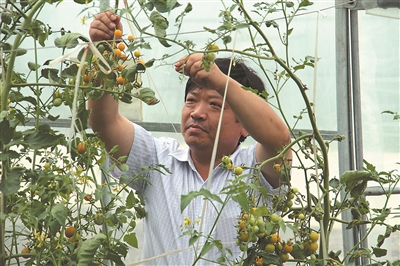
For Lu Xiaohua, a man born in the 1970s, half a lifetime has brought two "never expected" moments. The first: though his ancestors were farmers, he had wanted to escape the farm gate, yet after going round and round he ended up back in the fields. The second: after farming for a few years, he never expected to seize the "Internet Plus" tailwind and take vegetable growing onto the internet. "Don't hear 'farmer' or 'farming' and immediately link it with words like 'rustic' or 'sunset industry.' Last year our sales broke 100 million yuan, 20% of it sold online." Standing in front of the more than 2,000-mu vegetable base of the Nanjing Lishui Huacheng Vegetable Cooperative, watching the logistics vehicles coming and going at the gate, Lu Xiaohua told reporters calmly and confidently, "From now on, we won't just ride the tailwind, we'll create the wind and carry more people along as they 'fly.'"
In 1998, Lu Xiaohua worked at a township enterprise near his home. The overall economy was poor at the time, the enterprise couldn't collect payment for goods, and it ended up taking a lot of fertilizer in lieu of debt. To "cash out," he had to sell fertilizer everywhere. That running around, it turned out, uncovered a business opportunity. Quite a few fellow townspeople from Lishui had contracted land in Wuxi to grow vegetables, and since agricultural supply sales had not yet been liberalized, their biggest difficulty was buying fertilizer. That way, Lu Xiaohua not only sold off all the fertilizer on hand but also hit on a good way out. After returning to Lishui, he decided to resign, go to Wuxi to grow vegetables with his fellow townspeople, and open an agricultural supply outlet. With supply matching demand, plus the trust of his fellow townspeople, Lu Xiaohua quickly opened up the situation.
But the road of entrepreneurship is destined never to be smooth. A few years later, urbanization accelerated, much vegetable land was requisitioned, and Lu Xiaohua's business became harder and harder to run. It happened that Lishui was encouraging migrant workers to return home and start businesses, and Lu Xiaohua felt that in these years away he had broadened his horizons and accumulated experience, so he could try being his own boss. So in 2009, Lu Xiaohua resolutely "went home to farm."
At first, his family did not understand this choice. In their view, "how far can farming get you?" Lu Xiaohua had brought back 3.8 million yuan in working capital alone; with that much money and still farming, wouldn't people laugh at him? Lu Xiaohua did not think so -- "vegetable growing sounds rustic, but in fact there is great potential. First, an industry tied to eating is one ordinary people cannot do without. Also, right now the 'vegetable basket' business is generally rather extensive; as long as we play the 'local vegetables' card well, we will surely find a market."
Quality and price directly determine whether this "vegetable basket" can be viewed favorably. To guarantee quality and safety, Lu Xiaohua's vegetables must pass 4 inspection stages. As for price, most of the vegetables Nanjing people eat are shipped in from elsewhere, while Lu Xiaohua's local vegetables have lower transport costs, so he naturally has no worries about sales.
Having "seen the world," after all, Lu Xiaohua really grows vegetables differently from others. Apart from two "muddy legs," he can always straighten his back and look one layer farther ahead: "Just burying your head in growing vegetables won't do; farming also requires a sense of business." Not long after returning home to start his business, Lu Xiaohua set up a cooperative, incorporating the concept of land shares into it. After farmers join the cooperative, they convert the land under household contract management into shares at a assessed value and can receive a dividend of 1,200 yuan/mu each year, whereas for surrounding farmers who have not joined the cooperative, the land transfer rent is generally 700 yuan/mu. In addition, farming households that join can also have priority in working nearby at the cooperative, earning 20,000 to 30,000 yuan a year.
Setting up the cooperative was meant to form a joint force and build a brand. Lu Xiaohua told reporters that the cooperative unifies planting, management and sales: first, it guards the source by providing farmers with vegetable varieties that are competitive in the market; second, during the growing process it provides technical guidance, uniformly purchasing organic fertilizer and biological pesticides to ensure the quality and safety of agricultural products; third, for the vegetables farmers produce, the cooperative purchases them uniformly at a protective price and sells them under a unified brand. The cooperative initially had 13 members; today it has more than 130, and the vegetable planting area has grown from more than 300 mu to more than 2,000 mu. At present, the cooperative's main business includes canteen delivery, gift vegetable sales, home delivery of vegetables, field-edge picking by visitors, and wholesale sales to surrounding markets. This diversified sales model reduces market risk and keeps vegetables selling well all year round.
Though he comes from a migrant worker background, Lu Xiaohua's business philosophy is more advanced than that of many urban entrepreneurs: he actively trains employees to become bosses. "Everyone who comes here works for wages the first year, earning a fixed salary. From the second year on, as long as they are willing, they can contract land and manage it themselves." Lu Xiaohua explained, "70% of the profit goes to the leader of the production team. Besides the basic monthly wage, workers can also get 30% of the profit as a bonus." This way, employees are not only more motivated but also more responsible for product quality.
At first, Lu Xiaohua's company was still a "family business," with relatives having the final say in many positions. As the enterprise grew, he decided to "swap out the blood": bring in agriculture-major university graduates and phase out "our own people" who did not understand management. For this, his wife was at odds with him for a long time.
The benefits of bringing in talent need no elaboration, but even Lu Xiaohua himself did not expect that these university graduates would make the enterprise unintentionally seize the "Internet Plus" tailwind. In the period just after the graduates arrived, Lu Xiaohua occasionally noticed that express deliveries came very frequently; when he asked, he learned it was things the graduates had bought online. E-commerce that "buys globally, sells globally" instantly let Lu Xiaohua spot a business opportunity: "Once you're connected to the internet, can't you sell vegetables online?"
Online e-commerce, delivery on demand. In 2014, the cooperative's e-commerce platform went online, mainly selling vegetables online. Customers simply place an order online for whatever vegetables they want to buy. To meet the needs of different families, the website adopted a "home delivery" approach, delivering twice a week, with vegetables harvested the same day and delivered to the table the same day. After more than a year of operation, the e-commerce platform's annual sales have broken 20 million yuan.
Following the e-commerce platform, the cooperative also opened a mobile WeChat channel, presenting products in sync with the online store and launching a series of promotional activities such as group buying, buy-one-get-one, and base experiences, greatly broadening the platforms and channels for online sales. "Combining virtual and real," while doing e-commerce well, the cooperative also launched an agritainment project, letting customers experience planting, picking and other field work at the vegetable base, and taste farm dishes on the spot.
Although he is the boss, in the online field Lu Xiaohua, who calls himself "not even good at using a phone," does not "monopolize power," but instead chooses to "let professional people do professional things," with the university graduates acting as bosses of the internet company. In 2013, the internet company was formally established with 8 university graduates recruited by Lu Xiaohua as shareholders, responsible for vegetable sales on the online store. "In online sales, they have the final say; I work for them." Lu Xiaohua said, "Entrepreneurship sounds full of passion, but truly doing it well is not easy. Just standing on the shore watching, you will never learn; get in the water yourself, and even if you choke on a couple of mouthfuls, it's no big deal. With this experience, the road will get wider and wider, and won't my enterprise also grow stronger and stronger?"