Zhejiang son-in-law comes to Chongqing to farm: why leave a mountain of gold to seek gold in the city
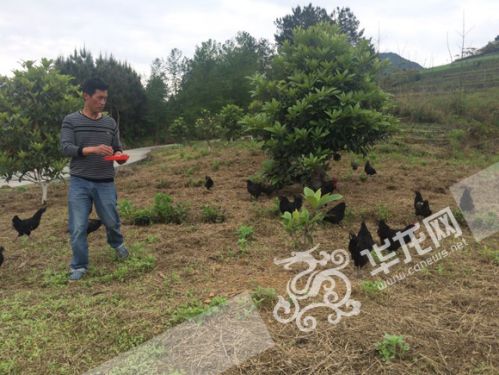
In the photo, Zhou Qing feeds chickens in the loquat orchard.
When the labor force goes to the cities for work, who will farm the rural land? A topic that makes people frown when it is brought up, yet someone was called to farm it. Who is he? Yesterday (the 21st), the large-scale themed interview "Study and Implement General Secretary Xi Jinping's Important Speech on Inspecting Chongqing - Chongqing in Action - Young Journalists Going Among the People to Change Their Style of Work" arrived at its third stop - Qianjiang District, Chongqing. Amid the "wave" of people leaving rural areas to work elsewhere, a Zhejiang son-in-law instead followed his wife back to Gaige Village, Heixi Town, Qianjiang. There, he transferred nearly 500 mu of wasteland from his rural neighbors, and today all of these fields have become a mountain of "gold."
Neighbors go out to work, abandoned land becomes a business opportunity
"It was so hard to get out of the mountains; coming back to farm is embarrassing." Facing all sorts of plans from their daughter Wang Xia and son-in-law Zhou Qing, the mother merely shook her head. "No matter how gloriously you put it, in the end it is still farming. Only by becoming a city person is one successful."
The idea of returning to the countryside to seek "gold" was not a momentary "impulse" for Zhou Qing and Wang Xia.
Zhou Qing comes from Wenzhou, Zhejiang, and was once a village party secretary in his hometown there. "Many young people there have returned to the countryside to grow fruit and get rich through outside sales." Zhou Qing was a witness and also wanted to become a practitioner, and it was precisely the fertile soil and large tracts of abandoned land in Heixi Town, Qianjiang District that caught his eye.
In 2009, Wang Xia, who had gone far to Zhejiang to work, fell in love with Zhou Qing. During the 2010 Spring Festival, the two returned to Chongqing to meet their parents as they discussed marriage. "The mountains here are much bigger than in our hometown." Zhou Qing recalled that at the time he felt a huge contrast in his mind. Both were rural areas, yet in Gaige Village, Heixi Town, of the hundreds of mu of formed terraced fields, only a few scattered plots were vegetable gardens. "Back in our hometown, this would simply be a treasure bowl."
That Spring Festival, Zhou Qing also heard many young people who had returned home say they planned to go out to work again after the holiday. At that moment, Zhou Qing realized that everyone was single-mindedly chasing the world outside, and this instead brought him a business opportunity.
That year, Zhou Qing and Wang Xia settled their marriage, and when leaving, Zhou Qing grabbed a handful of soil by the roadside. It was precisely because of this handful of soil that he returned to Heixi Town, Qianjiang just one month later. "The soil test showed it is rich in selenium."
Without worrying about the obstruction of Wang Xia's parents, Zhou Qing took out a loan and transferred 200 mu of local villagers' land, and transplanted white sand loquats from his hometown to grow there.
A flock of free-range chickens under the trees, branches full of fruit on the trees
On April 21, in Group 2 of Gaige Village, Heixi Town, Qianjiang District, the reporter and the group met Zhou Qing. Although he looked somewhat weathered from being exposed to wind and sun all year round, his dark skin, hearty laughter and sturdy physique all showed the healthy constitution of someone who eats pollution-free agricultural products year-round.
Today, the Fengfei White Sand Loquat Plantation that Zhou Qing runs occupies most of a hilltop. In the orchard, green fruit has already grown on the loquat trees, and over a thousand black silkie chickens run freely among the trees, busy catching insects to "satisfy their cravings." At the end of the loquat grove, three to five chicken coops are scattered in an orderly way.
As everyone approached the loquat orchard, the silkie chickens naturally scattered in all directions, but the reporter discovered an unexpected harvest - a greenish free-range egg hidden under a tree, coated with a layer of golden luster in the sunlight.
Do not think that what is running among the trees now is only free-range chickens. Two years ago, besides loquats, what was intercropped in the orchard was pumpkins. "The spacing between each loquat tree is 1.5 m. After planting loquats, a lot of land is left idle, and intercropping is a common way to increase the per-mu yield of the land."
Zhou Qing said that after he introduced white sand loquats from Zhejiang in 2011, he planted loquats on 200 mu of land in Gaige Village. In order to increase the utilization rate of the land, he began intercropping other crops in the gaps among the trees.
In the first year after planting, problems appeared. "Pumpkins and loquat trees absorb nutrients from the soil, and there are too many weeds, so neither grows well." Zhou Qing said, especially with weeds, workers had to be hired every month to remove them, and the labor cost alone was over a thousand yuan. Not only that, pumpkins and loquat trees both breed some pests, and the two affect each other, so instead they grow poorly, and the land is also difficult to nourish.
How to make the loquat trees grow well, keep land utilization high, and allow the soil nutrients to recover truly stumped Zhou Qing.
In the photo, Zhou Qing shows his free-range eggs.
Loquats paired with free-range chickens, land value increases by 100%
The turning point appeared at the beginning of 2012, when the Heixi Town government began promoting "under-forest economy" to the village. The so-called "under-forest economy" refers to relying on forest land resources and the forest ecological environment, making full use of under-forest land resources and the advantages of forest shade to engage in three-dimensional composite production and operation such as under-forest planting and breeding, thereby enabling agriculture, forestry and animal husbandry to achieve resource sharing, complementary advantages, circular mutual generation, and coordinated development as an ecological agriculture model.
This new way of thinking instantly solved Zhou Qing's problem.
"Yes, we should raise the natural enemy of grass and insects - chickens." Zhou Qing calculated that chickens eating insects can prevent pests and protect the forest, and their manure can fertilize the forest land. The good natural ecological environment under the forest is also conducive to the growth of chickens, not only reducing costs and disease, but also greatly enhancing the flavor of the free-range chickens.
There was no time to delay. Starting in 2012, Zhou Qing specially introduced 4,000 improved black-skinned chickens from Hubei and other places and began raising them freely in the loquat grove. "Usually the chickens look for insects in the grove and also eat some weeds, and are supplemented with corn, soybean meal and so on to ensure the quality of the free-range chickens. There is no need to worry at all."
Zhou Qing said that the natural weeds growing in the loquat orchard are a "natural oxygen bar" for the poultry. The poultry eat grass and insects, and their manure fertilizes the forest land, forming a benign biological cycle chain with the trees.
Starting in 2014, after a 3-year seedling period, the loquat trees began to bear fruit, and the chicks had also just grown up.
"On average, 50 loquat trees are planted per mu, and the average yield of loquats per mu is 250 jin. Calculated at 20 yuan per jin, that is 5,000 yuan. In one mu of loquat orchard, on average 25 free-range chickens can be raised, and at about 100 yuan per chicken, that is 2,500 yuan. Adding the 'green-shell eggs' at 3 yuan each, there is at least another 3,000 yuan in income a year. Altogether, that is more than 10,000 yuan in income." Zhou Qing said this is equivalent to doubling the value of each mu of land.
Picking tours become popular, earning 200,000 without leaving home
Last May, the white sand loquats Zhou Qing runs began to fully ripen. The tender-fleshed, sweet and delicious loquats immediately attracted the attention of residents of Qianjiang and surrounding areas, and citizens driving themselves to the loquat orchard to pick loquats came in an endless stream.
"20,000 jin of loquats is not nearly enough for picking; there is simply no need to sell them elsewhere." Zhou Qing said the good quality of the loquats attracted large numbers of tourists to come pick them, and at 20 yuan per jin, there was no worry about sales. Add to that the free-range chickens in the orchard, and citizens catching and buying chickens themselves added even more fun to the picking tours, with participation growing higher and higher.
Last year alone, Zhou Qing achieved a profit of 200,000 yuan from loquats and free-range chickens. This year, Zhou Qing transferred nearly 800 mu of land to plant loquats and also led surrounding poor households to jointly launch the under-forest economy model of loquats paired with free-range chickens, driving them toward prosperity.