To make agriculture bigger and stronger, farmers need to learn the spirit of craftsmanship
Original title: To do agriculture well, first cultivate craftsmanship
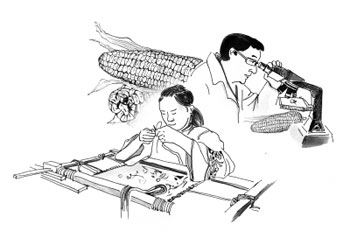
Illustration: Liu Nian
The current situation in our country, where agriculture is big but not strong and lacks competitiveness, is related to the attitude of some producers who focus only on yield and not on quality. To do agriculture well, one must first cultivate craftsmanship. In the final analysis, it comes down to a wholehearted earnestness in doing agriculture! During the "13th Five-Year Plan" period, developing modern agriculture and improving agricultural competitiveness is a major task of the times. Overcoming impatience, being patient and focused, and striving for excellence - this craftsmanship spirit advocated by Premier Li Keqiang is being translated into the actual actions of some rural entrepreneurs, and this is also the basic quality necessary to promote the transformation and upgrading of agriculture. - Editor
Gao Fenglan:
The highly skilled Yanmen embroiderer
"On one hand, rural women would rather gossip in their spare time than do needlework; on the other hand, embroidery is neglected and has no successors."
In 1999, Gao Fenglan, a woman from Dai County, Shanxi, returned to her village after retirement. After making a round of the village, she surprisingly could not find more than a few households still doing embroidery, and she became deeply worried.
The reason for her worry was that the Yanmen Ancient Road in Dai County was historically part of the "Tea Horse Road" and the "Land Silk Road"; "Among the nine passes under heaven, Yanmen is the first." Yanmen Pass was not only a place contested by strategists through the ages, but also a place where the civilizations of various ethnic groups blended. Every household doing embroidery was one of Gao Fenglan's greatest nostalgic attachments, and being able to embroider at age 9 had always been something she took pride in.
"This craft must be picked up and passed on." Gao Fenglan put on her reading glasses and took up needle and thread again.
With that, Dai County gained an intangible cultural heritage called Yan embroidery, and semi-idle rural women gained another path to prosperity.
From learning the craft to teaching it
Over the next six months, Gao Fenglan rode on her husband's electric scooter from village to village, visiting more than 20 villages in 8 flatland townships including Ekou, Zaolin, Mofang, and Xingao, seeking out and consulting more than 20 women embroidery artists, establishing deep friendships with artists and masters such as Jia Cui'e of Ekou Town, Cao Cuiqing of Shangguan Town, and Wei Yeye of Zaolin, and collecting more than 1,000 samples, patterns, and materials from embroidery artists both living and deceased.
Gao Fenglan carefully summarized and studied traditional drawing, color, and techniques, and finally formed a local embroidery craft atlas with 36 embroidery methods and 12 stitch methods.
In 2008, Gao Fenglan went to Suzhou to study the craft for 3 months, integrating Dai County's traditional embroidery with Su embroidery techniques, and innovatively formed Yan embroidery, which embodies both northern and southern embroidery methods. She also became an inheritor of this craft as intangible cultural heritage and was rated as a master of embroidery and fabric art by the National Arts and Crafts Association.
After Gao Fenglan became somewhat well known, she began to offer free training classes, building a platform for popularizing embroidery art and for women to start businesses and become self-reliant, encouraging rural women to set aside gossip, leave the mahjong table, and take up needle and thread to learn embroidery.
From a small room of a few square meters to a classroom of several hundred sq m, from 3 people to 300, more and more people joined her team of embroiderers. Over more than ten years, Gao Fenglan has provided free embroidery training to more than 5,000 person-times, trained more than 40 highly skilled embroiderers, and each embroiderer can earn more than 20,000 yuan a year. Some embroiderers have even become famous embroidery teachers and are invited to give lectures.
As a result, Yan embroidery became a new calling card for Dai County.
From entrepreneurship to industry
Li Fentuan, 55 years old this year, is an ordinary farmer from Shilipu Village, Mofang Township, Dai County. Previously, she farmed more than 10 mu of riverbank land in the village, with an annual income of several thousand yuan.
In 2002, in order to let her children go to school, Li Fentuan moved her whole family into Dai County's county seat, and was one of the earliest apprentices to learn embroidery from Gao Fenglan.
"In the past, when I had free time in the village, I would play cards and bicker. Now that I've learned embroidery, what I embroider can be sold for money, and I can also go out to give lectures and earn money. We can make a living with our craft too." Li Fentuan said that last year she earned 20,000 yuan.
In 2009, Gao Fenglan bid farewell to peddling with a basket and founded Dai County Yan Embroidery Workshop Culture and Art Co., Ltd. Relying on her skillful embroidery techniques, she opened up the market and carved out a splendid world in the national embroidery field.
At present, Gao Fenglan is leading several apprentices busy working on new embroidery pieces on the embroidery frames, about to participate in this year's "Baihua Cup" arts and crafts award competition.
"Last year she won a silver award, and she was a bit unconvinced. This year she wants to win gold." Wang Yong introduced.
In the embroidery workshop, Gao Fenglan uses a room specifically to display award-winning works and trophies from recent years. She said: "Some were embroidered stitch by stitch by dozens of embroidery workers, and some took nearly a year. Each trophy is the result of everyone's labor, and even more, recognition of embroidery culture."
Among them, the embroidery work "Childhood" won the gold award for innovative design at the 49th National Arts and Crafts and Tourist Souvenirs "Golden Phoenix" competition. At the same time, Yan embroidery works have also gone abroad and are sold to the United States and European markets.
Now, Li Fentuan has also become a teacher in the Yan Embroidery Workshop. When Gao Fenglan is away, it is she who "holds the fort" at the workshop.
Like Li Fentuan, a large number of rural women and laid-off workers have step by step become embroidery workers from apprentices. Embroidery craft has developed into a local industry, which not only opened a path to employment without leaving home, but also drove the diversified development of Dai County's cultural tourism industry. Not long ago, the Yan Embroidery Workshop was named a "Women's Entrepreneurship Training Base" by the Shanxi Provincial Women's Federation, and she herself was awarded the title of "March 8th Red Banner Pacesetter" by the provincial government.
At present, driven by the Yan Embroidery Workshop, nearly 3,500 women in the county have taken up embroidery to generate income. (Our reporters Ma Yu, Wu Jinbin)
Yang Tianlong:
The versatile "Corn Brother"
Dark skin, a sturdy build, sharp eyes, a backpack, and a set of coarse cloth sportswear... When meeting him for the first time, you would never associate the person before you with a boss; on the contrary, he looks more like a craftsman.
He is Yang Tianlong, founder of Yunzhongyang and "Corn Brother."
"Agriculture has been my dream since childhood"
In 1983, Yang Tianlong was born into a rural family in Gaoya Town, Yuzhong County, Lanzhou City, Gansu. "I am just a child from the mountains. I love this land. Agriculture has been my dream since childhood."
In 2003, Yang Tianlong was successfully admitted to a university. Because his major was unrelated to agriculture, he stubbornly chose to drop out. After repeating a year, he was admitted as he wished to China Agricultural University's Seed Engineering and Science major. At China Agricultural University, he met the one who would accompany him for more than 10 years - fruit corn.
During the winter vacation in 2005, Yang Tianlong wanted to bring some corn seeds home to try planting. With sheer tenacity, weighing 110 jin, he shouldered two large bags of seeds weighing more than 100 jin and stood all the way home on a standing-room-only ticket. "At the time, my idea was very simple. I just wanted to find a good product to change my hometown's planting structure and increase my parents' income." Perhaps he did not know then that these seeds would change the course of his entire life.
It turned out that among these two large bags of seeds, there was a very special variety different from common corn. The seeds looked shriveled and not plump. It was a new corn variety bred over more than 10 years by a professor at China Agricultural University. When the corn matured the following year, Yang Tianlong was delighted to find that the corn had thin skin and a crisp texture, as sweet and fragrant as fruit. With one raw bite, the fresh, fragrant juice filled his mouth. When he took it to the market to try selling, it unexpectedly sold out.