Functional agriculture cracks hidden hunger and drives supply-side reform and innovation
Original title: A new path for agricultural supply-side reform
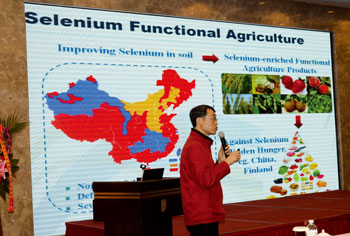
Dr. Yin Xuebin, Director of the Key Laboratory of Functional Agriculture at the Suzhou Institute of the University of Science and Technology of China, Secretary-General of the International Society for Selenium Research, and founder and chief scientist of Suzhou Selenium Valley Technology Co., Ltd., popularizes and promotes functional agriculture (network image)
This year's Central Document No. 1 proposed "continuously consolidating the foundation of modern agriculture and improving agricultural quality, efficiency and competitiveness." Recently, the monograph Functional Agriculture, co-authored by Academician Zhao Qiguo of the Chinese Academy of Sciences and his student Dr. Yin Xuebin, was officially published, providing a very good "case" for implementing this requirement in the central document.
As head of the strategic research group in the agricultural field of the Chinese Academy of Sciences, Academician Zhao Qiguo proposed in the 2008 Roadmap for Agricultural Science and Technology Development in China to 2050 the thesis that "agricultural products should move toward nutritionalization and functionalization." Over the past 8 years, he has continuously developed this thesis into an important field of systematic modern agriculture: functional agriculture. This monograph, Functional Agriculture, records this development process and, by combining theory with practice, systematically and comprehensively introduces the connotations and prospects of this new agricultural field, which is refreshing.
Functional Agriculture uses "hidden hunger" as a vivid metaphor for people's lack of important trace elements, reflecting the historical background and modern significance of the birth of functional agricultural products. Only when economic and social development reaches a certain level will this kind of functional agricultural product that promotes human health and longevity be researched and developed, and this kind of agricultural product with high technological content and good social benefits will inevitably bring corresponding economic benefits. This opens a new path for solving the difficult problems of agricultural product prices and low efficiency and poor returns, achieving the gratifying result of "increasing agricultural efficiency, increasing farmers' income, and increasing people's longevity."
This monograph, Functional Agriculture, not only explains the connotations of this emerging field of modern agriculture from the perspective of science and technology, but also, by combining theory with practice, describes many key links in pioneering and developing functional agriculture as well as the gratifying results already achieved by Yin Xuebin's team, enabling readers to feel the existence and role of this new thing. Their efforts and hard work have already obtained more than 200 domestic and foreign invention patents, established China's first academician workstation for functional agriculture, and organized four conferences of the International Society for Selenium Research, and successfully made the International Society for Selenium Research (a national first-level society) permanently based in China. All of this concretely and incisively explains the important significance, scientific system, and industrialization practice of functional agriculture, and paints a brilliant prospect for the development of functional agriculture. The book predicts that by 2020, the world will launch 80 to 100 functional products, and in China alone the output value of functional agriculture will reach 100 billion yuan.
Continuously developing products with high technological content that satisfy ever-increasing market demand is an important part of the supply-side structural reform currently proposed by the central government. The pioneering and development of functional industry conforms to this spirit and is a new path for agricultural supply-side reform. The birth and development of any new thing is not smooth and unobstructed, and the development of functional agriculture is also full of exploration and hardship. The book proposes six major trends in the development of functional agriculture, namely naturalization, functionalization, compounding, convenience, personalization, and internationalization, which both summarize the characteristics of functional agriculture and reflect that the development of functional agriculture has a long way to go.
On China's vast land, the ecological conditions such as topography, landforms, climate, and soil differ greatly among major regions. Functional Agriculture proposes the "ten major models" for developing functional agriculture according to local conditions, covering almost all of China's major agricultural regions, and has a good scientific guiding role for the development of functional agriculture in various places.
China still has 70 million poor people. The Party Central Committee has raised the issue of poverty alleviation to the height of a national development strategy. The vast majority of poor areas are dominated by an agricultural economy. Ecologically high-value functional agriculture can serve as an important development direction for agriculture in poor areas. This content mentioned in Functional Agriculture combines two major development strategies of China and can implement the spirit of the Party Central Committee's "industrial poverty alleviation" and "targeted poverty alleviation," and has strategic significance and a guiding role.
It is hoped that the brilliant prospects of functional agriculture expounded in Functional Agriculture can be successfully practiced in China's vast rural areas as soon as possible. (Shen Shisheng)
Functional Agriculture, by Zhao Qiguo and Yin Xuebin, published by Science Press in March 2016