Why can she make a profit of 20,000 yuan per mu from farming yellow catfish?
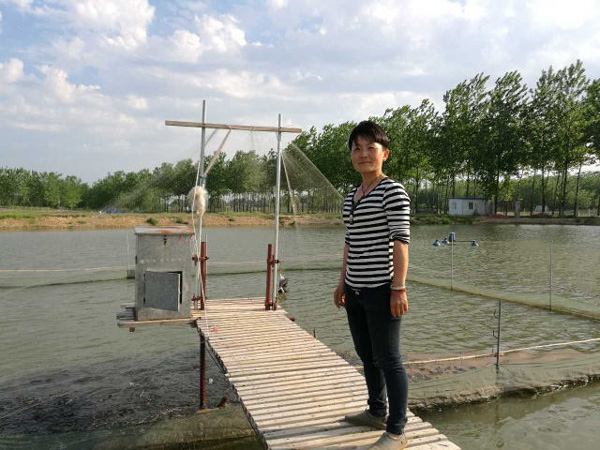
The picture shows Zhang Yuhua
In my impression, Zhang Yuhua (hereinafter referred to as Sister Zhang) is very cheerful, optimistic, and fairly sturdy. After all, with more than 100 mu of ponds, she handles many things herself. I never expected her to be so thin and small. Her farm is located in Wangyan Village, Sanshigang Township, Luyang District, Hefei City. As the car drove along the way, after entering the village, I clearly felt the sky was bluer and people felt more at ease.
Farming fish is like raising children; every child has different characteristics. There is no farming model that is guaranteed to succeed in fish farming either. You have to keep exploring and summarizing based on your own ponds. Before April 2012, Sister Zhang was still doing a clothing business at the Hefei Baima Wholesale Market, living a noisy urban life every day. In her words, now she cannot even go into town more than a few times a year, which was unimaginable before. Doing aquaculture requires being able to endure loneliness. There are very few households even near the farm, but Sister Zhang now enjoys this kind of life very much. Watching the fish she raises gives her a full sense of achievement, hard work and happiness together. Whenever someone comes to buy Sister Zhang's fry, she repeatedly reminds the buyer how to raise them after returning and how to feed them. This is because Sister Zhang already has a special emotional attachment to the yellow catfish she raises, so she hopes that others who buy fry from her can also raise the fish well.
Only with input can there be output
The actual area of Sister Zhang's ponds is 105 mu. Basically, from April to October, when the bottom oxygen and 23 aerators are running at the same time, the average electricity consumption is 100 kWh per hour. If dissolved oxygen cannot keep up, it affects later growth. You cannot tough it out, and you cannot have even a little bit of a gamble mentality. Adult fish have higher requirements for dissolved oxygen. If you do not turn on the aerators every day, the fish definitely will not grow. In addition, the density absolutely must not be high. If dissolved oxygen is insufficient, the fish will only eat without growing.
When it was feeding time, Sister Zhang took us to the pond to watch her feed the fish. While walking, she pointed to a pond directly facing the entrance and said that in this pond, 35,000-40,000 fry were stocked per mu. Some time ago, the pond-side price of yellow catfish was 12.5-13 yuan/jin, but because of the color-fading fish incident, the price dropped all at once, and now it is only 11.2 yuan/jin. Sister Zhang said that as long as she raises the fish well, the market is fair to everyone, and she just needs to follow market conditions. Her psychological target price only needs to reach above 10 yuan. It is impossible to have huge profits every season. If management is in place, the cost only needs to be 6.5-7 yuan, so even at 10 yuan, it is still very considerable. I calculated that based on a pond-side purchase price of 11 yuan/jin, even if only 35,000 fry were stocked, and the fish were sold at an average of 1.5 liang per fish, one mu would still have a gross profit of 57,750 yuan, and the net profit per mu would be at least 20,000 yuan.
Feeding has its particular requirements
After Sister Zhang poured the feed down from the feeding platform, she clapped her hands and told me that the fish are familiar with her voice, and when they hear this sound, they know it is time to come eat. Each feed platform has a feeder, but this feeder is not used to distribute feed. It is used to attract fish to come eat with the sound of the feeder, simply letting the fish hear the rumbling sound of the feeder. Sister Zhang said that when she had no experience before and the yellow catfish fry had just been put into the large ponds, training them to feed was still quite difficult. Every day, the feed had to be soaked soft and rolled into balls, then scattered along the pond edge while clapping hands. Basically, one pond was 10 mu, and more than a dozen ponds all had to be handled repeatedly like this. After a day, it was still very tiring, slowly training the fish to the habit of eating at the feed platform. Now, before the fry are put into the large ponds, they are all concentrated in a 4-5 mu small pond for size grading. Generally, the fry just stocked are 1,000 per jin, and they grow to about 700-800 per jin. After 10-15 days of concentrated feeding training, if the bought fry are relatively small, they can be graded for a few more days, and then divided into ponds to directly eat No. 0 feed, without the need for separate feeding training. When they hear the rumbling sound of the feeder and Sister Zhang's clapping, the fish know it is time to eat.
According to the feeding situation, decide the daily feeding amount. For example, if 80% of the fish are still on this feed platform, then continue pouring feed. If the fish hardly move after the feed goes down, then do not continue feeding. The feed conversion ratio is related to water temperature and weather. For example, when the water temperature is between 20-23°C, for floating feed, feed at 1%-1.5% of the pond's carrying capacity. For example, if this pond currently has 20,000 jin of fish, basically feed according to the standard of 200 jin. Before the feed was finished, Sister Zhang poured in another bag of feed, and the fish came up to eat again. Sister Zhang explained that you cannot wait until they have all finished eating before putting in feed, otherwise the fish will not eat. Fish are very lazy; they just stay in their own spot without moving.
Sister Zhang is relatively careful in doing things. For example, if the fish are not eating very eagerly, then do not continue feeding. Fish are poikilothermic animals. Sister Zhang said that if it will rain tomorrow and today's water temperature is lower than yesterday's, fish are poikilothermic animals, so their body temperature will drop and their vitality will also decrease. On cloudy and rainy days, she will stop feeding for one day, and aeration must be turned on to prevent sudden changes in water quality. During continuous cloudy and rainy days, ammonia nitrogen is especially likely to rise. Even if the weather is good every day, the fish cannot eat to the point of being stuffed every day. Just like people cannot always eat a lot, let their intestines rest appropriately, so that digestion and absorption function will be better. Sometimes, Sister Zhang lets the fish go hungry for one day every ten-odd days, and then feeds them again. If she wants to increase the feeding amount, she slowly adds it every 3-5 days, and cannot feed a lot all at once.
A more ecological three-dimensional farming model
In this pond of Sister Zhang's, many species are mixed together: bighead carp, silver carp, grass carp, bream, mandarin fish, black carp, and crucian carp, with yellow catfish as the main species. For example, if some grass grows along the pond edge, stocking 3-5 grass carp per mu means the grass along the pond edge does not need to be cut manually; mandarin fish can eat the small miscellaneous fish in the pond. This relatively three-dimensional farming model is more ecological. Sister Zhang explained that these polycultured species can increase income by tens of thousands of yuan per pond. This year she also wants to try raising one season of white shrimp and one season of fish. She said that even if the profit from fish farming only covers ordinary expenses, just earning the money from shrimp farming would be quite good.
Strengthen physique, improve water quality, and let fish get sick less
Before the Chinese New Year, in one of Sister Zhang's ponds, the skin on the belly and anal section of the yellow catfish turned white and ulcerated, somewhat like saprolegniasis. Some people said it would be best to give the fish oral medication, but the key issue was that at the time her fish were barely eating. She also asked many people, and in the end she combined her own methods: use humic acid + glutaraldehyde + benzalkonium bromide, applying once every other day at first; using only humic acid alone would be somewhat more expensive. Seeing signs of improvement in the fish, she used multivitamins + stress-relief agent mixed into feed for several days, then used Sanhuang, and finally used lactic acid bacteria to regulate the intestines. The most important thing is still to improve the fish's physique and regulate the water quality. Then keep killing the water mold, once every 5-6 days. Once the fish's physique is improved, feeding becomes easier. When the physique is good, they are less likely to get sick, so regulating the fish's physique and water quality is the key.
Finally, when I chatted with her about similar issues also mentioned by people on the "Aquaculture Village" APP platform, she pointed to some answers on the platform and told me which answers were obviously from highly experienced people, which answers were basically relevant, and which were explained in great detail. Clearly, when it comes to this yellow catfish, Sister Zhang has also become half an expert.