Liu Youshan Develops Specialty Planting to Benefit Local Folks
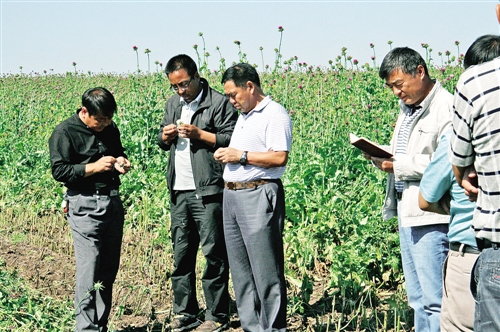
Liu Youshan (first from right) discusses planting techniques with companions in the field.
Showing His Skills in the Rapeseed Fields
Liu Youshan was born in Suining, Sichuan Province in 1964. Due to hardship in life, he came with his mother to Shangkuli Farm in Hulunbuir at the age of 10, and started working at Shangkuli Farm in 1981.
Liu Youshan was diligent in whatever work he did. He herded livestock in the production team, worked in construction, and drove tractors. But having been an outstanding student since childhood, he never gave up learning, and soon was admitted to the Hailar Agricultural and Animal Husbandry Secondary School to study agronomy. After graduation, he returned to the farm and became an agricultural technician, and from then on devoted himself to studying rapeseed cultivation techniques. He spent his days in the fields, checking seedling conditions and inspecting work quality. From land preparation, seed selection, sowing, pre-emergence chemical weeding, and intertillage field management to harvesting and threshing, sun-drying, and cleaning, every step was soaked with his sweat. When special situations arose, he was always the first to step forward. One day, a sudden gale of force 7 to 8 blew up, filling the fields with swirling sand. Liu Youshan, regardless of everything, found a vehicle and raced to the fields of three or four agricultural production teams to inspect the damage and carry out remedies. Another time, frost and snow suddenly appeared in the morning, and the already-emerged wheat and rapeseed suffered an unprecedented freezing disaster. At dawn, Liu Youshan ran more than 100 li in one breath, skipping meals, arranging remedies team by team and plot by plot, reducing losses to a minimum.
Based on the growth habits and developmental patterns of rapeseed, Liu Youshan conducted a large number of experiments on seed dressing, weeding, disease prevention, pest control, and prevention of freezing, wind, and drought disasters, using many new methods and summarizing a complete set of cultivation experience. At the time, in order to ensure increased yield and efficiency of rapeseed, he chose summer-plowed land for sowing as much as possible. For continuous cropping or repeated cropping plots, he chose hill-slope land and summer-plowed stubble fields with deep loosening foundations. In order to increase the multiple cropping index, he promoted conservation tillage and no-till sowing with stubble, which is an important measure for protecting the ecology, saving costs and increasing efficiency, resisting drought and preserving soil moisture, preventing wind and protecting seedlings for high yields. Using no-till seeding machinery, he sowed rapeseed no-till in small and large barley stubble fields, exploring the expansion of conservation tillage areas and crop types, and integrating with dryland farming techniques to accelerate the transition from minimum tillage to no-till, expanding the no-till sowing area year by year. For various disasters, he advocated that "prevention is more important than treatment." For example, to prevent drought, he would select or introduce drought-tolerant varieties. To prevent wind damage, he chose no-till conservation tillage in wheat stubble fields. For occasional sudden freezing disasters, he would reseed early, or switch to other crops depending on the situation.
Liu Youshan concluded that using glyphosate before rapeseed emergence had a very good weeding effect. This technique won the Hulunbuir City "Second Prize for Research and Promotion of Efficient Chemical Weeding Technology in Rapeseed Fields," and the high-yield technology for 1 million mu of rapeseed promoted for planting won the Second Prize of the Ministry of Agriculture's Harvest Award. Today, 1.5 million mu of rapeseed fields across the entire reclamation area are applying this technique, with a cumulative promoted planting area of more than 20 million mu. In 2006, from dozens of rapeseed varieties, Liu Youshan selected the new rapeseed variety Qingza No. 5, which has advantages such as cold tolerance, high yield, good quality, high oil content, and strong stress resistance. It was introduced and planted at Shangkuli Farm for the first time, and large-scale planting began in 2007. That year, under extremely dry conditions, Qingza No. 5 rapeseed fields achieved an average yield of 210 kg per mu, setting a new record in the history of Hulunbuir Agricultural Reclamation, and it was quickly promoted for planting across the entire reclamation area. Shangkuli Farm was also designated by the Ministry of Agriculture as a national rapeseed high-yield demonstration site.
The New Farm Manager Is a Lucky General
In April 2011, Liu Youshan was transferred by the Hulunbuir Agricultural Reclamation Group to Xiertala Agricultural and Livestock Farm (Branch Company) as general manager and farm manager. Over the past 5 years, he vigorously promoted comprehensive high-yield agricultural cultivation techniques, bringing total grain and oil output to 100 million jin and operating profit to over 100 million yuan, with both indicators "double exceeding 100 million." The workers happily said: "The new farm manager is a 'lucky general'; we've all benefited from following him."
But the "lucky general" knew best the hardships of the planting path.
In his first year in office, the heavens gave Liu Youshan a show of force. From early May to mid-June, there was no effective rainfall for more than 40 days. What to do without rain? Delay the rapeseed sowing period and try to avoid the early drought! "The normal sowing period for rapeseed is around April 25, and it's already May and still not sown?" The farm staff began to get anxious, but Liu Youshan said: "Wait a few more days; good food is worth waiting for." A few days later, the heavens truly sent a soaking rain. Liu Youshan immediately had all agricultural teams no-till sow rapeseed in all wheat stubble fields, strictly requiring standardized operations: strictly controlling sowing depth, ensuring seeders were equipped with two compaction devices, increasing the number of compaction passes, and seizing the opportunity to carry out post-sowing pre-emergence weed control. That year, the rapeseed fields achieved a bumper harvest. From the more than 40,000 mu of additional rapeseed alone, agricultural income increased by 10.8 million yuan.
Based on the main contradiction in the Xiertala area of dry weather with little rain, poor soil, and high sand content causing rapid water loss, Liu Youshan conducted an in-depth comparison of the main crops, rapeseed and wheat, and decisively proposed countermeasures. "In recent years, the main thing I have grasped is two points: First, adjusting the planting structure, stabilizing wheat and increasing rapeseed, and opening up a new path for specialty crop planting, such as large-scale planting of the medicinal herb milk thistle, carrots, and early corn. In particular, last year's trial planting of early corn reached a yield of 845 jin per mu, breaking at one stroke the difficulty of growing corn in the high-cold region north of the Greater Khingan Mountains. The second point is to make farmland water conservancy construction the top priority of invigorating agriculture through science and technology; water-saving sprinkler irrigation has played its role." Liu Youshan spoke eloquently about planting techniques.
Water conservancy is the lifeline for increasing agricultural yield and efficiency. Liu Youshan specially established a water conservancy section and actively sought national project funds to increase investment in water-saving irrigation. Over 3 years, more than 200 million yuan was invested to reinforce and repair the original main water conveyance canals and pipelines, and to extend and bury water conveyance pipelines, increasing the farm's farmland water conservancy coverage area from the original 32,000 mu to 200,000 mu, completely changing the passive situation of relying on the weather for a living.
Xiertala is a national key Sanhe cattle breeding base. Liu Youshan said: "We do not engage in single-minded agriculture; we must take the path of common prosperity." In order to thoroughly improve the current situation of humans and livestock living together and reverse the plight of low prices for free-range milk, Liu Youshan has invested a cumulative total of more than 70 million yuan since 2013 to build modern pastures and actively develop profitable animal husbandry. At the same time, he was committed to improving the living environment of the people of Xiertala. By the end of 2014, 43 residential buildings were completed, and more than 800 worker households moved into new homes. The workers happily said: "It really feels a bit like living in the city."