Anhui Agricultural University has taken root in the Dabie Mountains for 30 years
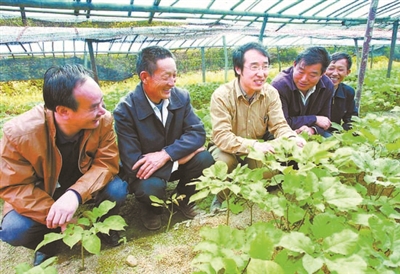
Teachers from Anhui Agricultural University guide villagers in planting techniques.
General Secretary Xi Jinping pointed out that whether a society is moderately prosperous or not depends on the rural folks, and in particular on whether the poor rural folks can escape poverty. At present, China's poverty alleviation drive still faces a severe situation, and many people remain deeply impoverished. To alleviate poverty, one must first empower the mind; if education lags behind, generations will remain backward. Doing a good job in targeted poverty alleviation through education, so that children in impoverished areas receive a good education and acquire a professional skill, is an important way to break the intergenerational transmission of poverty, and is fundamentally a way to "pull out the roots of poverty" and "pave the road to prosperity," enabling ordinary people to live good lives. Now, the clarion call to resolutely win the battle against poverty has been sounded. This newspaper is launching the column "Targeted Poverty Alleviation: Education in Action," focusing on the good practices and good experiences of various schools in all regions in their targeted poverty alleviation through education work. Please stay tuned.
As the car drove along Xinhe South Road in Jinzhai County, Lu'an City, Anhui Province, Mu Li, a teacher at Anhui Agricultural University, excitedly opened the car window and said, "Look, this is the old site of the Jinzhai Junior College Class!" The tides of the times roll ever forward; the teaching building from more than 30 years ago no longer exists, and new small high-rises have been built on both sides of the road, but the Meishan River in front of the gate is still as clear as before, gurgling eastward.
The mountains and rivers here have long been imprinted in Mu Li's heart. In the early 1980s, in response to the national call for poverty alleviation through science and technology, Anhui Agricultural University and Jinzhai County jointly created the "Jinzhai Junior College Class" to help local farmers master advanced agricultural techniques. As a teacher at the university's School of Life Sciences, Mu Li came to Jinzhai County to teach local villagers the methods of scientific silkworm rearing hand by hand. "I had to make at least a dozen trips a month to the fields and furrows. That period was the golden age of my life, impossible to forget."
"The knowledge learned more than 30 years ago is still useful today"
At the symposium held by the university to retrace the Dabie Mountains road, Zhan Wei, head of the Dashanli Tea Professional Cooperative in the mountains of Jinzhai County, seemed a little melancholy: "The teachers who taught me back then didn't come. I really wanted to chat with them face to face again." As a member of the first graduating class of the "Jinzhai Junior College Class," Zhan Wei has not forgotten for a single day over more than 30 years the help of the teachers from the agricultural university.
In 1985, Zhan Wei became one of the 76 students in the first "Jinzhai Junior College Class." "At that time, very few rural students could enter university through the college entrance examination. When I heard that university professors were coming to teach us here, I immediately applied to the county for a spot."
That year, Professor Duan Jianzhen and Professor Tian Xing'an of Anhui Agricultural University taught the students courses on tea cultivation. The two professors' rigorous scholarship and novel ideas left a deep impression on Zhan Wei.
"At that time, Professor Duan already put forward the concept of adapting measures to local conditions, requiring tea planting plans to be made according to the local ecological environment, and absolutely forbidding the destruction of forests to plant tea. Professor Tian, meanwhile, constantly reminded us that when planting tea we must never forget our roots, must preserve the classics, and must also advance with the times."
The advanced experience imparted by the professors saved Zhan Wei many detours on his later tea-growing path. From the late 1990s to the beginning of this century, Lu'an Guapian almost disappeared from the market. During that period, Zhan Wei gritted his teeth, overrode all objections, and insisted on continuing to grow Lu'an Guapian. Zhan Wei's persistence was repaid years later when Lu'an Guapian shone brilliantly in the tea market. Time proved the correctness of Tian Xing'an's judgment back then.
Today, the Dashanli Tea Professional Cooperative founded by Zhan Wei is developing vigorously, with annual profits reaching hundreds of thousands of yuan, driving a hundred villagers to prosperity together. "Thanks to the professors of the agricultural university; the skills they taught me have benefited me for life."
In the early 1980s, Anhui Agricultural University actively responded to the Party and the state's call to "help impoverished areas change their appearance as soon as possible," focusing on intellectual poverty alleviation, supported by scientific and technological services, and devoted the whole university's strength to science and technology poverty alleviation work. The "Jinzhai Junior College Class" jointly founded by the university and Jinzhai County was the first in the country for a university and local government to jointly cultivate talent.
The dream of "helping farmers escape poverty and become prosperous" has inspired batch after batch of experts and scholars dedicated to "agriculture, rural areas, and farmers" to step out of the classroom and out of the laboratory. According to statistics, from 1985 to the present, Anhui Agricultural University has organized more than 300 teachers to go deep into the Dabie Mountain area, training about more than 1 million farmers and realizing the dream of more than 200,000 farmers escaping poverty and becoming prosperous. Of the eight pillar industries in the Dabie Mountain area, including rice, tea, Chinese chestnut, and silkworm, six were directly developed with the participation of the university. A large number of advanced models have emerged, including Professor Ren Lizhong, who said "My life belongs to society, my technology belongs to the chestnut farmers" and who created a unique high-yield Chinese chestnut technique; Professor Wan Zhihu, of whom it was said "If you want to get rich, go find Wan Zhihu of the Agricultural University," and who successfully cultivated the mountain area's "fruit of prosperity"; and Associate Professor Zhang Liang, who said "For every additional technique I teach farmers, I complete one more research topic."
The friendship between teachers and villagers has continued uninterrupted for 30 years
For more than 30 years, the friendship between the teachers of Anhui Agricultural University and the villagers of the Dabie Mountain area has never been interrupted.
This year, Song Yongtang, a villager from Gubei Town, Jinzhai County, welcomed another great success in his career: at the beginning of the year, the Xinnong Agricultural Development Co., Ltd. he runs reached a cooperation agreement with Beijing Shounong Group on the sale of ecological black-haired pigs. More than 2,000 "Dabie Mountain black-haired pigs" in the breeding farm will enter a designated slaughterhouse in Beijing for professional slaughtering, processing, and packaging, and then be centrally purchased by Beijing Shounong Group and sold to the capital's high-end consumer market.
As early as several years ago, the black-haired pigs raised by Song Yongtang were already famous far and wide. At the suggestion of Li Fubao, a professor at Anhui Agricultural University's College of Animal Science and Technology, the economic benefits brought by the farm's original "sending pigs up the mountain" breeding model became a much-told tale in Jinzhai County.
"Free-range raising can release the pigs' natural instincts. When the pigs are in a good mood, the meat quality is naturally good." Combining years of teaching experience and on-site visits, Li Fubao tailor-made a plan for Song Yongtang's meat pig breeding, with a basis for when the pigs go up the mountain, come down the mountain, and are fed.
Song Yongtang said that Li Fubao started him on his life's path. In 2009, he made a small trial in the breeding industry, but unexpectedly, he suffered a disastrous defeat just as he was testing the waters. "In those years the pork market was very bad, live pigs were more than 4 yuan per jin, and the more than 500 crossbred pigs I bought lost me more than 100,000 yuan all at once." When Song Yongtang was almost ready to give up, at the recommendation of the local government, Li Fubao extended a helping hand to him.
"At that time, the village-to-village roads were not as developed as they are now. Cars couldn't get up there, so you could only walk." Song Yongtang said that in order to find a suitable breeding site, Li Fubao often walked in the mountains for a whole day. "It was Professor Li's persistence that made today's 'Dabie Mountain black-haired pigs' possible."
In Jinzhai County there are still many modern farmers like Song Yongtang who, with the help of Anhui Agricultural University teachers, found their "guide to prosperity." Carrying the ardent hopes of the previous generation of Anhui Agricultural University people, the Anhui Agricultural University people of the new era have given the "Dabie Mountains road" a more distinct contemporary meaning.
At the end of the 20th century, the university withstood the trend of "de-agriculturalization" and "comprehensivization" in agricultural institutions and resolutely chose to hold fast to "agriculture." Standing at a new historical starting point, the university has continuously innovated its institutional mechanisms for serving "agriculture, rural areas, and farmers," vigorously advanced the construction of the New Rural Development Research Institute, established 8 comprehensive experimental stations and 5 specialized experimental stations across the province, built a new agricultural extension service platform of "one station, one alliance, one center," and launched the "young farmer" training plan, focusing on cultivating modern farmers who understand production, are good at business, and know how to manage.