How the red-earth mountain fields of Guangxi created a miracle
Original title: Flying over Guangxi - an agricultural wonder on red earth
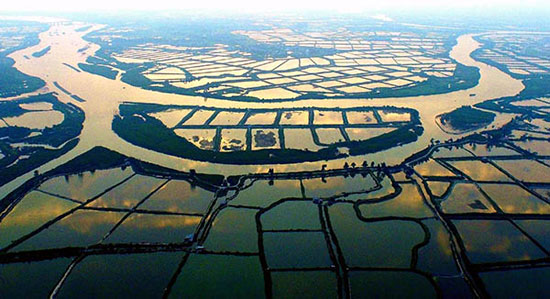
Shrimp ponds in the suburbs of Qinzhou, Guangxi (photographed on October 21, 2015).
The Guangxi Zhuang Autonomous Region, located in China's southern borderland, has more mountains and less arable land, hence the saying "eight parts mountain, one part water, one part field." People of all ethnic groups on this land have long pondered how to protect and make good use of the limited land, using their diligent hands to create breathtaking agricultural wonders on the earth and paint one beautiful picture after another.
For many years, Guangxi has strictly adhered to the "red line" for farmland, rationally used its limited farmland, and through measures such as guaranteeing space for development planning, construction land quotas and land consolidation projects, built beautiful modern countryside, triggering a surge of original ecological production and bringing well-being to the people. Data from the Guangxi Department of Land and Resources show that during the "12th Five-Year Plan" period, Guangxi built a total of 14.0026 million mu of high-standard basic farmland, raised overall cultivated land quality by 1-2 grades, and increased grain production capacity by more than 25 kg per mu; the 1,118 land consolidation projects that passed acceptance actually added 523,200 mu of cultivated land, benefiting more than 10 million farmers.
Photo by Xinhua News Agency reporter Zhang Ailin
Terraced fields in Ping'an Village, Longji Town, Longsheng Various Nationalities Autonomous County, Guangxi (photographed on April 20). The Longji Terraces have a history of more than 650 years, first built in the Yuan Dynasty and completed in the early Qing Dynasty. They are basic farmland developed by more than 30 generations of local compatriots of all ethnic groups with their blood, sweat and lives, and are famous worldwide for their neat plots and rich lines.
Banana plantation in Tanluo Town, Xixiangtang District, Nanning, Guangxi (photographed on April 3). Tanluo Town is a famous banana hometown in Guangxi, and currently has more than 200,000 mu of banana planting area.
Vegetable garden in Xijin Village beside Anji Avenue, Xixiangtang District, Nanning, Guangxi (photographed on February 12). During the "12th Five-Year Plan" period, Nanning's expansion accelerated. In order to enrich residents' vegetable baskets, vegetable farmers from all over the country made use of odd patches of land on the city outskirts to develop vegetable planting, forming today's vegetable fields in villages on the urban edge.
Autumn rice fields in Mashan Village, Mashan Township, Liucheng County, Guangxi (photographed on November 5, 2015). Every year at this season, the brilliant colors make this place a creative paradise for photography enthusiasts.
Rapeseed flower fields in Changfeng Village, Dongqi Township, Rong'an County, Guangxi (photographed on March 7). Every spring when the flowers bloom, thousands upon thousands of domestic and foreign tourists come here for sightseeing and enjoyment.