New trick in silkworm rearing and mulberry planting in Liyang: silkworm babies combined with cordyceps sinensis
This cooperative in Liyang has pulled off something remarkable in silkworm rearing and mulberry planting: not only did its new mulberry variety obtain a national invention patent, but it also got silkworm babies and cordyceps sinensis to “combine”
If this Chinese herbal medicine, cordyceps sinensis, is combined with other organisms, what magical results might ensue? The Liyang Tianmuhu Silkworm and Mulberry Professional Cooperative, in cooperation with the Institute of Botany, Jiangsu Province, Chinese Academy of Sciences, successfully developed silkworm cordyceps.
The cordyceps fungal stroma “combines” with live silkworms or silkworm pupae, growing out silkworm cordyceps
Silkworm cordyceps relies on the stroma of cordyceps sinensis as its base, grafting live silkworms or silkworm pupae onto the stroma, and in about a month silkworm cordyceps grows out. Its growth process takes less time than real cordyceps sinensis, and the price is lower, at 4000 yuan per kilogram. The grown silkworm cordyceps is bought back by the Institute of Botany for deep processing into health products.
Xia Ankou, chairman of the cooperative, explained that silkworms or silkworm pupae contain large amounts of protein, providing very favorable conditions for the smooth growth of silkworm cordyceps. At first, everyone grafted high-temperature sterilized silkworm pupae into the fungal spawn. After extensive trials, they found that grafting male live silkworms onto cordyceps sinensis stroma produced silkworm cordyceps with better activity.
Besides white, can silkworms be made to spin colored silk? This is a topic the sericulture industry has worked on for many years. To make silkworms spin colored silk, there are two ways: one is to change the genetic structure of the silkworm, and the other is to feed the silkworms food containing phytase pigments. Colored cocoons produced using the former method will not fade even when woven into silk fabric, washed in water and dried in the sun.
Under everyone's doubtful eyes, the cooperative introduced a new silkworm breed capable of spinning green silk, “Caoyuan × Shenyun”, which researchers bred by altering the silkworm's structure through gene mapping. Members who raised the new silkworm breed “Caoyuan × Shenyun” saw their income increase in the very first year. Colored cocoons sold for more than ordinary white cocoons, and the silk reeled from colored cocoons also skips the dyeing process, making it more environmentally friendly.
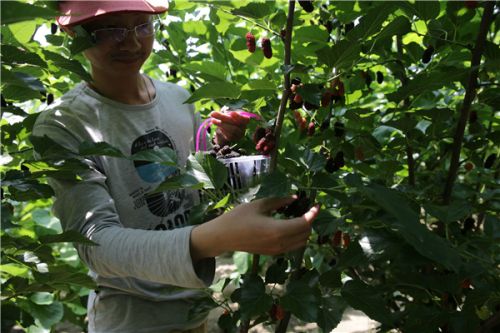
More than 100 varieties of fruit mulberry, among them mulberries that can grow to 14 cm
In the agricultural system of Liyang City, there are altogether two professional and technical personnel who enjoy the special government allowance of the State Council, and one of them is Xia Ankou, who was among those receiving this special allowance in 2010.
Xia Ankou studied sericulture in university, and after starting work spent more than half his time dealing with silkworms and mulberries. In his whole life he has done only two things: planting mulberries and raising silkworms. Even after stepping back to a secondary position, and even though in 2008 cocoon prices plummeted and large numbers of farmers cut down their mulberry trees, he still could not leave the sericulture cause he loved.
In the 1990s, sericulture was an important industry in Liyang City. Planting mulberries, raising silkworms and selling cocoons was the best way for farmers to get rich. At its peak, Liyang City had 100,000 to 120,000 mu of mulberry fields and as many as 5 silk reeling factories. With the development of the times and the adjustment of the economic structure, the sericulture industry has increasingly shrunk. Now, only in Hengjian and Pingqiao do some farmers still engage in traditional sericulture, with a combined mulberry plantation area of just over 10,000 mu, and most of them are cooperative members.
Xia Ankou explained that traditional mulberry varieties and the improved mulberry varieties from the heyday of sericulture were mainly for harvesting mulberry leaves. More leaves meant fewer mulberries, or even no fruit. Now, however, this contradiction has been alleviated. In cooperation with the Chinese Academy of Agricultural Sciences, Xia Ankou spent 10 years breeding a new dual-purpose mulberry variety for both fruit and leaves, which also obtained a national invention patent. This new variety's mulberry leaf yield is 20% higher than ordinary mulberry trees, and each mu can also produce 3000 to 4000 jin of mulberries.
In the cooperative's mulberry garden base, there are more than 100 introduced fruit mulberry varieties alone. Among them is one fruit mulberry whose sapling costs 100 yuan each, and the mulberries it produces can grow to 14 cm, about the length of a cigarette. The mulberry garden's picking tours are also open to visitors. Last year, its first year of opening, the response was good, and this year it will continue, with the garden expected to open in mid-to-late May. Visitors here can taste mulberries of various colors and varieties.