Song Zhengang develops large-scale farming and breeding, driving his fellow villagers to increase income and prosperity
Having heard that Song Zhengang of Lianjia Mao Village, Dianta Town, Shenmu, is a man of prosperity in the eyes of his fellow villagers, this writer recently visited the farming and breeding base he founded in Lianjia Mao Village, led by Song Zhengang and his wife.
Looking out, on the hills of Lianjia Mao Village's gullies and ridges, two tractors and a soil-loosening machine were loosening and leveling the farmland, after which a seeding machine would be used for planting; the 700 mu of leveled farmland seemed to come alive under the spring light.
Land transfer, large-scale planting to increase income and prosperity
Lianjia Mao Village has a typical Loess Plateau landscape. More than ten years ago, the farmland was scattered across the various hillsides, and villagers had to carry water from the gully in front of their homes, so most people in the village chose to go out to do business or work for money, causing more and more farmland to become wasteland.
Rolling up his sleeves, he set to work. In 2002, Song Zhengang began taking out loans to contract the village's wasteland, transferring more than 1000 mu of land. At first he planted grass on a large area of the contracted land and raised 200 beef cattle, but because of lack of experience and poor management, he ultimately did not make money.
In the autumn of 2005, Song Zhengang did not give up and began to regroup, developing crop farming. "In recent years, the government has strongly supported agricultural development, and there are subsidies for both farmland and livestock; last year the county subsidized more than 70000 yuan in total. I also actively learned about relevant provincial and municipal agricultural policies and sought projects with the county agriculture bureau; last year the county leveled 700 mu of land for the village free of charge," Song Zhengang said.
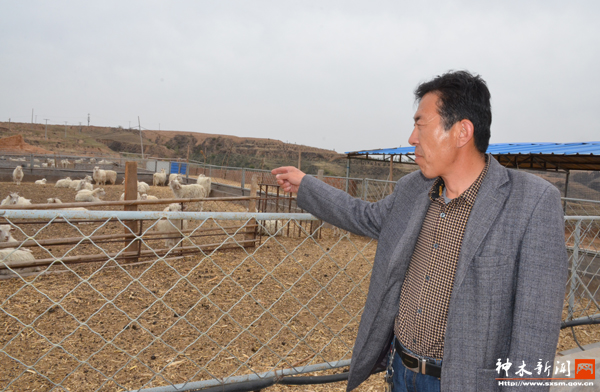
Song Zhengang introduces the white cashmere goat farm to this writer
This year, Song Zhengang will continue large-scale planting of plastic-mulched corn, millet, black beans and other miscellaneous grains, expected to reach more than 800 mu. At the same time, he raises more than 300 white cashmere goats, with more than 100 sold each year, and the annual net income from animal husbandry reaches more than 70000 yuan.
Establishing a minor grain brand to drive fellow villagers to prosperity
Song Zhengang believes that since his living conditions have gradually improved through large-scale planting, he should persuade the surrounding villagers to return home and develop farming and breeding. "Doing business outside certainly brings high income, but the risks are also great. Now the whole county strongly supports agricultural development, and with one's own down-to-earth efforts, life can also be very fulfilling," he said. At present, 8 farming households nearby have already developed contiguous planting.
Minor grains bought in scattered lots fetch low prices and are hard to sell, so Song Zhengang successfully registered the trademark "Yangcheng Wugu Minor Grains," and this year he will buy machinery to set up a minor grain fine-processing factory to solve the grain sales problem for himself and the surrounding villagers. "After the processing factory is completed, minor grains will be packaged to a standardized standard and sold directly in supermarkets in Shenmu and surrounding areas," he said.
Following the example of those above, setting a good example for the younger generation
"My wife and I keep our feet on the ground, simply hoping to set a good example for our children, hoping that when they grow up they can be hardworking and capable, and be upright and kind people," Song Zhengang said. Now his daughter has graduated from university, and his son is in middle school; they are both sensible and filial, and are unanimously praised and well regarded by the villagers.
His mother, Shan Junze, is 62 years old this year, and she often praises her daughter-in-law's filial piety to the villagers. She recalled that in 2013 she was hospitalized due to illness, and when her daughter-in-law Chen Huilian saw the mother's physical condition, she decided not to go out to work and devoted herself to caring for her mother at home, cooking delicious meals for her every day, washing clothes and bathing the elderly woman, often taking her out for walks when the weather was warm, buying clothes for her on holidays and birthdays, and often chatting with the elderly woman.
Chen Huilian told this writer that being filial to the elderly is what one should do, and it also sets an example for the children, hoping that they too will be well-educated and courteous, and filial to the elderly.