Exploring the Artificial Breeding of Chinese Sturgeon: The Ganzhou Dam Spawning Pool
Original title: The Past and Present of the "Patriotic Fish"
-- Lifting the Veil of Mystery on the Artificial Breeding of Chinese Sturgeon
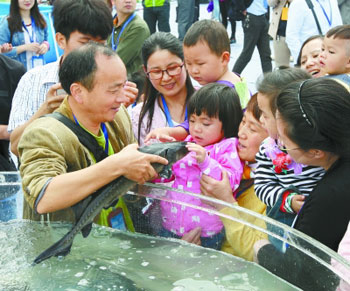
On April 24, at the Yangtze rare fish release point in Yanzhiyuan, Yichang City, Hubei Province, Chinese sturgeon attracted a crowd of onlookers. Photo by Sun Ronggang
"Leaving home young and returning old" -- this line by He Zhizhang of the Tang Dynasty describes himself and describes a wanderer, but does it not also describe the Chinese sturgeon?
The Chinese sturgeon, a fish named after "China," is born in the middle and upper reaches of the Yangtze River and lives in the Yellow Sea and East China Sea. Chen Lei, director of the Chinese Sturgeon Research Institute of China Three Gorges Corporation, said that when Chinese sturgeon reach maturity at 9-14 years of age, they can rely on their remarkable recognition ability to accurately find the Yangtze River estuary in the vast ocean, and in summer and autumn they travel upstream in groups, returning to their birthplace to pair up and reproduce.
Equally remarkable is that from the moment it enters the Yangtze River estuary until it leaves the Yangtze River and returns to the sea the following year, it eats not a single morsel of food, yet can travel 3,000 kilometers to find the place of its birth, demonstrating an astonishing capacity for enduring hunger and hardship. If one understands this behavior through human emotions, it is bringing life to the Yangtze River while taking almost nothing from it. Many people call it the "returnee overseas faction" and the "patriotic fish."
As a central state-owned enterprise with the mission of "building the Three Gorges and developing the Yangtze River," Three Gorges Corporation takes the ecological civilization construction of the Yangtze River as its responsibility, and has invested a cumulative total of more than 200 million yuan to carry out scientific research and protection work on the Chinese sturgeon. It has organized 58 Chinese sturgeon release events, with a cumulative release of more than 5 million fish, including more than 17,000 fully artificially bred "second-generation" Chinese sturgeon, effectively supplementing the Chinese sturgeon species resources in the natural environment.
On April 24, Three Gorges Corporation invited volunteers from 9 cities along the river, including Yueyang, to Yichang to release Chinese sturgeon. Sun Cheng, deputy general manager of the corporation, said with deep feeling: "I wish the Chinese sturgeon released today a smooth return to the embrace of the sea; I wish them endless life in the Yangtze River, our mother river!"
The "Living Fossil" Is Endangered -- Urgent!
The Chinese sturgeon, also called the kaluga sturgeon, is the most primitive extant species of fish in the world and can be called a "living fossil among fish." For 140 million years, with its superbly strong adaptability, it has witnessed the prosperity and extinction of the dinosaurs and personally experienced the formation and changes of the Yangtze River.
In ancient times, it was not yet called by this name with national significance; in the Erya it was called yellow fish. Chen Lei said that the Chinese sturgeon is a large anadromous migratory fish unique to our country, and among the more than 20 species of sturgeon in the world it has the lowest distribution latitude, the largest body size, and the fastest growth. It is an important reference for studying fish evolution and has important scientific value and immeasurable ecological, social, and economic value in studying biological evolution, geology, geomorphology, marine transgression, marine regression, and other aspects of Earth's changes.
For various reasons, the Chinese sturgeon is on the verge of extinction. Protecting this "living fossil" has profound significance for developing and rationally utilizing wildlife resources and maintaining ecological balance. In 1976, the state proposed protecting it through artificial propagation and release. Xiao Wang, a docent in the exhibition hall of the Chinese Sturgeon Research Institute, told reporters that many characteristics of the Chinese sturgeon are somewhat similar to those of humans. Its lifespan is generally seventy or eighty years, and long-lived ones can also live to around 100. In addition, the original spawning ground of the Chinese sturgeon was in Yibin, Sichuan, which is its old home. The small fry swim 3,000 kilometers from there into the sea, and then more than ten years later, they can return to their old home to spawn without the slightest error. Is this not very similar to human feelings toward one's hometown?
Daddy Sturgeon "Pays with His Life" -- Painful!
On January 4, 1981, the main river channel of the Gezhouba project was closed off, and the Chinese sturgeon's route back to its old home was blocked. Some people proposed building a fish passage on the Gezhouba hub to leave a way for the Chinese sturgeon, but due to technical and funding limitations, decision-makers chose to protect this species through artificial breeding.
In 1982, a specialized institution for protecting the Chinese sturgeon -- the Gezhouba Fisheries Office (renamed the "Chinese Sturgeon Research Institute" in 1987) -- was established in Yichang, and protection work began immediately.
Because the environment of the research institute's ponds was very different from the original spawning ground in the Jinsha River, the wild Chinese sturgeon caught could only undergo artificial insemination and artificial induced spawning. Artificial induced spawning required spawning-inducing materials, and the induced spawning technique was to kill male Chinese sturgeon, take their pituitary glands, and use them to induce spawning in female fish. Zhu Xin, former director of the breeding center of the Chinese Sturgeon Research Institute, recalled: "Using the taking of life to protect life made the researchers extremely conflicted."
On April 24, reporters saw at the release site that Chinese sturgeon of no small size were placed into the Yangtze River one after another from a slide. But in the 1980s, researchers used basins on boats to pour 1-centimeter-long newly hatched fry into the river. Zhu Xin said: "Under the artificial conditions at that time, only 5% to 10% of the eggs laid by Chinese sturgeon could develop into 1-centimeter-long 'water blossoms.' If these 'water blossoms' were kept growing in the artificial environment of the research institute, they would probably all die. Putting them into the Yangtze River was in the hope that they could survive in the natural environment."
The "Household Register" Gets Revised -- Joyful!
Under tremendous pressure, the researchers devoted themselves to study. In 1985, the Chinese Sturgeon Research Institute successfully used a self-developed synthetic hormone -- luteinizing hormone-releasing hormone analog (LRH-A) -- to replace male fish pituitary glands for induced spawning, ending the tragic history of Chinese sturgeon fathers trading their lives for their offspring.
Researchers conducted in-depth study on the problem of the artificial environment affecting the growth of fry. "Does the artificial environment easily cause fish diseases? How should water quality be improved? How should temperature be regulated? Even details such as whether the bottom of the fish pond was too rough and scraped the skin on the belly of the Chinese sturgeon became content for the researchers to think about and test," Zhu Xin said. "Now, what is released is all adult fish of more than 30 centimeters, which marks the maturity of the entire set of techniques for artificial breeding of Chinese sturgeon, from catching parent fish to releasing fry."
Good news also came from nature: below the Gezhouba Dam, a natural spawning ground formed. This shows that the Chinese sturgeon has adapted to the environmental changes brought by the closure of the Gezhouba project. The Chinese sturgeon's household registration moved from Yibin, Sichuan, to Yichang, Hubei.
That the Chinese sturgeon can gradually adapt to the Gezhouba project does not mean it can accept the effects of all human activities. "In the early 1980s, we could observe that Chinese sturgeon sperm had very strong vitality and tumbled up and down; in recent years, Chinese sturgeon sperm can only move in a straight line in the seminal fluid," Zhu Xin said. "Pollution of Yangtze River water quality will affect Chinese sturgeon reproduction; the increase in ships and frequent fishing activities will also squeeze the Chinese sturgeon's space for activity."
In 1988, the Chinese sturgeon was listed as a national first-class protected animal, and fishing was strictly prohibited; in 1996 it was included in the IUCN Red Data Book of endangered animals. Gao Yong, deputy director of the Chinese Sturgeon Research Institute, called out: "Only if the government, scientific research institutions, environmental organizations, and citizens -- especially the people along the Yangtze River -- join hands with one heart and truly work hard can we prevent the Chinese sturgeon from repeating the fate of the baiji."
The "Second Generation" Takes Over -- Strong!
On October 4, 2009, the first fully artificially bred "second-generation" Chinese sturgeon in the history of Chinese sturgeon research broke out of its fertilized egg membrane. In June of the following year, the first batch of "second-generation" Chinese sturgeon was released into the Yangtze River.
What is the "second generation"? Researchers call the wild Chinese sturgeon caught the "grandparent generation"; the generation artificially bred from them is called the "parent generation"; and the next generation of Chinese sturgeon obtained through artificial breeding from male and female fish of the "parent generation" is the "second generation."