Pesticide Supply-Side Reform Advances, New Product R&D Breaks New Ground
Original title: How should the supply side of the pesticide industry be reformed?
R&D should win through novelty, and services should be more down-to-earth
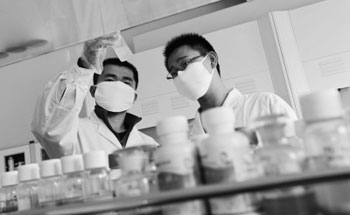
R&D and innovation are an important part of supply-side reform in the pesticide industry. Photo by Zhang Tao
At present, China's pesticide industry is in a period of low growth, with declining industry prosperity, slowing market demand growth, rigid overcapacity in most products, and intensifying disorderly homogeneous competition, pushing the industry into an era of thin profits. Coupled with the proposal of the zero-growth target for pesticide use and new changes in the market environment, all of these are forcing supply-side reform in the pesticide industry. How should the supply side be reformed? How can competitiveness be improved? Let us listen to the insights of people in the industry.
Pesticide supply-side reform is imperative
In recent years, the pesticide market has experienced a lean year, not because demand is insufficient, but because too many pesticide products that should not be produced have been produced, while the pesticide products needed for agricultural production are in short supply. Pesticide supply-side reform is imperative, and this has become a consensus in the industry.
Li Zhonghua, secretary-general of the China Pesticide Industry Association, pointed out in his analysis that the current downward pressure on the domestic economy is constantly increasing, enterprises are facing enormous pressure from environmental protection and safety, the pesticide industry has overcapacity, and the contradiction of homogeneous competition is becoming increasingly prominent. Last year, the Ministry of Agriculture proposed the zero-growth target for pesticides, multinational companies are continuously expanding their territory in China, and product promotion efforts are constantly increasing. Various unfavorable factors led to a general decline in industry profitability in 2015.
"In the current pesticide market, on the one hand, competition among homogeneous products with the same active ingredients is becoming increasingly fierce and has even reached a white-hot stage, with many varieties already unprofitable; on the other hand, for some minor crops, pesticides are hard to find or even unavailable, leading to misuse and excessive use of pesticides in some places." Deng Zhaoli, general manager of Hunan Meili Environmental Ecology Co., Ltd., pointed out that this contradiction should attract great attention from pesticide enterprises. Product R&D must closely follow market needs. Only products that the market needs have vitality.
"Zero growth in pesticide use has become a trend in industry development. To truly implement this target, the role of pesticide enterprises is indispensable. The new situation of modern agricultural development has put forward higher requirements for the production and operation of pesticide manufacturers, and urgent requirements for the adjustment of manufacturers' product structures." Yang Fuchu, director of the Hunan Plant Protection and Quarantine Station, pointed out that achieving "zero growth" in use means improving product quality and standards and producing new, highly efficient, low-risk pesticides. This requires pesticide manufacturers to accelerate the development of high-tech products, eliminate outdated production capacity, accelerate the cultivation of new strategic growth points, and vigorously develop highly efficient low-risk pesticides, integrated pesticide-fertilizer products, biological pesticides, and more.
Agrochemical services must be more down-to-earth
The pesticide market has changed from the previous "sell whatever is available" to today's growers making their own choices, with pesticide enterprises becoming the ones being chosen. In addition to providing good products, improving service capabilities has also become a lesson that enterprises must take seriously.
Liu Jie, secretary-general of the Hunan Crop Pest and Disease Specialized Control Association, said that removing intermediate circulation links, developing customized pesticide products, reducing manufacturers' marketing costs and growers' procurement costs, and achieving specialization, automation, informatization, and transparency in the sales process are inherent requirements and inevitable trends in pesticide sales. One of the most effective ways is to achieve production-demand alignment. On the one hand, scientific application techniques can be directly transmitted to growers; on the other hand, production can be determined by sales and circulation costs can be reduced.
Li Weiguo, chairman of Guangxi Tianyuan Biochemistry Co., Ltd., introduced that in response to the current problems of low spraying efficiency, poor control effectiveness, and difficulty finding workers among farmers, the company has achieved a successful transformation "from selling pesticides to farmers to spraying pesticides in farmers' fields." In recent years, it has established more than 500 spraying teams nationwide, with a cumulative service area of more than 10 million mu-times, effectively expanding market space through plant protection services.
"Whoever can provide farmers with better and more comprehensive services is the winner." Shen Qunbin, general manager of Hunan Jindadi Agricultural Materials Co., Ltd., stated that the transformation of agricultural materials distributors into service providers is the general trend. To build service-oriented enterprises and distributors, the prerequisite is to provide meticulous service, which requires more specialized technology. To this end, Jindadi Company and pesticide manufacturers jointly built an "Agrochemical Service Center," creating a four-level agrochemical service platform consisting of "an expert team, a company full-time agrochemical team, a company frontline agrochemical team, and a county-level agricultural technical expert team." Through training lectures, experimental demonstrations, on-site guidance, and other professional agrochemical services, products, technology, and services are brought to villages and households, truly solving the "last mile" problem of agricultural science and technology serving agriculture, and genuinely achieving a win-win-win for production, sales, and use.
"At present, more than 60% of the company's profits come from agrochemical services, while profits from pesticide production account for only 30% of the company's total profits." Huang Anhui, general manager of Hunan Wanjiafeng Technology Co., Ltd., pointed out that the fundamental way out for pesticide enterprises lies in accelerating innovation in agrochemical service methods, becoming providers of overall agricultural solutions, improving agrochemical service levels, guiding farmers to use pesticides scientifically, and winning development space under the new "zero growth" requirement through "products + services."
Homogeneous competition is not as good as winning through novelty
For the pesticide industry, product R&D and innovation are the key to supply-side reform, and this is also a weak point for domestic pesticide enterprises, requiring especially great effort. As safety and environmental protection requirements become increasingly strict, pesticide products that are green and efficient, have novel mechanisms of action, and meet segmented market demands will usher in greater development space.
Fan Kuncheng, deputy general manager of Zhejiang Xinnong Chemical Co., Ltd., stated that pesticide enterprises must promote the transformation from mainly producing homogeneous products to mainly producing personalized and distinctive products, providing new market space for enterprise development.
"The area of farmland weeds in China increased by more than 100 million mu from 2010 to 2014. This is because the single use of herbicides, farming systems, and other factors have led to changes in the weed spectrum in farmland, with resistant weeds developing rapidly. In the future, the number of resistant weed species will increase rapidly. In particular, paraquat will soon be banned, and the market urgently needs herbicides with new mechanisms of action." Tang Huilian, deputy director of the Hunan Plant Protection and Quarantine Station, pointed out that pesticide manufacturers' product R&D must win through novelty. Rather than cheaply developing unprofitable homogeneous products, it is better to develop personalized and distinctive products with independent intellectual property rights on a grand scale and from a high starting point. Pesticide enterprises must dare to change the herd mentality of being good at imitation and weak at innovation. Only with a unique trick can one eat all over the world.
Many enterprises have already tasted the sweetness of independent innovation. Huang Anhui, general manager of Hunan Wanjiafeng Technology Co., Ltd., stated that the company's rapid development in recent years has benefited from the copper abietate series of products with independent intellectual property rights, which have not only become the company's number one brand product but also its flagship product for resisting risks and protecting profits. In recent years, Guangxi Tianyuan Biochemistry Co., Ltd. established a dedicated aerial spraying agent R&D team, and its aerial spraying dedicated agents have grown at an annual rate of up to 50% in Hunan.
Integration of seeds, fertilizer, pesticides, and machinery is the trend
Modern agricultural production not only requires high-quality and affordable agricultural materials but also full-process services from planting to harvest. The trend of deep integration of the seed, fertilizer, pesticide, and agricultural machinery industries is becoming increasingly obvious.
In 2015, Guangxi Tianyuan Company attempted to mobilize distributors to transform into spraying teams. In addition to spraying, the spraying teams also provided rice seedling raising, transplanting services, and harvesting and drying operations based on the time differences in rice planting across different regions. In this way, farmers' pesticide costs can be reduced, and they do not need to purchase agricultural machinery such as seedling raising equipment, transplanters, harvesters, and dryers, greatly reducing agricultural production costs. For the spraying teams, this can achieve full utilization of agricultural machinery and equipment and maximize returns.