Citrus, green peppers, and honey peaches: how can Quzhou's three treasures be upgraded?
Original title: The Variation of Citrus, Pepper, and Peach
-- Quzhou's Exploration of Supply-Side Structural Reform in Agriculture
In late spring, walking into this green land of western Zhejiang, one can feel the vibrant spring vitality everywhere.
Advancing supply-side structural reform in agriculture -- this new requirement, written into the Central Document No. 1 for the first time this year, is for the cadres and people of Quzhou not only another baptism of agricultural development concepts, but also the best affirmation of their reform explorations in recent years. From creating a modern ecological circular agriculture development system to the integrated development of the primary, secondary, and tertiary industries, from strengthening agriculture through green development to enriching the people through ecology, Quzhou's practice of supply-side structural reform in agriculture has always been underway.
Now, benchmarking against the requirements of the Central Document No. 1, Quzhou is pushing supply-side structural reform in agriculture deeper with further understanding, a more conscious attitude, and greater practical efforts.
Supply-side reform reflections triggered by a single citrus fruit
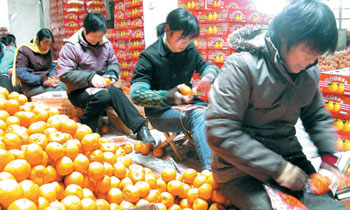
Quzhou citrus is one of the local leading agricultural industries with the largest planting area and the most households involved.
In today's increasingly diversified planting industry, Quzhou still has 560,000 citrus farmers and 510,000 mu of citrus orchards. However, against the backdrop of overall overcapacity in the national citrus industry, Quzhou citrus has encountered "difficulty in selling" more and more frequently in recent years.
Estimates by relevant local departments show that Quzhou's total citrus output last year was 650,000 tons. At present, only a little over 70 percent of the city's citrus has been sold, whereas in previous years at this time sales were already close to 90 percent.
Fang Peilin, deputy director of the Agriculture and Forestry Bureau of Kecheng District, Quzhou City, has dealt with citrus for more than 30 years. In his view, there are two main reasons for the "difficulty in selling" citrus:
First, the production and operation system is backward, and citrus orchards are fragmented. Taking Kecheng as an example, among 180,000 mu of citrus, there are only a few contiguous orchards of more than 50 mu. Planting is scattered among thousands of households, and advanced production factors such as technology and facilities cannot be concentrated, severely restricting improvements in production efficiency.
Second, production and operation entities are weak and tend toward part-time farming and aging. In the past, specialized households dominated, with energy and technology, and family income mainly came from citrus. Now, farmers mainly earn money by working elsewhere, citrus planting is generally part-time, and it is often left to elderly people and women staying behind to manage casually. Extensive management results in low citrus quality.
Unlike previous years, this year citrus is not only "difficult to sell" but has also suffered natural disaster. The rare severe cold last winter caused nearly 80 percent of the city's citrus trees to be severely frozen.
The dual crises of unsold inventory and freeze damage have fully exposed the deep-seated problems of the citrus industry and also prompted Quzhou people to think -- how to use the approach of supply-side structural reform to promote the transformation and upgrading of the citrus industry.
The Quzhou Municipal Party Committee believes that it is necessary to start from the supply side to reduce overcapacity, eliminating a batch, transforming a batch, upgrading a batch, and transferring a batch, so as to achieve quality improvement and efficiency enhancement in the citrus industry and sustained increases in farmers' incomes.
Quzhou has designated this year as "the decisive year for the transformation and upgrading of the citrus industry," fully mobilizing and implementing an upgrading plan, striving to eliminate 50,000 mu of "three-low" citrus orchards citywide, transfer 50,000 mu of citrus orchards, establish 50,000 mu of greenhouse facility-cultivated citrus orchards, transform 50,000 mu of low-yield and low-efficiency citrus orchards, and top-graft 5,000 mu of citrus... Every measure points directly at the supply side.
At present, Quzhou is actively mobilizing smallholders to transfer land, concentrate advanced production factors, and improve quality and efficiency. In Kecheng District, more than a thousand mu of scattered citrus orchards have recently been transferred to large growers and cooperatives for upgrading and transformation of the orchards.
The practice of supply upgrading behind a single green pepper
While "difficulty in selling" agricultural products is heard from time to time, consumers also complain that "nothing feels safe to eat." Seizing this major trend of consumption upgrading, Quzhou fully leverages its ecological advantages and, by building a pioneering zone for ecological circular agriculture, promotes the upgrading of agricultural product supply.
Qujiang is one of the first pilot counties nationwide for agricultural product quality and safety creation. In 2014, it began establishing eight major systems for trustworthy agriculture covering pre-production, mid-production, and post-production, taking the lead in building a trustworthy agriculture brand across the entire region and the entire industrial chain.
In Lianhua Town, Qujiang District, on farmer Chen Jianhai's family farm, even an ordinary green pepper has a QR code "ID card." Whether the soil environment where it grows meets standards, when it was sown, pesticide and fertilizer use, when it was harvested, test results before going to market... all can be traced through the entire process. Consumers at direct sales stores can also view real-time dynamics of the production base via video. "Other people's green peppers sell for 4 yuan per kilogram at wholesale, but mine sell for 6 yuan and people still scramble to buy them," Chen Jianhai said.
In Qujiang, more than 1,000 family farms have transferred more than 60 percent of the district's arable land, driving surrounding farmers to grow trustworthy agricultural products. Whether it is wild rice stem, grapes, strawberries, tea, or flowers, Qujiang has a unified standardized production model. From production area environment to quality control, there are rules and standards to follow in every aspect.
In recent years, Qujiang has built and improved a four-level agricultural product testing system at the "provincial, municipal, district, and township" levels. Chen Jianhai said that on average, there is a provincial-level test here once a month, a municipal-level test almost once a week, and district-level and township-level tests are even more frequent.
In Qujiang, business entities responsible for major agricultural product quality and safety incidents are permanently barred from enjoying relevant policy subsidies; those failing spot checks twice in a row may not enjoy policy subsidies for two years. In 2015, Qujiang tested nearly 40,000 batches of agricultural products, with a spot-check pass rate reaching 99.3 percent.
Trustworthy agriculture promotes supply upgrading on one hand and drives farmers' income growth on the other. Now, among Qujiang District's 260,000 mu of land, there are 62,000 mu of "10,000-yuan fields," including 30,000 mu of "20,000-yuan fields." Quzhou has built more than 600,000 mu of organic, green, and pollution-free agricultural product bases citywide, and the spot-check pass rate for agricultural products has stabilized above 99 percent.
The "connected secondary and tertiary industries" chain behind a single honey peach
At the recent Peach Blossom Festival, Guoqiang Family Farm in Kela Village, Hu Town, Longyou, was packed with visitors.
"Several thousand tourists came in just one weekend, and the farm restaurant had to turn over tables seven or eight times a day," farm owner Li Guoqiang said with emotion. In the past, the banks of the village's several streams were all full of livestock farms. Not only was the stream water black, but in summer the stench was overwhelming. Thanks to the "Five Water Co-governance" initiative shutting down heavily polluting livestock farms, otherwise who would come to his peach orchard.
Li Guoqiang has more than 200 mu of peach orchards. After starting pick-your-own tours, he had no worry about selling peaches at all, and even the honey peach wine sold out. So he also brewed kiwi fruit grown on the farm into kiwi wine, dried figs into dried figs... In processing alone, Li Guoqiang earned nearly 400,000 yuan last year. Next, Old Li also wants to develop homestay tourism.
Making up for shortcomings in the ecological environment not only improves the living environment but also provides broad space and infinite possibilities for building a richer and more efficient production and supply system.
In recent years, Quzhou has made up for ecological and environmental shortcomings through "Five Water Co-governance" and "Three Reforms and One Demolition," nurturing and giving rise to more and more new business formats integrating the primary, secondary, and tertiary industries, such as "agriculture + tourism" and "agriculture + health."
The city has vigorously shut down heavily polluting small and medium-sized livestock farms, reducing the cumulative pig inventory by more than 4 million head. Former pig sheds have become mushroom sheds, vegetable sheds, and medicinal herb sheds...
At present, Quzhou has nearly 5,000 registered family farms citywide, among which 456 creative agriculture and leisure sightseeing family farms have been cultivated. (Reporters Deng Wei, Weng Jie, Mao Guanghui; Correspondent Zhu Xiaofen)