A post-80s couple returns from the city to the countryside to build a rice kingdom
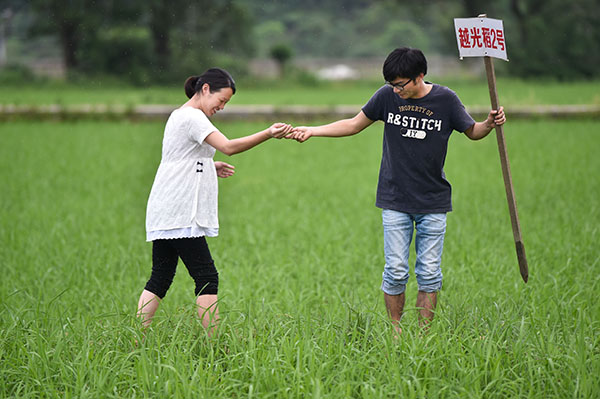
On May 3, Li Xiaowen (right) assists Liang Yongying, who is pregnant with their second child, in a soil remediation experimental field. The couple has set aside part of their land for public-interest soil remediation experiments.
Junlian Village in Zhongdu Town, Shanghang County, Longyan City, Fujian Province is located in the former revolutionary base area of western Fujian, with many mountains and little farmland. Even now, some villagers still cannot understand why Li Xiaowen and Liang Yongying, who had worked so hard to leave this poor mountain valley to attend university in big cities, came back to farm, and to farm 869 mu of land at that, all of it rice paddies.
But the "post-80s" couple Li Xiaowen and Liang Yongying are quite clear in their own minds: "We wanted to come back and make something of ourselves."
In 2006, Liang Yongying and Li Xiaowen graduated from East China University of Political Science and Law and Nanchang Institute of Technology respectively. After striving for many years in cities such as Shanghai and Fuzhou, these two young people who had come out of the countryside still set their sights on their familiar hometown.
In 2013, they returned to their hometown of Junlian Village and, through much trial and error, set up a family farm. From raising cattle and pigsraising geeseto vegetable cultivation, they went through an initial period of "hammering here and there," as Li Xiaowen put it: "We wanted to do everything well, but in the end we couldn't attend to anything. Of more than 100 geese, only a little over 10 survived. We paid a lot of tuition in the school of hard knocks."
After many attempts, investigations and explorations, Li Xiaowen and Liang Yongying finally chose to grow rice, for which the cultivation techniques were relatively mature. With the help and guidance of their families and agricultural departments, their planting scale expanded from more than 180 mu at the beginning to 869 mu today, with more than 70 long-term workers, an annual output of nearly 1,000 tons, and an annual net income of more than 100,000 yuan. They own agricultural machinery including rice transplanters, seeders and harvesters, and even spent more than 80,000 yuan to buy a drone for field management.
Production and operations have gotten on track, and what is even more gratifying is that Liang Yongying became pregnant with their "second treasure" at the end of 2015. In addition to the imminent new arrival, "this year we will also build a 600-ton grain warehouse, and achieve fully mechanized production even in the mountainous areas of the south," Li Xiaowen said.
On May 3, Liang Yongying (left) talks in the field with villagers she hired to spray pesticides.
Composite photo: On May 3, Liang Yongying inspects the rice growth in the field (top); Li Xiaowen takes photos to document rice production conditions for later analysis (bottom).
On May 3, Li Xiaowen (right) and Liang Yongying load the unused organic fertilizer onto a truck to haul it back.