Ecological feed for raising meat pigeons boosts income and prosperity for villagers in the old revolutionary base areas
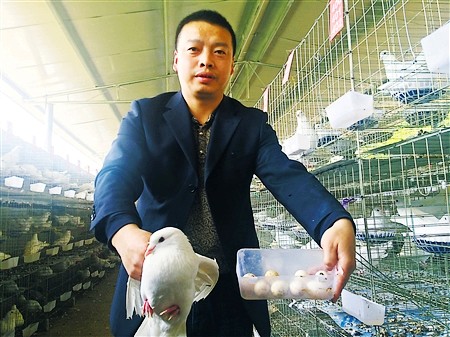
On April 28, in Shizhu County, Yuan Rengui raised meat pigeons on feed made from golden buckwheat (Fagopyrum cymosum), and their disease resistance improved; golden buckwheat is the main raw material of "Jizhi Syrup."
As the saying goes, "one pigeon beats nine chickens." The pigeon, a protein-rich rare meat bird, has always been a delicacy on the dining table. Yuan Rengui, 41, under the government's guidance, has been vigorously developing Chinese medicinal herbs in Shizhu. Now, he combines Chinese medicinal herbs with meat pigeon breeding, using golden buckwheat, the raw material for producing "Jizhi Syrup," to make feed for pigeon breeding, reducing the proportion of pigeons suffering from disease by 30 percent, while the price has risen by nearly half thanks to the excellent meat quality.
Abandoned golden buckwheat straw becomes a problem
On April 28, participants in the large-scale interview activity "Studying and Implementing the Spirit of General Secretary Xi Jinping's Inspection of Chongqing - Chongqing in Action: Young Journalists Going, Turning and Reforming" arrived at the last old revolutionary base area of this trip - Shizhu County.
Baohe Village, Xixin Township, Shizhu County, is more than a 2-hour drive from the Shizhu county seat, sits at an altitude above 1200 m, and is a small village bordering Hubei Province. Yuan Rengui is not tall and is rather thin, but he is a capable man in the eyes of the villagers.
"Following him, you can make money; I admire him from the bottom of my heart," said local villager Ma Zixiang. If not for Yuan Rengui coming to the township to teach the techniques of growing golden buckwheat and raising meat pigeons, they would still be poor households today.
A row of factory buildings by the road keeps emitting "coo coo" calls; this is the "incubation ground" where Yuan Rengui leads the villagers to prosperity - the pigeon house. It turns out that, with the support of the Municipal Old Revolutionary Base Areas Construction Promotion Association and the local government, Yuan Rengui had just established the "Red Baohe Pigeon Raising Cooperative."
Speaking of "raising pigeons," one must first mention Yuan Rengui's original trade - growing Chinese medicinal herbs.
Yuan Rengui was originally from Jinshan Town, Nanchuan District. In 1998, after graduating from Fuling Industrial School with a secondary specialized school diploma, he entered the Nanchuan Pharmaceutical Company, rising from Chinese medicine supervisor all the way to deputy general manager of the company. At the end of 2003, he was spotted by the Shizhu Chinese Medicinal Materials Company and brought in to serve as deputy general manager of the Shizhu County Chinese Medicinal Materials Company, responsible for building golden buckwheat bases and other work. In March 2004, he developed 50 mu of golden buckwheat planting in Wugang Village, Yuelai Town, and that year each household achieved a good result of 2000 yuan in income per mu.
Yuan Rengui said that golden buckwheat is simple to plant and easy to manage. Planted in March each year, it only needs good fertilizing and weeding, after which it can go for several months without much management, and by November the mature golden buckwheat rhizomes can be dug out. For farmers living above 1000 m in altitude, who previously could only rely on growing corn and potatoes, growing golden buckwheat is a path to prosperity.
Li Fengxian, 51 this year, is a beneficiary of growing golden buckwheat. "Now I grow 7 mu of golden buckwheat myself, with an annual income of nearly 30,000 yuan, which is an earth-shaking change compared with growing corn before."
Yuan Rengui also established the first golden buckwheat professional cooperative in Shizhu County, greatly raising the degree of farmers' organization, and at the same time signed a long-term supply contract with Taiji Group, resolving the villagers' worries.
The benefits of growing golden buckwheat grew better and better, and the planting scale grew larger and larger. By 2010, nearly 20 townships across the county were growing golden buckwheat, and the planting scale had developed to more than 20,000 mu. As the planting scale continued to grow, the worthless golden buckwheat straw became waste; the piled golden buckwheat straw gave off a disgusting stench, drawing widespread complaints from the people, and Yuan Rengui was even more anxious and frantic.
Meat pigeons eat "Jizhi Syrup" to build up their bodies
Looking at the golden buckwheat straw piled up like mountains across the hills, Yuan Rengui thought while consulting relevant materials.
In the winter of 2010, combining a large amount of relevant information collected recently, and under the guidance of relevant professional departments, Yuan Rengui learned that using golden buckwheat to produce livestock feed could greatly alleviate the problem of abandoned straw.
How feasible was it? What were the market prospects? How much was the production investment? Where were the production equipment... a whole series of questions was placed before Yuan Rengui all at once.
Yuan Rengui traveled between Rongchang, Chengdu and other places, investigating feed demand and learning feed processing and its formulas.
Golden buckwheat, also known as bitter buckwheat, has effects such as expelling phlegm, relieving fever, anti-inflammation and anti-tumor; the commonly used "Jizhi Syrup" uses golden buckwheat as its raw material.
"I always thought only the root of golden buckwheat used in medicine was useful, but it turns out the whole buckwheat plant is a treasure." Yuan Rengui, back in Shizhu after his study tour, said that other places use plant straw to process feed, and golden buckwheat straw can not only prevent blue ear disease in pigs, but also improve immunity and enhance pork quality, so it should be able to be processed into feed.
Yuan Rengui then took out his savings from previous years to build a feed processing plant.
The golden buckwheat straw and root fibers that used to be considered a burden were "turned from waste into treasure" as pig feed additives, allowing villagers to sell about 1000 yuan more per mu of golden buckwheat, and everyone was overjoyed.
Yuan Rengui also keenly saw the development prospects of the meat pigeon market, so last year he built a pigeon house and used golden buckwheat as feed to trial-raise meat pigeons, assigning dedicated staff to stay at the breeding farm and conduct trial feeding by groups, keeping ledgers and recording the process.
Yuan Rengui's employees recorded the growth of the meat pigeons day and night, and raised them under the guidance of experts. "Pigeons fed golden buckwheat feed had their illness rate and mortality rate reduced by at least 30 percent." Yuan Rengui said that throughout April, the pigeon house had a total of 1170 pairs of pigeons, and fewer than 10 died; with ordinary breeding, at least more than 30 pigeons would get sick and die. Yuan Rengui said that the meat pigeons eating "Jizhi Syrup" every day greatly reduced the illness rate and ensured improved meat quality.
At the same time, Yuan Rengui took the quality of the meat pigeons to relevant departments for testing and found that the protein content and trace elements of the meat pigeons were higher than those of meat pigeons fed ordinary feed.
Ecological feed for raising meat pigeons increases villagers' income
Yuan Rengui currently develops 1400 pairs of meat breeding pigeons in Xixin Township, with 1170 pairs in concentrated breeding, and through the method of "borrowing pigeons to raise pigeons," drives 46 targeted poverty alleviation households to raise meat breeding pigeons.
"Poor households borrow 5 pairs of pigeons from the company for free to breed at home; after breeding, the company helps sell them, and they can also get dividends." Yuan Rengui said that this not only increases poor households' motivation to breed, but also ensures sales, allowing villagers to increase their income.
After the project is completed, the meat pigeon industry is expected to increase annual income by more than 448,000 yuan, which can increase each household's annual income by more than 4370 yuan.
Golden buckwheat stalks and root fibers were "turned from waste into treasure" and made into feed additives, and Yuan Rengui last year also opened Shizhu County's largest feed plant, producing feed for pigs, chickens, ducks, geese, fish, pigeons, rabbits and so on.
Yuan Rengui said that at present, by establishing a golden buckwheat planting base, a Chinese medicinal herb rough processing plant, a golden buckwheat feed plant and a golden buckwheat pig farm, a golden buckwheat circular industrial chain has been formed. Farmers grow golden buckwheat, and both the golden buckwheat and the main stalks are sold to the professional cooperative; the golden buckwheat feed produced by the professional cooperative is sold to farmers to raise pigs; the professional cooperative implements a minimum protective purchase price; pig manure is also the best farmyard manure, used to grow golden buckwheat, and so the cycle repeats.
"Poverty in the old base areas is not frightening; what matters is adapting to local conditions, and in poverty alleviation, aspiration must come first." Yuan Rengui said that relying on the unique natural conditions and using high-tech methods to develop modern agriculture, there is no fear of poverty again.