The money-making story of Duan Biqing, a young man from a small border village
He grew up in the city, yet he went to live in a small village on the China-Myanmar border in Yunnan. The villagers here have their own language, and the wild flowers, fruits and vegetables on the mountain are their delicacies. Here, he went from being unable to afford a meal at first to making the villagers rich along with him. See how this post-85 generation young man created a new industry with annual sales of over ten million yuan.
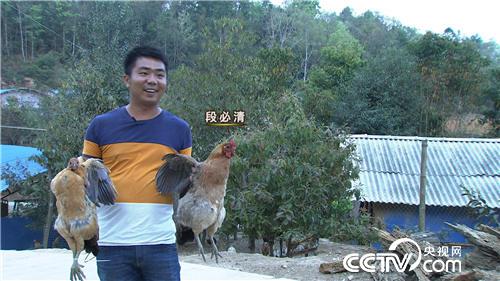
On March 14, 2016, the reporter came to Huwa Village in Ruili City, Yunnan Province, a typical small border village.
Duan Biqing: “This is a ferry crossing in our village. This side is Myanmar, this side is China. Our side uses the river as the boundary.”
Duan Biqing's chicken farm is built in Huwa Village, where there is a special food that chickens love to eat.
Duan Biqing: “Banana, very sweet. Below is the banana flower, very sweet, with lots of honey-like stuff. This is the honey; the bees all collect honey here.”
What surprised the reporter was that what the chickens love to eat is not the banana flower, but the trunk of this wild banana plant.
Duan Biqing: “Watch out, it's going to fall, it's about to fall.”
The reporter had heard of chickens eating grass and eating tree bark, but eating an entire tree trunk was a first.
Reporter: “It looks dry and withered, but there's so much moisture inside.”
Duan Biqing: “The chickens especially love to eat it. The villagers plant lots of banana trees where they raise chickens. When I go to check a couple of days later, another banana tree will have fallen, and a couple of days after that, another one will fall. The chickens peck at its roots, peck a ring around it, it becomes thin, and then it falls.”
Duan Biqing is one of the top ecological chicken farmers in Ruili. Those who know him well know that he raises chickens differently: the price of one of his chickens is thirty to forty yuan higher than that of chickens nearby, and annual sales exceed ten million yuan. But just over three years earlier, Duan Biqing had fallen so low that he could not even afford a meal. When talking about his entrepreneurial experience, he gets very emotional.
Duan Biqing: “These past couple of days, it seems like all at once, all the emotions of these past few years, all of it, has been released.
One day in early September 2012, Duan Biqing, who had been too proud to contact his father for over a year after a quarrel, finally, after hesitating for a long time, dialed his father's phone number.
Duan Biqing: “I haven't eaten for five or six days, just pickles. Can you bring me some meat to eat?”
Hearing the cry for help, his father Duan Shengming immediately rushed over with the hand-held rice noodles his son loved most. He will never forget the sorry state his son was in at the time.
Duan Biqing's father Duan Shengming: “Hand-held rice noodles, a big package. Normally you can't finish it all, but in just over ten minutes, he ate and swallowed the whole thing.
Duan Biqing's home is in Ruili City. He is the only son in the family. His father did not have this son until he was 33, and doted on him greatly, never letting him suffer any grievance or hardship. In 2009, after graduating from university, Duan Biqing applied to be a village official. Full of anticipation for the job, he came to Huwa Village.
Huwa Village is located on the border, with limited access to information. Duan Biqing wanted to use his knowledge to accomplish something in his position. But what he did not expect was that once he arrived, he found many things he could not adapt to.
More than 80% of the villagers in Huwa Village are Jingpo people. Knives are inseparable from their lives. The mountains are their vegetable garden. Years of experience living in the mountains have taught them to distinguish edible wild flowers, fruits and vegetables, turning them into delicacies on the table.
In Huwa Village, making a fire with firewood to cook is the most basic life skill, but for Duan Biqing, who grew up in the city, it was a big problem.
Duan Biqing: “I had never lit a fire before. I didn't know how to prop up the firewood one stick at a time to light it. I just threw a pile there and lit it randomly. I could try for half an hour and still not get it lit.”
Villager Shi Yankang: “He didn't know how to boil water, and there was no electricity. He bought instant noodles, so what could he do? He ate them dry.”
The Jingpo people have their own language. The vast majority of villagers cannot speak Mandarin well. Duan Biqing wanted to blend into the villagers' lives, but he could not even make small talk with everyone, and the villagers were unwilling to come to him to get things done. When he first came to be a village official, Duan Biqing thought, a village official is still an official of some sort, but he never expected reality to be so far from his imagination.
Duan Biqing: “At that time I had to sweep the floor, wipe the tables, flush the toilets. The sense of defeat at that time was especially, especially strong.”
Gradually, Duan Biqing felt out of place in the life of Huwa Village. There was nowhere to put his youthful ambitions to use. Emptiness and confusion crept into his heart, and Duan Biqing began to think about giving up.
Duan Biqing began to suffer from sleepless nights, night after night. He felt it was time that he had to change and do something. After spending 2 months visiting more than three hundred households in Huwa Village, he made a wealth discovery.
Duan Biqing: “At that time, I felt that being a village official was more about discovering the problems here and finding the opportunities here.”
Duan Biqing decided to start a business while working. Ignoring his father's opposition, he had his mother help him borrow 60,000 yuan to contract 10 mu of barren mountain land. In order not to neglect the village work, he also brought in a classmate as a partner. Duan Biqing planned to build a money-saving bamboo house, but what he did not expect was that cutting bamboo was not easy.
Reporter: “What are you looking for?”
Duan Biqing: “I'm looking for bamboo.”
Reporter: “There's so much bamboo, just find one at random.”
Duan Biqing: “Cutting it is very easy, but getting it out is especially hard. They're all interwoven one with another. It's very hard to bring them down. That's where the difficulty in cutting lies. It's not like cutting a tree. Cut a tree, and crash, it falls. Bamboo won't do that. It's like dismantling building blocks. If you cut randomly, you won't be able to take it apart.”
Duan Biqing is now an expert at cutting bamboo, but at first, looking at one bamboo stalk after another, he had no idea how to start. Moreover, carrying the cut bamboo out of the mountain was even more difficult.
In the face of reality, Duan Biqing fully experienced the hardships of starting a business. After gritting his teeth and persisting for more than a month, he finally built this bamboo house in the mountain.
Duan Biqing: “At that time we lived right here. It was all ventilated. You see, these bamboo stalks are all ventilated; you can see outside. When there's fog, if it's foggy outside, it's foggy inside too. At night you had to sleep with your head covered, otherwise your eyebrows and hair would all get wet. At that time it was completely unable to keep warm.”
At the time, although Duan Biqing was living in this house that let the wind through on all sides, his blood was boiling. What exactly was Duan Biqing going to do on the barren mountain? The villagers all watched and waited to see.
In early 2012, Duan Biqing purchased 1,000 native chicken chicks. Everyone had thought that Duan Biqing, after going to so much trouble, was brewing some big plan, but in the end it was just raising chickens. People were immediately stunned.
Villager: “Raising chickens here, many chickens die every year. We ourselves don't even want to raise chickens. He came here to develop chicken farming, and no one believes in him.”
Villager: “I'm afraid he won't be able to handle it, won't be able to keep them alive, and it'll all be for nothing, wasting his parents' money.”
Almost every household in Huwa Village raises chickens, but even the ones who raise a lot keep no more than ten or twenty. Duan Biqing grew up in the city and had never even fed a chicken before, yet he wanted to start a chicken farm. The villagers thought he was jumping into a pit of fire. Sure enough, in the days that followed, not only did Duan Biqing make a mess of raising chickens, but his own life was thrown into chaos as well.
Duan Biqing: “I started blindly without understanding many things. The chickens were brought over and couldn't adapt to the environment, and I didn't know how to take care of them. They died every day, died every day. After they died, I got anxious, just anxious,