Tech cadre Tao Manxi carries out poverty alleviation work tailored to local conditions
Original title: A brilliant performance from the office to the fields - the story of Tao Manxi, a cadre of the Henan Provincial Department of Science and Technology
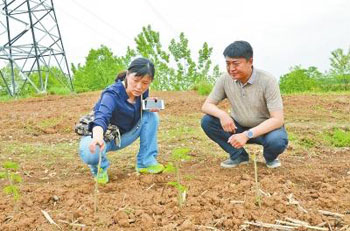
Tao Manxi (first from left) inspecting crop growth in the fields (online image: Dahe Daily)
On April 22, at 7:48 a.m., the earliest high-speed train from Zhengzhou to Xinyang. Tao Manxi pulled her suitcase and quickly stepped aboard.
Previously, she was director of the Small and Medium Enterprise Office of the Henan Provincial Department of Science and Technology. Now, she is first secretary of Zhouwan Village, Guangshan County, Henan Province, carrying on her shoulders the task of lifting 174 poor households out of poverty.
From the office to the fields, Tao Manxi has delivered an equally brilliant story.
From bringing a "translator" when entering the village to becoming the village's "tough woman"
On August 27, 2015, Tao Manxi came to Zhouwan Village for the first time, in her new role: first secretary stationed in Zhouwan Village.
To implement the central government's task of "targeted poverty alleviation," in August of that year, the Organization Department of the Henan Provincial Party Committee selected 12,332 outstanding cadres to serve as first secretaries in villages, spending two years leading farmers out of poverty and onto the path to prosperity.
However, on her first day stationed in the village, she suffered a crushing blow.
"At the time, I was focused on getting into the role as quickly as possible, and on the first day I 'begged' the village cadres to take me door to door." Tao Manxi brought cooking oil, rice, flour and other condolence goods to poor households to express sympathy and learn about their situations. But when the villagers took her hand and talked for a long while, she did not understand a single word.
To Tao Manxi's ears, the Guangshan dialect of the Dabie Mountain area in southern Henan sounded simply like a "foreign language," making her feel as if she had been stationed "abroad."
To make communication easier, the township assigned Chen Manxi a "translator" for door-to-door follow-up visits.
"Right after she came down, Secretary Tao caused quite a few laughs." Liu Dongling, chairwoman of the Women's Federation of Luochen Township, was Tao Manxi's "interpreter." She told reporters that at the end of the first day's follow-up visit, as soon as Secretary Tao stepped out of the villager's gate she asked: That sick old gentleman just said he eats "oil" three times a day - doesn't he find it greasy? That question delighted Liu Dongling. She told Tao Manxi with a laugh that the old man had said he "takes medicine" three times a day.
Bringing a translator on household visits always made Tao Manxi feel there was distance between her and the villagers. Two weeks later, she overcame the language barrier and could finally understand the Guangshan dialect.
But it took her another two months to truly blend into local life.
In the village, Tao Manxi would also chat with the villagers at the top of her voice. "When I first came down, I wasn't used to speaking loudly, and the villagers felt there was distance." When she saw the villagers again, she imitated them when chatting, and gradually everyone accepted this first secretary who put on no airs. Just like that, Tao Manxi transformed from a soft-spoken "gentle girl" in the office into the village's out-and-out "tough woman."
From introduced projects that "didn't adapt to local conditions" to grasping the key and tailoring measures to local conditions
Zhouwan Village has a total of 562 households and 2,798 people. There are 174 poor households and 783 poor people. "Especially for some families without labor power, escaping poverty is extremely difficult."
When she first arrived in Zhouwan, Tao Manxi found that some villagers and cadres believed that poverty alleviation from above simply meant giving money, and that paving some roads and building some houses for Zhouwan would be enough.
But Tao Manxi said: "I came to Zhouwan to help the villagers escape poverty, not simply to build a bit of infrastructure and be done with it."
To help the villagers escape poverty quickly, Tao Manxi searched everywhere for projects and sought to bring in industries.
"During that period, Secretary Tao thought about nothing but how to escape poverty all day long. Sometimes she would call everyone together in the middle of the night to discuss it." Zhou Moquan, party branch secretary of Zhouwan Village, said.
But what kind of projects should be launched? Tao Manxi also took some detours.
Tao Manxi kept pondering how to tailor measures to local conditions and integrate science and technology into poverty alleviation projects, so as to both ensure that villagers had income in the short term and leave behind industries capable of sustained "blood production."
Zhouwan Village administers 19 administrative bays and 23 natural bays, and basically every bay has an abandoned pond. Tao Manxi set her sights on these ponds.
"In the past, the ponds were full of fish, and every household got a share of fish at the end of the year. After the 1980s, no one managed these ponds anymore." Tu Qiming said the ponds were full of garbage, with silt at the bottom, and fish simply could not survive in them.
Tao Manxi brought in a professional engineering team to clear the silt, build guardrails and harden the roads. "We have now cleared 6 fish ponds, and at the end of March, more than 10,000 jin of fry were put into the ponds."
These fish ponds are contracted by villagers, and at the end of the year the contractors, villagers and poor households share the dividends according to proportions. "This not only strengthened the village's cohesion, but each poor household can receive several hundred yuan in dividends at the end of the year."
When poverty alleviation meets science and technology, it doesn't need to be "high-end" yet still brings big changes to the village
The fish ponds were only the first industrial project. To ensure that villagers had income in the short term, Tao Manxi and her poverty alleviation team also developed a mulberry planting and silkworm rearing project.
"This year, Zhouwan Village opened up 125 mu of mulberry fields. The Henan Provincial Department of Science and Technology purchased 130,000 mulberry saplings and gave them to the villagers for free, and they have all now survived and sprouted green leaves." Pan Xiaodong of the Rural Center of the Henan Provincial Department of Science and Technology introduced that they also invited the Henan Sericulture Association to help compile a mulberry planting technology and management manual, and invited Tian Jiwu, an expert from the Economic Crops Station of the Henan Provincial Department of Agriculture, to Zhouwan Village to teach villagers hand by hand how to plant mulberries.
Tao Manxi said that planting mulberries and raising silkworms yields 4,000 yuan per mu of wasteland per year. "We have already helped the villagers contact silkworm cocoon buyers, and the minimum price for one kilogram of silkworm cocoons is 36 yuan." Most of the poor elderly people in the village can escape poverty by raising silkworms.
The rice "indica-to-japonica conversion" project has also begun. After Song Shizhi, president of the Xinyang Academy of Agricultural Sciences, inspected the village, he suggested that Zhouwan switch to planting japonica rice, "which can not only increase yields, but japonica rice also sells at a higher price than indica rice."
At night, Tao Manxi and the reporter strolled along Zhouwan's newly hardened village road, talking about all the efforts of the past more than 8 months, about what else should be done in the remaining 16 months of poverty alleviation, and also about the life trajectory of their batch of government cadres from the office to the fields, and they could not help but sigh with deep emotion. Tao Manxi said that next they also plan to develop a vegetable greenhouse project and a solar power generation project. (Hou Mengfei, our reporter Qiao Di)