Wei-style powder-ridge yield-increasing technology safeguards food security in three steps
Original title: The powder-ridge "trilogy" of increasing yield while staying safe
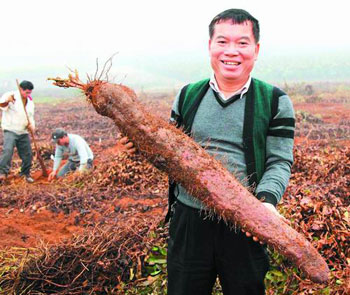
Wei Benhui harvesting his Chinese yam "fruits" (network illustration: China Science Daily)
Recently, Wei Benhui, inventor of the new farming method "powder-ridge technology" and a researcher at the Guangxi Academy of Agricultural Sciences, proposed the concept of a powder-ridge-driven "trilogy" to help safeguard food and environmental security: first, raise the production capacity of existing arable land through powder-ridge cultivation to achieve relative food and environmental security; second, develop a "new growth pole for grain, meat and fish agriculture" through "adding grain" on saline-alkali land, "adding meat" on grassland returned from farming, and "adding fish" through reproduction in river and lake waters; third, drive and promote widespread adoption to form a new situation of "abundant grain, a better climate and a pleasant ecology," allowing humanity and nature to coexist in greater harmony.
This was proposed by Wei Benhui against the backdrop of the self-propelled powder-ridge machinery recently developed by Guangxi Wufeng Machinery Company, with more than 100 units already being promoted for large-scale contracted cultivation in Hainan, Guangdong, Yunnan, Guangxi and other places, greatly welcomed by users, especially in Guangxi's Chongzuo, Laibin and other sugarcane "double-high" bases, where users are scrambling for the machines and supply falls short of demand.
It is understood that over the past seven years, "powder-ridge technology" has been applied to 20 crops including rice, corn, wheat and sugarcane in 20 provinces, and without increasing the application of chemical fertilizers and pesticides, it can increase yields by 10%-30%, improve quality by 5%, and double water retention.
Wei Benhui told reporters, "Powder-ridge cultivation may look simple, but it activates soil, retains water, supplies abundant oxygen, raises temperature and reduces salt. Its scientific essence lies in: doubling the amount of loosened soil, increasing soil water storage and oxygen content by more than 1 times, greatly increasing the availability of soil nutrients, improving soil aggregate structure, and benefiting soil microbial activity while warming the soil and reducing salt."
The secret of powder-ridge cultivation's yield increase, quality improvement and water retention lies in the spiral drill bit of the powder-ridge machinery entering the soil vertically for deep rotary tillage, which in one pass can carry out deep reclamation and deep loosening according to crop planting needs, deepening the tillage layer by 1 times or more compared with tractor cultivation, and without disturbing the soil layers; when the spiral drill bit cuts the soil at high speed, it generates instantaneous high temperature, and together with the rapid entry of air and oxygen during the rotary grinding process and the action of soil enzymes, the nitrogen, phosphorus, potassium and other mineral elements in the soil are released, increasing nutrient availability by 10%-30%. In this way, the soil becomes rich in oxygen, which is more conducive to the activity of aerobic microorganisms and promotes a higher fertilizer utilization rate.
Regarding the first part of the powder-ridge-driven "trilogy" - raising the production capacity of existing arable land to achieve relative food and environmental security - Wei Benhui analyzed that domestic agriculture currently suffers from severe water shortages and extensive pollution. If powder-ridge technology were promoted across 1 billion mu nationwide, each year it could be equivalent to adding 150-200 million mu of arable land production capacity. Not only could the increased grain feed 300 million more people, it could also save 10%-30% of the use of "chemicals" such as chemical fertilizers and pesticides and store an additional 30 billion cubic meters of natural rainfall.
Driving the second part of the trilogy, developing a "new growth pole for grain, meat and fish agriculture," Wei Benhui introduced that China has 500 million mu of saline-alkali land. If 100-200 million mu were transformed into normal fertile farmland, at an increase of 400 kg of grain per mu, it could add 40-80 billion kg of grain; using powder-ridge technology to carry out "well-shaped," "five-ring" and "full-cultivation" tillage on grassland returned from farming, with a powder-ridge depth of about 30 cm, would activate the grassland soil and concentrate natural rainfall in the soil, both preserving the grassland's original characteristics and growing abundant grass to raise sheep and cattle, increasing high-quality meat by a considerable amount; land-based rivers, lakes and offshore waters are China's most noteworthy fishery and aquaculture resources for development and utilization. If powder-ridge technology could be widely promoted, reducing chemical fertilizer and pesticide application by 20%-30%, while vigorously controlling industrial and urban domestic sewage, and with the state allocating special funds for breeding and releasing fry so that fish and shrimp in river and lake waters reproduce naturally, it would provide safe aquatic products and increase the nation's protein sources. (Staff reporter Ma Aiping)