Guizhou farmer-entrepreneur succeeds in growing apples in rocky desertification areas
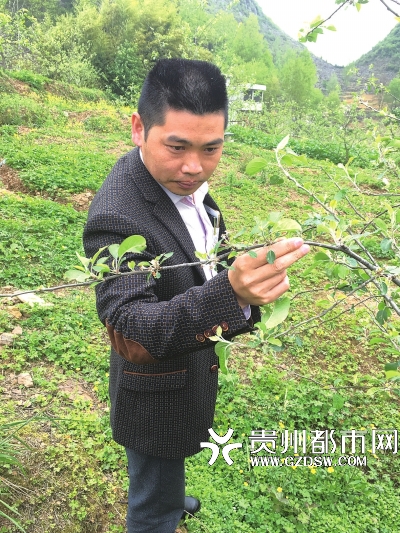
Several hailstorms occurred one after another this year, and Wu Longhua had to frequently check his apple orchard for damage to the apples after flowering.
On August 28, 2014, the 5 apples Wu Longhua secretly left on the trees were successfully harvested, giving him the confidence to persist in growing apples in Qianxi.
China's large-scale apple planting bases are all in the north, and in the southwest only apples grown in a few places such as Zhaotong in Yunnan can be sold to surrounding provinces and cities. However, in Qianxi County, Guizhou Province, there is a stubborn farmer-entrepreneur named Wu Longhua, who since 2013 began trying to grow apples on land severely affected by rocky desertification in the karst region. After more than three years of trials, Wu Longhua's apple cultivation succeeded and he registered the trademark “Shuixi Plateau Red”. The “Shuixi brand” Red Fuji apples produced in Qianxi are expected to enter mass production and be marketed this year.
Contractor wanted to grow apples; villagers were initially not optimistic
Thirty-six-year-old Wu Longhua is from Xinhai Village, Dingxin Township, Qianxi County. There were seven siblings in his family, and he was the sixth. Because the family was poor, even going to school was very difficult. “The land produced no crops, and my parents made a living by carrying coal.” Wu Longhua said that at that time the family kept a horse, which was the whole family's source of livelihood. The income of five or six yuan a day was completely insufficient to support nearly 10 people in the family.
In 1995, Wu Longhua was about to enter the second year of junior high school, but the family could no longer afford to keep him and his siblings in school. Wu Longhua took the initiative to tell his parents to leave the money for the other siblings, and he dropped out to work. In the end, he carried more than 30 jin of soybeans from home to Qianxi county town, sold them for more than 20 yuan as travel money, and began his life of making his way in the world.
At the time he was only 15 years old. He first went to the Anshun Pingba Fertilizer Plant to rely on relatives, and later went to Guiyang and Zunyi and other places, successively doing many kinds of work including back-basket carrying, cement work, and rebar work. “You could say I did every construction-related job. By 2003, I went out on my own to take on contracted projects.” But after 10 years of effort, Wu Longhua became a locally well-known entrepreneur.
At his peak, Wu Longhua had more than 100 workers under him and successively undertook the construction of some schools and large projects around Qianxi. His personal assets reached more than 30 million yuan. He was not only a widely known construction contractor, but also one of the handful of rich people in Qianxi at the time.
“In 2012 I returned to the village to pay respects to my ancestors, and the car could not get past the village entrance. At that time I made up my mind to change my hometown.” Although Wu Longhua had long since moved to live in Qianxi county town, his idea of launching a wealth-building project in his old home made the people of Xinhai Village very excited. Wu Longhua sought the villagers' opinions, and everyone unanimously suggested raising livestock.
But after investigating markets everywhere, Wu Longhua gave up the idea of raising livestock. “I told them I wanted to plant apples that Qianxi had never had before.” Wu Longhua believed that whether it was livestock raising or other projects, they would cause pollution, and only by developing planting could they become rich while preserving their hometown's green mountains and clear waters. At the time, 90% of the villagers were not optimistic about Wu Longhua's project.
Trial planting brought a surprise: it was actually sweeter and crisper than Shandong's
In January 2013, Wu Longhua introduced seedlings from Qixia City, Yantai, Shandong. In order to find out as quickly as possible whether Qianxi could actually grow apples, Wu Longhua bought mature apple trees with trunk diameters of more than 5 cm and saplings about 2.5 m tall for trial planting. “This kind of sapling costs 350 yuan each, while the same variety as a young seedling would cost only 10 yuan.” Wu Longhua said he bought 380 in one go and planted a total of 10 mu of apple orchard for the experiment. After planting, the input cost per tree was 480 yuan, and this trial planting cost more than 200,000 yuan.
According to the guidance and suggestions of Shandong experts, for Wu Longhua's newly transplanted apple trees, because the root system was severely damaged during transplanting, although they could bloom and bear fruit, the root system was unstable in the first two years after transplanting, so they could not be allowed to bear fruit, otherwise it would be very detrimental to the later growth of the apple trees. “I secretly left a few small fruits in the corner of the apple plot, just wanting to see whether they could grow into big apples that were both round and red.”
After more than a year of careful management, Wu Longhua found that Shandong apples in Qianxi not only bloomed and faded on schedule, but their growth cycle was not very different from that in Yantai, and the sunlight that Wu Longhua worried about most could also fully meet the growth requirements of apples. “In the end, in the second year of planting, the saplings I had secretly left bore 5 apples.” Wu Longhua still remembers August 28, 2014, because it was on this day that he picked the apples from the trial planting to try them and found that the apples grown in Qianxi were even sweeter and crisper than Shandong's, and ripened more than 20 days earlier.
Although only 5 apples were kept in the second year's planting trial, this gave Wu Longhua great confidence and determination. “Since they can be grown, then I will find a way to make them bigger and better.” Wu Longhua said that because he had no confidence at the time, he invested more than 200,000 yuan in the experiment, all without telling his wife. Now that the planting has succeeded, he has begun planning to pursue professionalization and high-quality production.
Qianxi Red Fuji has applied for a trademark: Shuixi Plateau Red
In October 2013, Wu Longhua sent soil samples from Hai Village to Shandong for testing, and began setting up a company and registering a trademark, preparing to build Qianxi-grown apples into high-quality premium fruit.
Although his education level is not high, Wu Longhua appears very professional in handling matters. According to the testing report provided by the Zhaoyuan City Agricultural Quality Supervision, Inspection and Testing Center on January 7, 2014, the three soil samples Wu Longhua submitted were all suitable for growing apples, and based on differences in soil quality, it gave Wu Longhua suggestions to plant the preferred Yanfu No. 3, No. 6, and No. 0 varieties, while also providing professional suggestions on fertilization and pollination according to the soil quality.
At the same time, on January 14, 2014, Wu Longhua registered and established Guizhou Shuixi Wushi Agricultural Development Co., Ltd., whose main product is growing apples. A filing document issued by the Qianxi County Development and Reform Bureau in June 2014 shows that Wu Longhua invested 50.5 million yuan to build a 1,525-mu farmer planting and sightseeing park. “Growing apples can produce economic benefits and also develop tourism.” Wu Longhua said that their village is less than an hour's drive from the famous Baili Azalea Scenic Area, so he also wants to build the apple orchard into a comprehensive park integrating agriculture and sightseeing.
“The township also particularly supports my planting. In 2015, my first year of growing apples had a bumper harvest, and township leaders all came to taste them.” Wu Longhua's apple orchard finally welcomed a small harvest in August and September 2015. Because experts advised that large-scale fruiting was still not possible in the first few years, the 10-mu apple orchard ultimately harvested only two to three thousand jin. “None were sold externally. Everyone came to taste them and they were all picked clean, but going forward our output will only get larger and larger!”
In June 2015, Wu Longhua formally applied for a trademark for the apples he grew, naming it “Shuixi Plateau Red”. Shuixi is the old name for the area around Dafang and Qianxi, meaning apples produced in the ancient land of Shuixi. The Bijie City Administration for Industry and Commerce recognized Wu Longhua's apple planting base as a 2014 “contract-abiding and creditworthy” small and micro enterprise.
On April 21 this year, the Qianxi County Dingxin Township Xinhai Planting and Breeding Professional Cooperative registered by Wu Longhua was successfully inaugurated.
In three years he expanded the planting to 1,000 mu; he wants to become the “Apple King”