How can a vegetable grower never worry about sales? Professional vegetable farmer Weng Shunyu shares her secrets
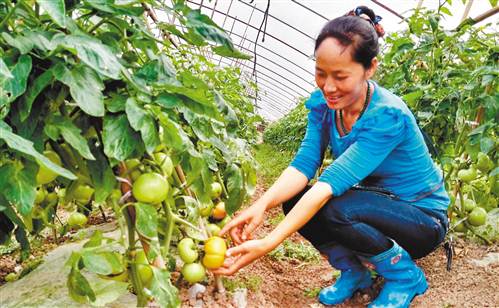
Weng Shunyu inspects the growth of a new tomato variety introduced this year in her field.
These are a group of dream chasers and entrepreneurs walking across vast stretches of land. Their dreams rest on the land, yet they differ from traditional farmers. They come from a wide range of backgrounds, including highly educated successful professionals and grassroots farmers rooted in rural areas, but they share one common name: new farmers. They use wisdom to engage in scientific and systematic agricultural production and entrepreneurial activities, and with new farming techniques, new marketing thinking and new circulation methods, they inject new elements and energy into the transformation of traditional agriculture.
Starting today, this newspaper launches the "Bayu New Farmers" column. Reporters will go deep into the fields to explore the far-reaching significance of their role in advancing China's agricultural modernization. Please stay tuned.
Weng Shunyu is the head of the Chongqing Shuangrun Vegetable Professional Cooperative in Maliuhe Village, Liuyin Town, Beibei District. On May 4, when the reporter met her, she was picking out the poorly shaped zucchini from the field to give to surrounding villagers.
Weng Shunyu grows vegetables a little differently from ordinary vegetable farmers. Her greatest trait is her precise analysis of the vegetable market and her close alignment with it. What should the land be planted with in the current season? How should it be planted? Everything revolves around the market, which has enabled her to carve out her own path among the many vegetable farmers.
Revolving around the market, diligently growing "exclusive vegetables"
Weng Shunyu is 49 this year. She farmed with her parents from childhood, and after marriage she ran passenger transport and sold furniture with her husband, and also did vegetable wholesale in Panxi. Taking advantage of her husband's ability to accurately grasp market trends through vegetable wholesale in Panxi, at the end of 2006 she transferred 200 mu of land in Liuyin Town, Beibei District, and began growing vegetables.
Weng Shunyu grows vegetables differently from the surrounding vegetable farmers: in terms of vegetable varieties, she chooses only "exclusive" ones.
Take the grafted eggplants she grows, for example. These days the wholesale price has reached 3-3.5 yuan per jin, and demand still exceeds supply, which makes the surrounding vegetable farmers very envious. Yet when she switched the grafted eggplant variety last year, no one understood, because the Hei Liren eggplant at the time was already the fifth eggplant variety she had switched to, and the price was also good. But based on vegetable wholesale trends at the Panxi market, she still insisted on trial-planting this grafted eggplant with better taste and firmer flesh. Sure enough, this year's market confirmed her judgment, but she did not become complacent and began investigating the next variety.
Her exclusive varieties are not limited to eggplant. Years of experience in vegetable wholesale have given Weng Shunyu a particularly strong ability to accept new varieties.
As long as a new vegetable variety appears on the market, even if its advantages are only slightly greater than those of current varieties, she will seek out the seeds and trial-plant them, and after success promote them on a large scale. Over the past few years, she has changed four or five vegetable varieties every year, which also makes her vegetables more aligned with the market, so sales are naturally not a problem.
Making good use of time gaps, skillfully growing "four-season vegetables"
Finding sales for one's own vegetables is not hard; what is hard is how to sell one's own vegetables at a higher price than others. Weng Shunyu, who is good at using her head, also arranges plantings across her 200 mu of vegetable land according to changes in market demand and the length of vegetable growth periods, maximizing land utilization and improving vegetable planting efficiency.
Her 200 mu of land is planted year-round with 6-8 varieties, each occupying about 20-30 mu, with growth cycles mostly of 50-100 days. In this way, she can guarantee both quality and quantity for suppliers and reasonably plan the "time gaps" for vegetables to reach the market, controlling market risks.
For example, these days are the peak period for early cucumbers to reach the market, but she does not chase this wave. Instead, she has just planted cucumbers in the newly prepared cauliflower field. In this way, her cucumbers can reach the market during the gap in mid-June when early cucumbers leave the market and summer cucumbers have not yet caught up, so there is no worry that the price will not be high.
Not only that, under her skillful "pairing," one mu of her family's land can grow at least three seasons of vegetables a year, and at most four seasons.
How are these four-season vegetables grown? Weng Shunyu says: sell zucchini this season, immediately plant cowpeas after harvesting in May, harvest the cowpeas in September and plant baby cabbage, harvest the baby cabbage in November and then plant spinach. Exactly, four-season vegetables!
Do not follow trends in planting, specifically grow "unsalable vegetables"
It is easy for the planting industry to fall into "following trends." Whichever vegetable has a high price this year, everyone rushes in all at once, which easily leads to supply exceeding demand and low vegetable prices hurting farmers. In recent years, many frequent cases of unsalable vegetables and fruits have stemmed from this.
Having seen this happen many times, Weng Shunyu does the opposite: whichever vegetable is currently unsalable on the market, she grows that vegetable. Because the earlier low vegetable prices hurting farmers dampened vegetable farmers' enthusiasm, in the following marketing season this vegetable will instead sell at a good price due to demand exceeding supply.
For example, last year the prices of green beans and stringless beans on the market were high, while loofah could not be sold, with the lowest price at only two or three jiao per jin. When planning this year's land use, she canceled the planting plans for green beans and stringless beans and switched to growing loofah. Now that this year's loofah is about to reach the market, many vegetable dealers have already called to order goods in advance, offering more than 2 yuan per jin right away.
Take the cucumbers she is preparing to plant these days as another example. The current wholesale price is only two or three jiao per jin, and vegetable farmers simply cannot make much money. At this point, she, who had originally planned to plant cowpeas, immediately changed the use of 10 mu of vacant land and planted all of it with cucumbers. "Based on past years' experience and the current market, I estimate that when this year's cucumbers reach the market, they can sell for at least more than 2 yuan per jin," Weng Shunyu says confidently.