Nyêmo Tibetan chicken eggs are expected to reach Beijing residents' dining tables next year
Tibetan chicken
“Raising Tibetan chickens was just a local habit; no one ever thought of getting rich from it”
Three months of research revealed the path to prosperity
In July 2013, Peng Songtao arrived in Nyêmo County, Lhasa. “Nyêmo” translates into Chinese as “wheat ear,” symbolizing a bountiful harvest, but at that time Nyêmo had nothing to do with harvests. “Back then Nyêmo was poorer than the poorest village in our area.” Peng Songtao calculated that in Huaxiang, Fengtai District, Beijing, the poorest village at that time had an annual income of at least 40 million yuan, yet Nyêmo, as an entire county, had only 21 million yuan. Among Lhasa's 6 counties and 2 districts, it was indisputably at the bottom.
“First we had to figure out exactly where Nyêmo's poverty lay, and whether there was any opportunity to get rich.” After more than 3 months of research, Peng Songtao discovered that all of Nyêmo was nothing but mountains and gullies, with less than one mu of arable land per person. Getting rich through crop farming was utterly unrealistic. But the advantages lay within this too: the air was good, the soil and water sources were pure, and developing livestock farming was a very promising direction.
Peng Songtao then quickly zeroed in on Tibetan chicken farming, because nearly every household in Nyêmo raised Tibetan chickens, at least 20 and sometimes over a hundred, and the state subsidized the purchase of chicks, so the foundation for developing Tibetan chicken farming existed. Despite their small size, Tibetan chickens had good meat quality, and their eggs had high nutritional value, so there was no worry about finding a market.
“But later I learned that raising Tibetan chickens was merely a habit among the locals; no one ever thought of getting rich from it.” When the weather turned cold, Peng Songtao went to the villages again to do research and found that Tibetan chickens were not so easy to find. Upon inquiring, he understood: Tibetan chickens laid very few eggs, with an annual output of only 60 eggs per bird, and they stopped laying after October. For the not-so-wealthy locals, chickens that only ate and did not work during winter were undoubtedly a burden, so they neglected their management, and for so many years, Tibetan chickens never gained any real traction locally.
Peng Songtao
“We need to give everyone a complete industry chain, so Nyêmo Tibetan eggs can go out into the world”
Tibetan chickens entering Beijing now shows promise
“To boost the locals' enthusiasm for raising Tibetan chickens, slogans alone won't work; there has to be something concrete!” Peng Songtao said they needed to give everyone a complete industry chain so Nyêmo Tibetan eggs could go out into the world. At the beginning of preparations, Peng Songtao exchanged ideas with the fourth batch of aid-Tibet cadres and learned that in Doilungdêqên County, Lhasa, there was already a large-scale chicken farm, which was a very good reference.
Afterward, Peng Songtao and his fellow aid-Tibet cadres worked together to negotiate with a local enterprise, and the industry chain took its initial shape. When the time was ripe, Peng Songtao also set his sights on a bigger market——Beijing. Starting in 2014, Peng Songtao and his colleagues approached Beijing DQY Agricultural Technology Co., Ltd. and reached a preliminary cooperation intention. The general direction was that DQY would provide Tibetan chicken chicks, farmers would handle the raising, and the Nyêmo County government would be responsible for collecting eggs and meat chickens. By 2015, Nyêmo and DQY began signing cooperation agreements. With the involvement of a Beijing enterprise, the matter of Nyêmo Tibetan chickens entering Beijing began to show promise.
Last week, reporters came to Nyêmo County and saw that DQY's chicken houses had already begun construction. The project was divided into three phases, and the first phase was nearly complete. Construction workers told reporters that after the first phase was finished, the chicken houses could accommodate about 7,000 sets of Tibetan chickens (7,000 hens with an appropriate number of roosters).
Peng Songtao said that by 2017, when Nyêmo's Tibetan chicken industry truly reached scale, Beijing residents would be able to eat Nyêmo Tibetan chicken eggs. “By then I will have already returned to Beijing, yet I'll still be able to eat Tibetan chicken eggs from my ‘hometown.’ Thinking about it makes me especially gratified.” In his words, Peng Songtao had clearly already treated Nyêmo as his second hometown. “If you treat this place as your own home and manage it accordingly, you can bring real benefits to the locals.”
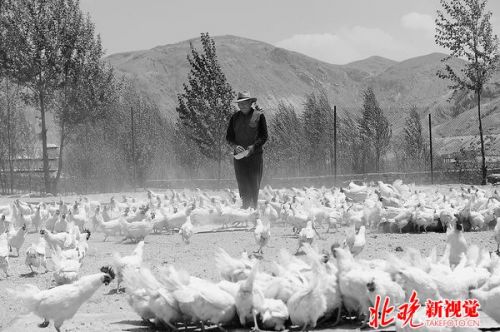
After impoverished resident Tudan Zhaxi began raising Tibetan chickens, his income rose substantially.
“Now all the farming households in Nyêmo County are tempted, and cooperatives have grown to 6”
Promising future income attracts more farming households
A complete industry chain was ready, but the real main players still had to be Nyêmo's chicken farmers. The start is always the hardest. Whether everyone's enthusiasm could be mobilized, even Peng Songtao himself was not fully confident at first. Judging from the local situation, there had to be several successful examples for people to see before a leap from nothing to something could be achieved.
“Secretary Peng, I'd like to try raising Tibetan chickens, is that all right?” Jiacuo, a farmer from Tunba Township in Nyêmo County, made a good start. Compared with ordinary local farmers, Jiacuo's outlook was much broader. He had already seen the path to prosperity in the Tibetan incense industry, and this time he took the initiative to apply to establish a Tibetan chicken farming cooperative. In this way, not only he himself but also 9 nearby impoverished households could be led toward prosperity together. Peng Songtao said Jiacuo's cooperative earned more than 40,000 yuan in a year from raising Tibetan chickens, and his cooperative was also rated as an advanced cooperative.
“Now all the farming households throughout Nyêmo County are tempted, and cooperatives have grown to 6!” As for the issue of enthusiasm, Peng Songtao was finally no longer so anxious. Last week, Peng Songtao took reporters to a local Tibetan chicken farming cooperative. As soon as the yard's iron gate opened, nearly a thousand free-range chickens could be seen everywhere in the yard, looking like snow from a distance. The cooperative's owner was local farmer Tudan Zhaxi. He told reporters through a translator that he once relied on farming and earned only 4,000 yuan a year. Now, raising Tibetan chickens together with several impoverished households, conservatively estimated, his annual income could reach over 30,000 yuan. “The cost of a chick is 42 yuan each, but I only pay 5 yuan myself; the rest is subsidized by policy. We've caught a good time!” Peng Songtao said the reason farmers still had to pay 5 yuan themselves was precisely to raise their cost awareness.
When reporters asked Tudan Zhaxi whether he had ever thought about selling eggs to Beijing, he nodded incessantly, a simple, honest smile on his face.