Overseas-Returned Engineering Graduate Starts Business in Wangting, Focuses on Soilless Cultivation of Potted Vegetables
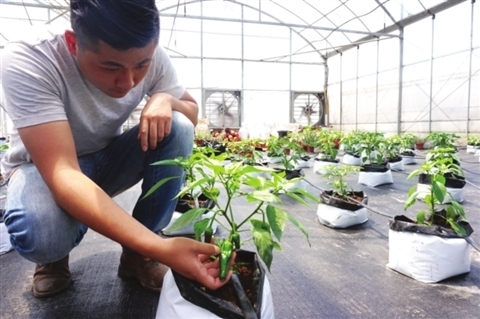
Lu Shenbao Tends His Organic Vegetable Garden
Not only can they be enjoyed visually, but they can also be picked and eaten. Balcony vegetable gardens have quietly sprung up in many cities across China in recent years, with a number of agricultural growers and enterprises developing related businesses. Since September last year, Lu Shenbao, who returned from studying in Australia, has also joined the ranks of potted vegetable growers. What sets him apart from ordinary growers is that he has introduced advanced foreign technology, adopting soilless cultivation without pesticides or chemical fertilizers.
At the Yuting Modern Agricultural Industrial Park in Wangting Town, the reporter met Lu Shenbao and his vegetable garden. Though called a vegetable garden, it looks more like a bonsai garden. Neatly arranged pots burst with lush greenery. The pots holding the vegetables, some round and some square, closely resemble those used for growing bonsai. The cherry tomatoes about to be harvested have vines already half a person's height, with clusters of jade-green fruits hanging beneath the leaves.
"We call these potted vegetables. They use advanced soilless cultivation technology to provide healthy vegetables grown without pesticides, chemical fertilizers, preservatives or hormones," Lu Shenbao explained. Inside each vegetable pot is not soil, but an organic substrate called coco coir, made from coconut husk fibers that are crushed, fumigated, sterilized and compressed into bricks before being shipped to China. He said the cultivation technology he introduced is called the activated fiber humus soil project. This avoids soil-borne diseases such as plant autotoxicity, microbial diseases and root-knot nematodes that arise from using soil, thereby eliminating the use of pesticides. "We use seaweed fertilizer and nutrient solution as organic fertilizer, replacing the traditional method of fermenting chicken and duck waste into fertilizer," he explained. Consumers who buy live potted vegetables only need to use their organic fertilizer alongside.
It is understood that these pots of solanaceous vegetables sell for between 120 and 180 yuan each, while leafy greens cost 6-8 yuan per plant. The rarer the variety and the longer the growing cycle, the higher the price. For example, a pot of imported cherry tomatoes sells for 120-160 yuan and can grow for 1-2 months per season. The farm currently mainly grows climbing solanaceous vegetables such as peppers, eggplants, cucumbers, cherry tomatoes and okra. After these are delivered to customers' homes, a little water every day along with organic fertilizer allows them to keep growing, so that fresh vegetables can be eaten every day. Moreover, Lu Shenbao's farm can also carry out personalized cultivation and sales of vegetables according to customers' requirements for varieties.
"These potted vegetables placed on a balcony can be both ornamental and edible. A balcony becomes a vegetable garden, which is quite appealing to people living in cities. When customers finish eating their vegetables, they call us, and we deliver new ones to their door," Lu Shenbao told the reporter. The fun of the balcony vegetable garden, the safety of the vegetables and the vegetable delivery sales model have given their fledgling business a modest boost. He compiled statistics on their customer base: young people make up the majority, along with quite a few high-end restaurants and department stores.
In fact, Lu Shenbao, 28 years old this year, is an overseas returnee from Australia whose major was mechanical engineering, completely unrelated to agriculture. As potted vegetables and balcony vegetable gardens have risen in popularity in China in recent years, he saw a business opportunity. It happened that another partner's father already had considerable experience growing organic potted vegetables in Malaysia, so he decided to introduce this new technology to China. Last year, at the first Yangcheng Lake Maker Annual Conference held in Xiangcheng District, he and two other overseas returnee friends, with their potted vegetable project, were brought in as talent to Xiangcheng. They rented 10 greenhouses at the Yuting Modern Agricultural Industrial Park and embarked on the entrepreneurial path of the balcony economy.
Lu Shenbao told the reporter that in Australia, organic vegetables account for 30% of vegetable sales, with prices 2-4 times those of ordinary vegetables. In China, however, organic vegetables make up a small proportion, yet prices are as high as about 10 times those of ordinary vegetables. "To put it most directly, I want to bring down the price of organic vegetables in China so that ordinary people can afford them," he said. The organic vegetables produced in his garden are priced at 2-3 times higher than ordinary vegetables. He explained to the reporter that the "out-of-control" prices of organic agriculture in China are mainly due to excessively high cultivation costs. Soil must lie fallow for 3-4 years, and no pesticides or chemical fertilizers can be used during cultivation, to qualify for organic certification. Yet pests and diseases originate from the soil, and once soil is used for planting, pests and diseases easily spiral out of control, leading to low yields, so the price of organic vegetables naturally rises. In their cultivation, however, they effectively avoid the risks of soil and use coral-type seaweed fertilizer to make up for problems such as insufficient fertility.
In Lu Shenbao's view, using potted plants as an entry point to enter agriculture can shorten the profit cycle. He intends to cooperate with farms on cultivation and expand into commercial complexes to promote the sales of potted vegetables.