Tan Huaisheng of Qingyang Village, Linjiang Town, Kaixian County, Chongqing, boldly innovates peach-growing techniques
Northern peach trees bear fruit in the south
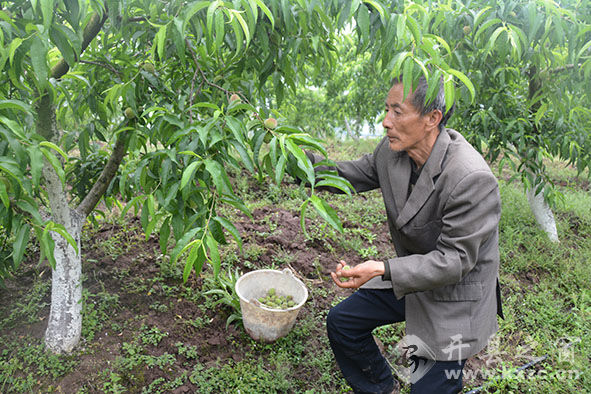
Tan Huaisheng thins the fruit on his peach trees
Tan Huaisheng thins the fruit on his peach trees
On a small hillside in Qingyang Village, Linjiang Town, peach trees with lush branches and leaves are laden with ping-pong-ball-sized peaches.
"Pick and discard all the densely set and poorly formed peaches, and also remove the branches that grow upward..." Recently, this reporter visited the peach orchard, where more than 10 villagers, under the direction of a spirited elderly man, were thinning fruit and removing buds from the peach trees. This elderly man is the owner of the orchard - Tan Huaisheng.
Quietly exploring, northern peach trees take root in the south
In 2009, Tan Huaisheng saw on CCTV's "Daily Agricultural Economics" program that someone in Shandong had become rich by growing late-maturing honey peaches, and he, always restless, conceived the idea of growing peaches.
Temperature, humidity and soil all differ greatly, and getting late-maturing peaches suited to northern growth to bear fruit in the south is no easy task.
"Only by doing it will you have no regrets." Tan Huaisheng, always daring to think and act, ignored others' advice and, relying on a book on honey peach cultivation and management given to him by a Shandong fruit grower, resolutely purchased peach saplings and began planting.
In which season should fertilizer be applied? In which season should weeds be cleared? After the peach saplings were planted, Tan Huaisheng followed what was written in the book, tending each sapling as if caring for his own child.
In the spring of 2010, the peach trees sprouted new buds, giving Tan Huaisheng hope.
"Growing peaches is nothing special after all." Tan Huaisheng felt secretly pleased, but before long the leaves began to turn yellow and wither, and he panicked.
"Could it be insects?" After a careful check, Tan Huaisheng found no insects. While looking up relevant information, he also consulted experts, and finally found the real cause of the yellowing and withering leaves - bacterial shot hole disease.
"Doesn't the book say that June and July are the peak period for this disease? Why did it appear in March?" Only then did Tan Huaisheng understand that because the temperature, humidity and soil of Shandong and Kaixian County differ greatly, it is simply impossible to grow peaches by referring to a book useful in the north.
From then on, Tan Huaisheng began a long period of exploration and research. During the first year of fruiting, the peaches dropped and tasted poor, so he decided not to put them on the market, losing more than 100,000 yuan.
In 2015, Tan Huaisheng's peach orchard earned more than 300,000 yuan, and through hard work and persistence he made northern peach trees take root in the south.
Innovative cultivation improves peach quality
Late-maturing honey peaches have a long growth cycle and high sweetness, and are deeply loved by consumers, while the main factor affecting peach sweetness is the weather.
"These peaches fear rain, not heat." Tan Huaisheng said that if there is continuous overcast and rainy weather, the sweetness of the peaches will decrease, and Kaixian County is a place of high heat, high humidity and relatively abundant rain, which poses a great challenge to ensuring peach quality.
According to Tan Huaisheng, in order to resist flood disasters, the orchard site must be chosen carefully, selecting places with a relatively steep slope and not prone to water accumulation, and the soil should preferably have a slightly higher sand content, which is more conducive to drainage.
"Last year, some peaches in the orchard reached 20% sweetness, but after growing a few more days they were only about 15%, all because it rained for several days in a row." Tan Huaisheng said.
"What is hardest to guard against now is peaches encountering continuous rainy days at harvest time." Tan Huaisheng said that the orchard covers several dozen mu, and building sheds to shield the orchard from rain is unrealistic, so he can only use weather forecasts to appropriately adjust the harvest period and ensure peach quality as much as possible. If the rain lasts too long, there is nothing he can do, and he hopes to explore a solution to this problem in the future.
Building a cold storage warehouse to extend the peach preservation period
After peaches are picked, ethylene in the air combines with receptors inside the peaches to ripen them, so the peaches soften the same day and rot the next day, making "peach preservation" a difficult problem in the industry.
"I now control the orchard's annual output at 70,000 to 80,000 jin." Tan Huaisheng said that because peaches have a very short preservation period after being picked from the tree, they will rot if they cannot be sold in time, so he controls the output.
While controlling output, Tan Huaisheng also worked hard on how to extend the peach preservation period, and building a cold storage warehouse was his bold attempt.
Last year, Tan Huaisheng invested several hundred thousand yuan to build a cold storage warehouse beside the orchard, preparing to refrigerate peaches that had not been sold in time to extend their preservation period. Through exploration, he found that things were far from as simple as imagined. It turned out that after refrigeration, the peaches' original flavor changed and they lost the crisp fragrance they had when freshly picked.
"I don't believe peaches can't be refrigerated." Tan Huaisheng, who likes to be stubborn, tested successively at minus 5°C, 4°C, 3°C... and at humidity of 40%, 50%... In many attempts, he finally found that only at a temperature between minus 0.5 and 2°C and humidity of about 80% could the peaches' preservation period be extended by about 20 days without changing their taste.
"I am now also trial-planting two other peaches in this series." Tan Huaisheng said that the two newly planted peaches come onto the market nearly 1 month earlier and later respectively than the current variety, and if successful, the orchard will have fresh peaches to eat throughout the whole autumn.