Villager Mao Xingdong's flower business in Bin County
For days, Mao Xingdong, a villager of Damaojia Tun in Toudao Village, Jingjian Township, Bin County, has been busy nonstop: receiving farmers who come to inquire about peony cultivation, repairing the weeding and fertilizing tools in the peony nursery, and going to his flower base to tend those peony root seedlings ready to sprout.
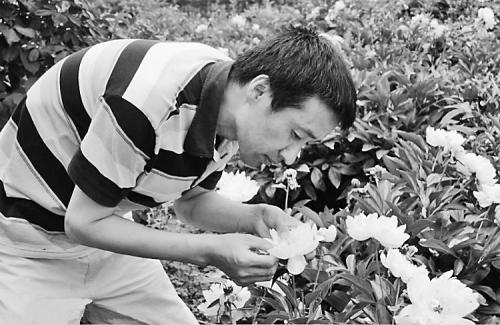
Mao Xingdong inspects the growth of peonies at his own flower base.
Most of the farmland in Jingjian Township, where Mao Xingdong lives, consists of hilly and sloping land, and local farmers make a living by growing dry-field crops such as corn, soybeans and sorghum. As the economic returns from growing dry-field crops such as corn have been getting lower and lower since last year, switching to the cold-region peonies bred by Mao Xingdong has become one of the choices for local farmers to change their planting structure.
Mao Xingdong, now 45 years old, graduated in 1996 from a university in Harbin with a major in broadcasting and was hired by a radio station as a host. After working for 6 years, Mao Xingdong began to think about leaving. Having grown up in the countryside since childhood, Mao Xingdong has a special feeling for the land. Mao Xingdong knew that returning home to start a business could not mean retracing the old path of his parents' generation; he had to find a new way, and he felt that growing peonies could change the fate of himself and his family.
Growing peonies is easier said than done. Because the area is located in a cold region, peonies from inside the passes cannot be grown on a large scale in Bin County. Wild peonies in the mountains have a single variety and very low yield. Mao Xingdong went to peony-producing areas such as Luoyang, Wuhan and Jinan to learn. There, Mao Xingdong saw that peony plants can be used for urban landscaping, the petals can be used to make flower tea and spices, the seeds can be used to press oil, and the rhizomes can also be used as medicine. Market demand for peonies is very large, which strengthened Mao Xingdong's confidence in growing peonies in Bin County.
To grow peonies on a large scale, it is necessary to grow varieties adapted to local natural conditions such as climate and soil, but at that time there were none. "If there are none, then I will breed them myself." Mao Xingdong is full of tenacity and daring spirit.
Starting in 2004, Mao Xingdong selected local wild peonies in Bin County as the female parent, then introduced more ornamental peonies from other provinces, and then let the various peonies repeatedly undergo natural hybridization. In order to master the habits of various peonies, Mao Xingdong, a layman, learned while doing and did while learning, learning as he worked. He bought many books on peony cultivation, downloaded all kinds of materials about peonies from the internet, and also consulted and sought advice from experts inside and outside the province. Gradually, Mao Xingdong became a "local expert" in peony cultivation.
Newly planted peonies take 5 or 6 years to bloom, so at the beginning of cultivation there was only input and no output. In order to support his family and ensure continued investment in breeding new peony varieties, Mao Xingdong continued to work in Harbin and handed over the management of the nursery to his father, only asking for leave to go back and tend them during key periods of peony growth.
A sharp sword is honed from grinding, and the fragrance of plum blossoms comes from the bitter cold. Mao Xingdong's efforts were not in vain. A few years later, he bred more than 200 cold-resistant peony varieties, with 8 color series: red, white, black, blue, pink, yellow, purple and multicolor, and the flower types also developed from the originally less ornamental single-petal type into 9 flower types including crown, golden ring, hydrangea and terrace.
The road to success is never smooth. Mao Xingdong's peony business almost died young because of a mishap in 2010. One day that autumn, Mao Xingdong hired people to dig up peony seedlings from the small nursery, enough to plant 100 mu, in preparation for transplanting them to the flower base. When he went home at noon to eat, he was unexpectedly bitten and injured by his own dog. Because the wound was very large, Mao Xingdong had to be hospitalized to have it stitched. Misfortunes never come singly. Just as Mao Xingdong was being treated in the hospital, another accident happened at home: a hired villager drove the Mao family's farm vehicle and crashed into a jeep passing through the village. Recovering from his injury and dealing with the traffic accident delayed the transplanting of the peony seedlings, causing 20,000 peony seedlings to wither and die. The loss of the peony seedlings plus compensation for the traffic accident cost Mao Xingdong more than 200,000 yuan.
Mao Xingdong did not stop because of this blow. Through his persistence, the peony seedlings that had not withered were transplanted into the flower base, but the plantable area had grown to only 10 mu. In 2011, Mao Xingdong quit his job in Harbin and devoted himself to managing his flower base.
An extremely cold weather event in the winter of 2011 put Mao Xingdong's cold-region peonies through a test. That extremely cold weather almost completely wiped out tens of thousands of peonies in a certain plantation in the province, but not a single peony in the Mao family peony garden was frozen to death. When a peony and tree peony expert from the provincial botanical garden heard about this, he made a special trip to inspect the Mao family flower base. After looking, he said excitedly to Mao Xingdong: "The peonies you bred have filled the gap in China, especially Heilongjiang Province, in large-scale cultivation of cold-region peony populations."
Now, Mao Xingdong's peony garden has reached 20 mu, with more than 100,000 peony plants, and Mao Xingdong has finally ushered in the harvest period. Mao Xingdong sold his peony seedlings online. He registered as a WeChat merchant, opened a blog, and also set up a QQ sales group. Through the internet, Mao Xingdong's peony seedlings entered markets in Heilongjiang, Jilin, Liaoning, Shandong, Henan and other places. The year before last, a farmer from Amur Oblast, Russia made a special trip to Bin County to purchase peony seedlings.
Mao Xingdong said: "I have a dream, which is to lead all the villagers in the village to become rich together. The peony flower is not mine alone, but the common wealth of our Damaojia Tun." For this reason, in the past two years, Mao Xingdong has actively invited fellow villagers, especially young people returning home, to study at his peony base, so as to encourage them to join the flower business.
Now, 3 households of villagers have begun trial-planting the peonies bred by Mao Xingdong in their own courtyards. Mao Xingdong also mobilized villagers to start agritainment businesses to receive tourists who come to the village to sightsee and admire the flowers. "In the future, I will lead all the villagers in the tun to build Damaojia Tun into a flower tun and a tourism tun." Speaking of the future, Mao Xingdong said excitedly to the reporter.