Grape cultivation in Ziyun, Guizhou helps farmers onto the path to prosperity
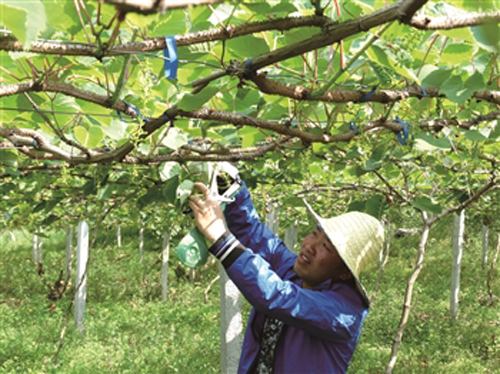
In the photo, large-scale grower Wei Zhihua prunes branches in the vineyard.
On May 9, Wei Zhihua, a large-scale grape grower in Dabang Township, Ziyun Autonomous County, got up as usual, washed up, ate breakfast and went to the grape base. The first batch of grapes planted in the vineyard was already heavy with fruit. Wei Zhihua lifted a cluster-laden branch and counted the young berries. Thinking that this year might bring a bumper grape harvest, a faint smile appeared on his face.
Wei Zhihua, 37 this year, is from Dezhao Village, Zongdi Township, Ziyun Autonomous County. In 2013 he resigned from a stable job and went to Dabang Township to develop the grape industry. To date, he has expanded his vineyard to 1,100 mu. Although in the early stage of developing the grape industry he was troubled by many factors such as capital and technology, he hopes that while using his wisdom and labor to gain profits, he can also realize the dream of helping the local people escape poverty and become prosperous.
"Although the grape industry requires large investment, it yields results quickly." Wei Zhihua explained that 40 grape seedlings can be planted per mu, and building a grape trellis requires 50 cement poles and 500 jin of steel wire, with these basic costs nearly 7,000 yuan. However, Dabang Township's climate, soil and other environmental conditions are suitable for grape growth. The grapes planted bear fruit in 2 years and enter the full-production period in 3 years, yielding results quickly.
In 2013, after on-site investigation, Wei Zhihua believed that Dabang grapes had development prospects, so through land transfer he planted 45 mu of grapes in Nazuo Village that year. In 2014, seeing that the grapes planted the previous year were growing well, Wei Zhihua planted more than 200 mu. By 2015, the grapes planted in the first year had borne fruit. With enhanced confidence, Wei Zhihua planted more than 370 mu. In three years, he planted more than a thousand mu of grapes in total, investing more than 6.3 million yuan through bank loans and self-raised funds.
"From the countryside, to the countryside, doing what you like to do." Wei Zhihua said that when he first decided to plant grapes on a large scale, because of the large investment and high risk, his family and friends once opposed it. It was not until 2015, when he took his family and friends to see his grape base, that they saw the grapes growing beautifully and that the first batch of grapes had entered the full-production period. Not only did they no longer oppose his grape growing, but they instead supported it.
While developing the grape industry, Wei Zhihua also brought tangible benefits to local villagers. Most of the land he used for grape growing was wild sloping farmland. Villagers not only received land transfer fees, but also worked at the grape base to increase their income. "The land for growing grapes was transferred in three ways." Wei Zhihua said. One was that they (large-scale growers) directly transferred land from villagers who held contracted land; the second was that the township government, in accordance with industrial development planning, transferred land from villagers in a unified way and then handed it over to them; the third was obtaining land in the form of farmer shareholding, namely "company + farmers + base + cooperative (or large-scale grower)." In this way, besides receiving dividends after results were achieved, farmers could also work at the base to increase their income, so that farmers gained more tangible benefits.
In order to make the grape industry develop on a large scale and in a healthy way, Wei Zhihua also took the lead in organizing three professional teams. The first was a professional "three-prevention" team, namely disease prevention, disaster prevention and drought prevention; the second was a base construction team, namely encouraging and supporting villagers to develop the grape industry; the third was a professional labor team, namely planting, bud removal, fertilizing and so on.
Driven by Wei Zhihua and other large-scale growers, in just a few years Dabang Township's purple grapes have grown to nearly 50,000 mu and have become a provincial-level high-efficiency agricultural demonstration park. As Ziyun's grape industry flourishes, in order to promote the healthy and sustainable development of the grape industry, Ziyun established a grape industry chamber of commerce, and Wei Zhihua was elected as its first president.
As the grape industry gradually enters the full-production period, because the profit from fresh fruit is relatively low and due to constraints such as production limitations, in order to make grapes form an industrial chain that "connects the secondary and tertiary sectors," Wei Zhihua and his partners set up a deep-processing workshop to produce Getu Red wine.
"Because the grapes are of good quality, the Getu Red wine produced through processing is delicious. Last year's 30,000 jin of wine was sold out long ago." Wei Zhihua said that this year they plan to process 100,000 jin of wine and want to gradually expand production. Next, he will build a winery at the grape base, so that the grape industry forms a diversified industrial chain integrating fresh grapes, deep processing, winery and more.