Migrant worker becomes a large-scale mushroom grower: having a plan means fewer detours
Original title: Using discarded straw to return home and start a mushroom-growing business
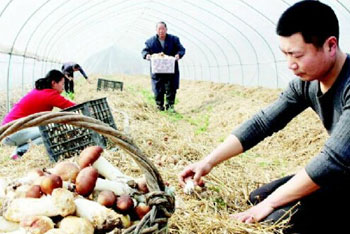
Wang Chaoliang, a resident of Linying Village, Yuanzhai Town, Yingdong District, returned home to found an edible fungus cooperative, using discarded straw, corn cobs and other materials as raw materials to develop greenhouse cultivation of oyster mushrooms, lingzhi (Ganoderma lucidum) and other edible fungi, achieving an annual profit of more than 400,000 yuan. The photo shows cooperative members harvesting mushrooms on March 2. Our correspondent Liu A'na, Su Fei, photo (online illustration: Fuyang Daily)
A chance discovery during a trip home to visit relatives changed the course of his life, turning him from a migrant worker into a successful large-scale mushroom grower. He is Wang Chaoliang, head of the Chaoyu Edible Fungus Cooperative in Yingdong District.
Returning home to start a mushroom-growing business
Recently, this writer came to Luzhuang Natural Village, Linying Village, Yuanzhai Town, Yingdong District. Standing at the village entrance, one could see rows of plastic greenhouses neatly arranged amid the green waves of wheat in the distance, refracting dazzling light under the sunshine. This is Wang Chaoliang's mushroom cultivation base.
Lifting the plastic door curtain and stepping into one of the plastic greenhouses, Wang Chaoliang was guiding cooperative members hand by hand in picking mushrooms. "Be gentle when picking mushrooms. Look, just hold the mushroom stem and gently lift it up. Be careful to pick the large ones and leave the small ones." Seeing this writer visit, Wang Chaoliang stopped the work at hand and came over.
This writer saw that Wang Chaoliang was young, looking no more than about thirty years old. What kind of entrepreneurial story did he have?
"After I graduated from secondary school in 2001, I went out to work with fellow villagers," Wang Chaoliang said of his experiences in a calm tone. In the summer of 2008, when he returned home for the summer harvest, he found that a large amount of crop straw was piled up at will, which both polluted the environment and had nowhere to be used. He thought to himself: how could he use this discarded straw to do something and turn waste into treasure?
Wang Chaoliang searched online and found that in many places across the country there were cases of people using crop straw to grow mushrooms and become rich. Thinking of the large amount of usable straw in his hometown, he had the idea of returning home to start a mushroom-growing business.
Wang Chaoliang is a person who does things with a plan. To master mushroom cultivation techniques, he first went to Wuhan and other places to study, spending several months systematically learning cultivation techniques such as mushroom composting, inoculation, and temperature and humidity control. After the summer harvest in 2010, Wang Chaoliang returned home to start his business. He borrowed 20,000 yuan from relatives and friends as startup capital and built two plastic greenhouses on his own two mu of land, trying to grow oyster mushrooms. Because he understood the techniques, knew how to manage, and was careful and capable, the two greenhouses of oyster mushrooms had a bumper harvest that very year, with each greenhouse earning a net profit of more than 6,000 yuan.
After winning the first battle, Wang Chaoliang became even more confident in growing mushrooms. Using the profits earned earlier, he continuously expanded the mushroom cultivation area. At present, he has developed a cultivation area of more than 50 mu and built 20 greenhouses, and has successively introduced new varieties such as the big stemmed mushroom (Stropharia rugosoannulata) and lingzhi (Ganoderma lucidum). At the same time, he also initiated the establishment of the Chaoyu Edible Fungus Cooperative in Yingdong District, leading nearby villagers to grow mushrooms together. Learning new cultivation techniques. As the cultivation scale expanded day by day and the varieties gradually increased, Wang Chaoliang was not complacent. He kept learning new mushroom-growing techniques. "Take cultivating the big stemmed mushroom as an example. It mainly uses the raised-bed cultivation method, using discarded wheat and corn straw and other materials as raw materials. Composting and inoculation start from September and October, and after the spawn run, by late November the mushrooms can be harvested; during management, as long as ventilation is timely, temperature is well controlled, humidity is kept within an appropriate range, and harvesting is timely, otherwise the caps easily open and the economic value declines." Today, Wang Chaoliang has become a mushroom cultivation expert, speaking about cultivation techniques fluently: "Growing the big stemmed mushroom not only has good economic benefits, but is also rich in fairly high protein and various minerals and vitamins beneficial to the human body, and has the effect of treating or improving many human diseases. It can be called fresh in color and delicious in taste, a complete nutritional health food known as 'meat among vegetables,' and it sells very well on the market."
Economic benefits are considerable
Speaking of the benefits of growing mushrooms, Wang Chaoliang calculated an account for this writer: "In terms of expenses, each mu of land requires straw worth 2,500 yuan, spawn 1,500 yuan, land rent 900 yuan. Adding the costs of building greenhouses, labor, pesticides and fertilizers, the investment per mu is about 7,500 yuan. Looking at income, harvesting starts in March in spring and can continue to June, with five or six flushes in total, a mushroom yield of about 4,000 jin, an average price of 4 yuan per jin, and a net profit per mu of 8,000 yuan."
Today, Wang Chaoliang has become a well-known local mushroom king. To increase market share, Wang Chaoliang introduced techniques such as pickling and drying. His mushroom products sell well in markets in Beijing, Shanghai, Guangdong and other places, with annual profits of more than 400,000 yuan. "The next step is to expand the cultivation area of the big stemmed mushroom to 1,000 mu, pass on the cultivation techniques and experience I have mastered to the surrounding people, provide one-stop production, supply and marketing services, and lead everyone to increase income and become rich together." Looking to the future, Wang Chaoliang said with full confidence. (Xu Licheng, Liu A'na)